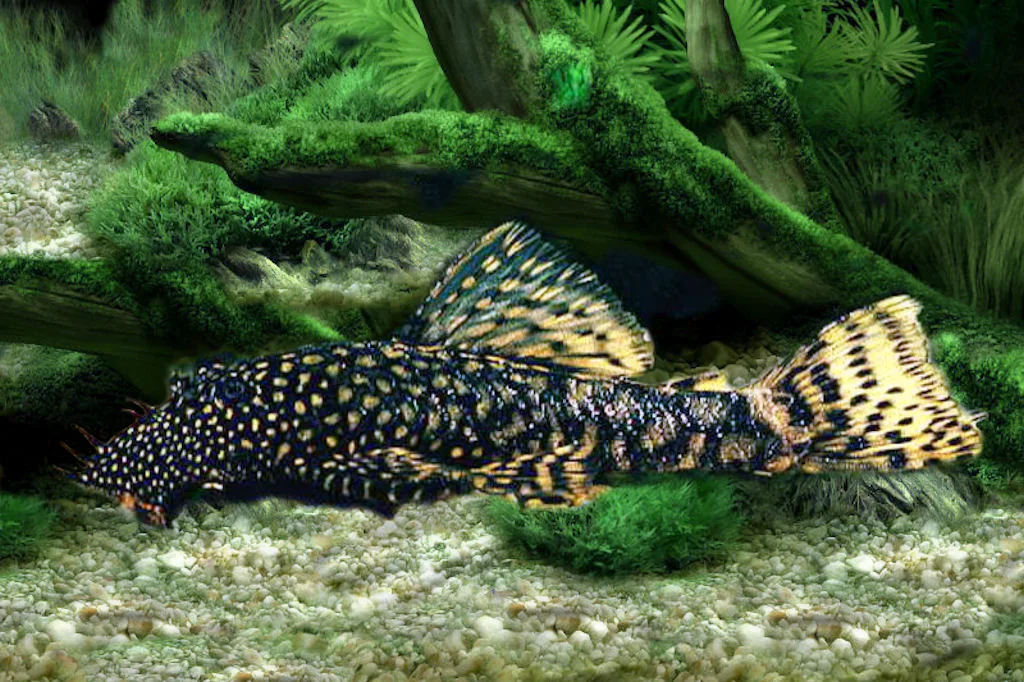
Gold nugget pleco
Baryancistrus xanthellus
2 views
A black suckermouth catfish with yellow spots and yellow fin edges from the Rio Xingu. It needs warm, oxygen-rich water with current.
- Temperature
- 27 – 30 °C
- pH
- 6.5 – 7.5 pH
- General hardness
- 2 – 12 °dH
- Maximum size
- 20 cm
- Minimum tank size
- 300 L
2 min read · 187 words
Quick facts
Place in the aquarium
Highlighted are the water layer and the spots where the species usually stays in the tank.
- Near the bottom Mostly stays just above the bottom. Food has to reach the substrate.
- Rocks and caves Needs caves, crevices or rockwork as hiding place, territory or spawning site.
Shrimp in the tank
Shrimplets at risk
- Not shrimp safe
- Dwarf shrimp at risk
- Shrimplets at risk
- Shrimp safe
- Adult dwarf shrimp
- Safe
- Shrimplets
- Get eaten
- Safe from shrimp size
- about 1.5 cm
The gold nugget pleco eats aufwuchs and sinking food and does not hunt shrimp. Adult dwarf shrimp from about 1.5 cm are therefore usually safe. Juvenile shrimp sitting on stones can be lost while it rasps.
The water is the harder part. The species needs 27 to 30 °C and strong current. For many Caridina that is too warm. Sturdy Neocaridina cope better.
Home & range
Hatched countries are where the species occurs. It lives in particular waters there, not across the whole country. The points name known waters for orientation, not collection sites.
- Country of origin
- Water for orientation
Native
Overview
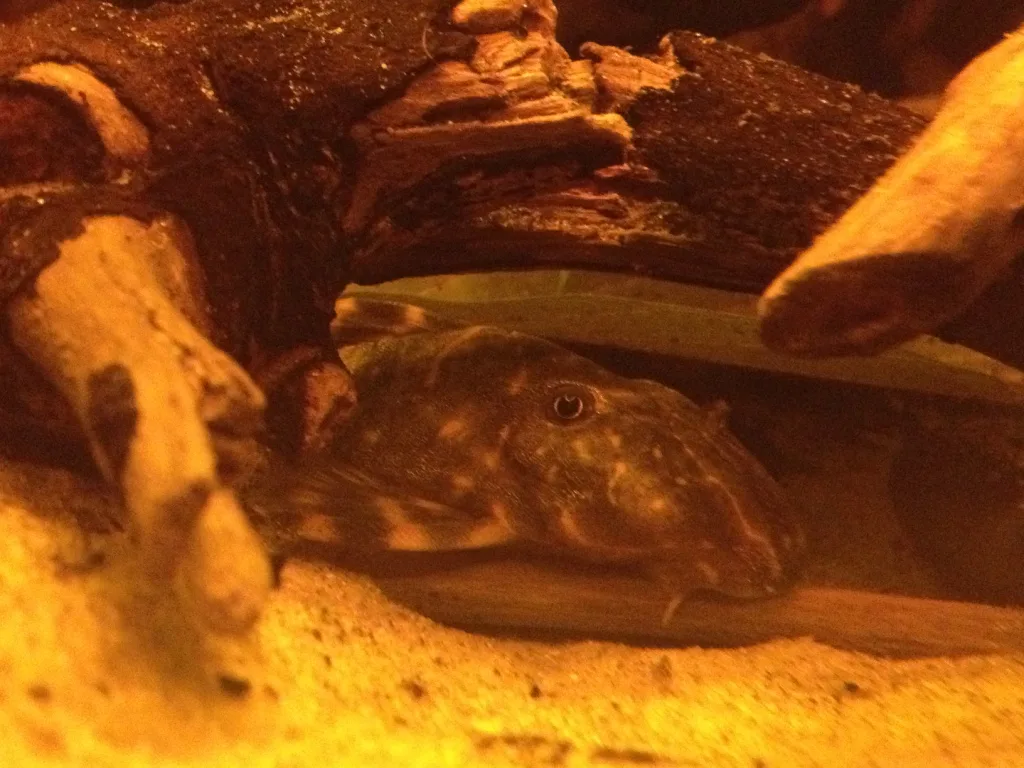
Baryancistrus xanthellus reaches about 20 cm. The body is dark with yellow spots, and the dorsal and tail fins carry a yellow edge. Juveniles have larger spots, older fish finer ones. In the trade the fish run under several L-numbers, including L081, L018 and L177. They are regarded as forms of the same species.
Many spotted suckermouth catfish look similar. This profile means xanthellus. A fish without a reliable origin is not relabelled afterwards.
Origin & habitat
This describes the origin, not how to furnish the aquarium.
Rocky, fast-flowing stretches of the Rio Xingu in Brazil. The origin stays coarse. Warm, clear, oxygen-rich water with stones matches that.
Care
Current
27 to 30 °C, pH 6.5 to 7.5. One fish from about 300 litres and 120 cm, with strong current, flat stones and caves. Several fish need clearly more floor area.
Company
Calm fish that tolerate the warmth. Other suckermouth catfish not on the same caves.
Diet
Omnivore with an aufwuchs share. Plant and animal granules, frozen food, vegetables. Algae alone are not enough.
Behavior
Territorial toward its own kind and other suckermouth catfish. Often hidden by day, active in the evening and at night.
Reproduction
Cave spawner. The male guards the clutch. Rarely bred in the aquarium.
More species in this group

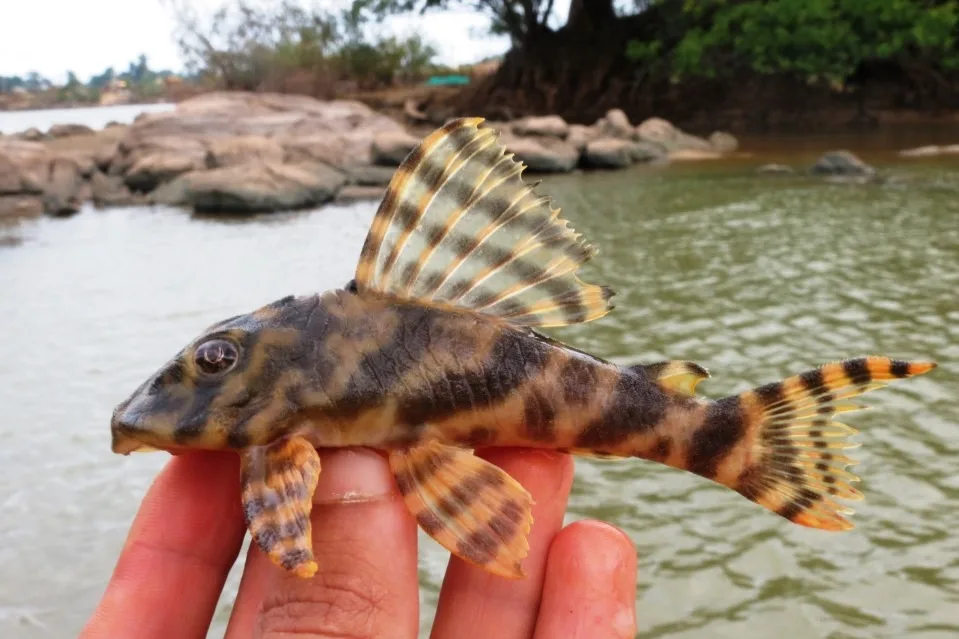

Similar water needs
Species with a similar temperature, a similar pH and a comparable adult size. Whether their behaviour fits as well is what the compatibility check is for.