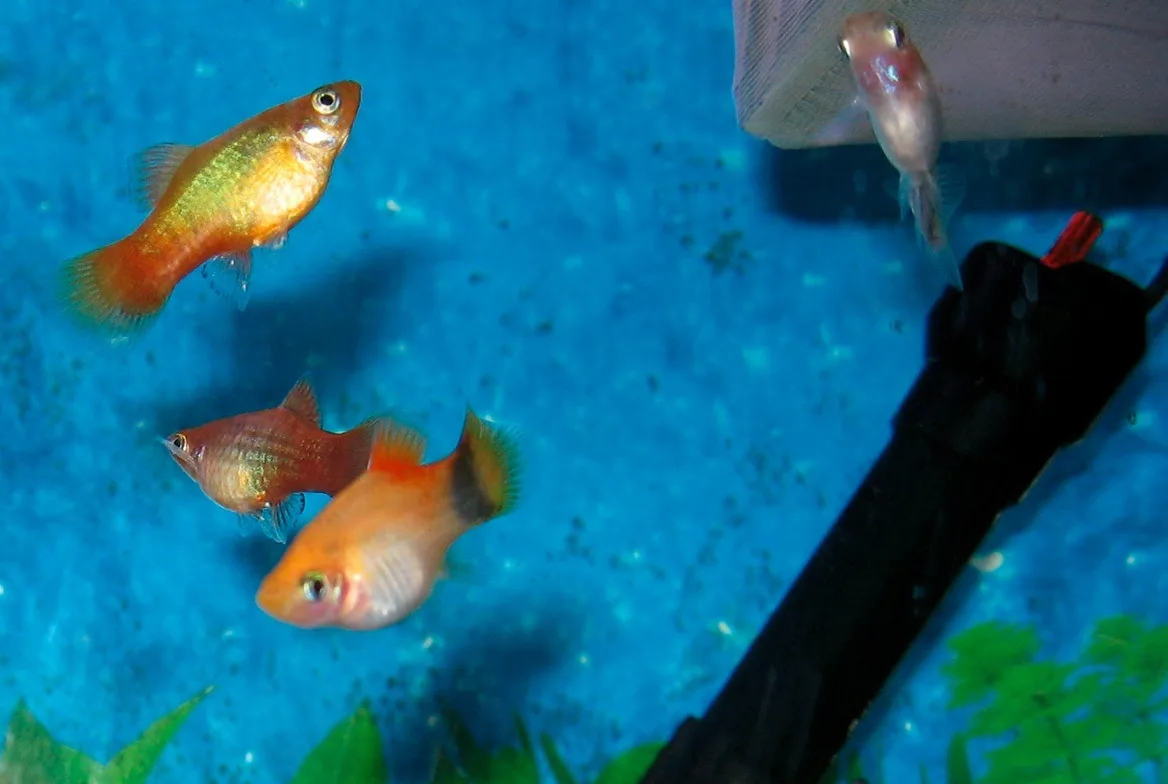
Redtail splitfin
Xenotoca eiseni
28 views
A splitfin, 6 to 8 cm. The genus name is often written in quotation marks. The catalogue name here stays Xenotoca eiseni.
- Temperature
- 15 – 30 °C
- pH
- 6 – 8 pH
- General hardness
- 15 – 20 °dH
- Maximum size
- 8 cm
- Minimum tank size
- 70 L
3 min read · 500 words
Fresh water
Quick facts
Further published values
- Lifespan
- 5 a
Place in the aquarium
Highlighted are the water layer and the spots where the species usually stays in the tank.
- Upper water Usually stays in the top third of the tank.
- Middle water Usually stays in the middle of the tank, between bottom and surface.
- Open swimming space Needs an open area without plants or decor to swim at length. Tank length matters more than height.
Shrimp in the tank
Dwarf shrimp at risk
- Not shrimp safe
- Dwarf shrimp at risk
- Shrimplets at risk
- Shrimp safe
- Adult dwarf shrimp
- At risk
- Shrimplets
- Get eaten
- Safe from shrimp size
- about 4 cm
The redtail splitfin endangers even adult dwarf shrimp. It grows to 6 to 8 cm, eats a wide variety of food with an animal share and nips fins on a one-sided diet. Young shrimp are eaten, and Neocaridina and Caridina of 2 to 3 cm often come under pressure too. Amano shrimp from about 4 cm are usually safe.
A separate tank is recommended for dwarf shrimp. Anyone adding larger shrimp provides enough food with a plant share and hiding places among stones and plants.
Home & range
Hatched countries are where the species occurs. It lives in particular waters there, not across the whole country. The points name known waters for orientation, not collection sites.
- Country of origin
- Water for orientation
Native
- Central highlands
- The named states of the central highlands.
Overview
Moderately deep-bodied, deeper with age. A yellow or orange band on the caudal peduncle, clearer in males. Otherwise light grey or light ochre.
Features and sexes
The caudal peduncle is relatively long, and the back and belly lines are almost mirror images. The back is darker, the fins ochre to yellowish. Only adult males carry the red-orange tail and tail base, and they develop a hump behind the head that grows with age. Head and upper body are olive-brown to dusky, and a broad, poorly defined bluish-black band runs from the gill cover to the tail and fades at mid-body. Throat and belly are yellowish to whitish. Females are plainer and usually slightly larger, at 7 cm against 6 cm for males. Among goodeids the red-orange tail occurs only in this species and its close relatives X. doadrioi and X. lyonsi.
Name and taxonomy
The species name honours Gustav Eisen, who collected the type specimens and was curator of marine invertebrates at the California Academy of Sciences. Two populations formerly placed here, from the endorheic basin near Etzatlán and from the Río Coahuayana, were described in 2016 as X. doadrioi and X. lyonsi.
Origin & habitat
This describes the origin, not how to furnish the aquarium.
Clear water in the central Mexican highlands: Guanajuato, Jalisco, Michoacán, Nayarit, Querétaro and San Luis Potosí. Mexico stays coarse and is not filled as a country shape.
The species comes from the Río Grande de Santiago basin and from waters near Compostela in Nayarit, possibly also from the uppermost Ameca and Armería basins. It lives in springs, pools, lakes, creeks and rivers, usually where there is little or no aquatic vegetation, and prefers shallow water.
Care
Suited to a community tank. If the diet is one-sided they nip fins.
Keeping notes
The redtail splitfin is regarded as undemanding but prefers hard, alkaline water. It tolerates temperatures from 15 to 30 °C. It is one of the most commonly kept goodeids. Occasional fin nipping can be reduced by keeping the fish in a group.
Diet
A one-sided diet is named as a risk.
The species accepts a wide variety of food but needs some plant matter in its diet. A diet that is too one-sided can encourage aggression towards tankmates.
Behavior
First imported to Germany at the end of the 1960s.
In an experiment, redtail splitfins learned to tap the larger or the smaller of two orange circles. Faced with the Ebbinghaus illusion, they chose, like humans, the circle that looked larger or smaller because of its surroundings. The researchers concluded that the fish form a mental model of their environment.
Reproduction
Gestation 30 to 65 days, 50 to 70 young, over 10 mm at birth. One brood can take two or more days.
Instead of a gonopodium, males have a notched anal fin, the andropodium, which transfers sperm. The female nourishes the embryos through trophotaeniae, which work much like an umbilical cord. Roughly every two months 10 to 50 young of about 15 mm are born. In the wild both sexes prefer partners of similar size, which keeps the size difference between the sexes small.
Gallery
More species in this group
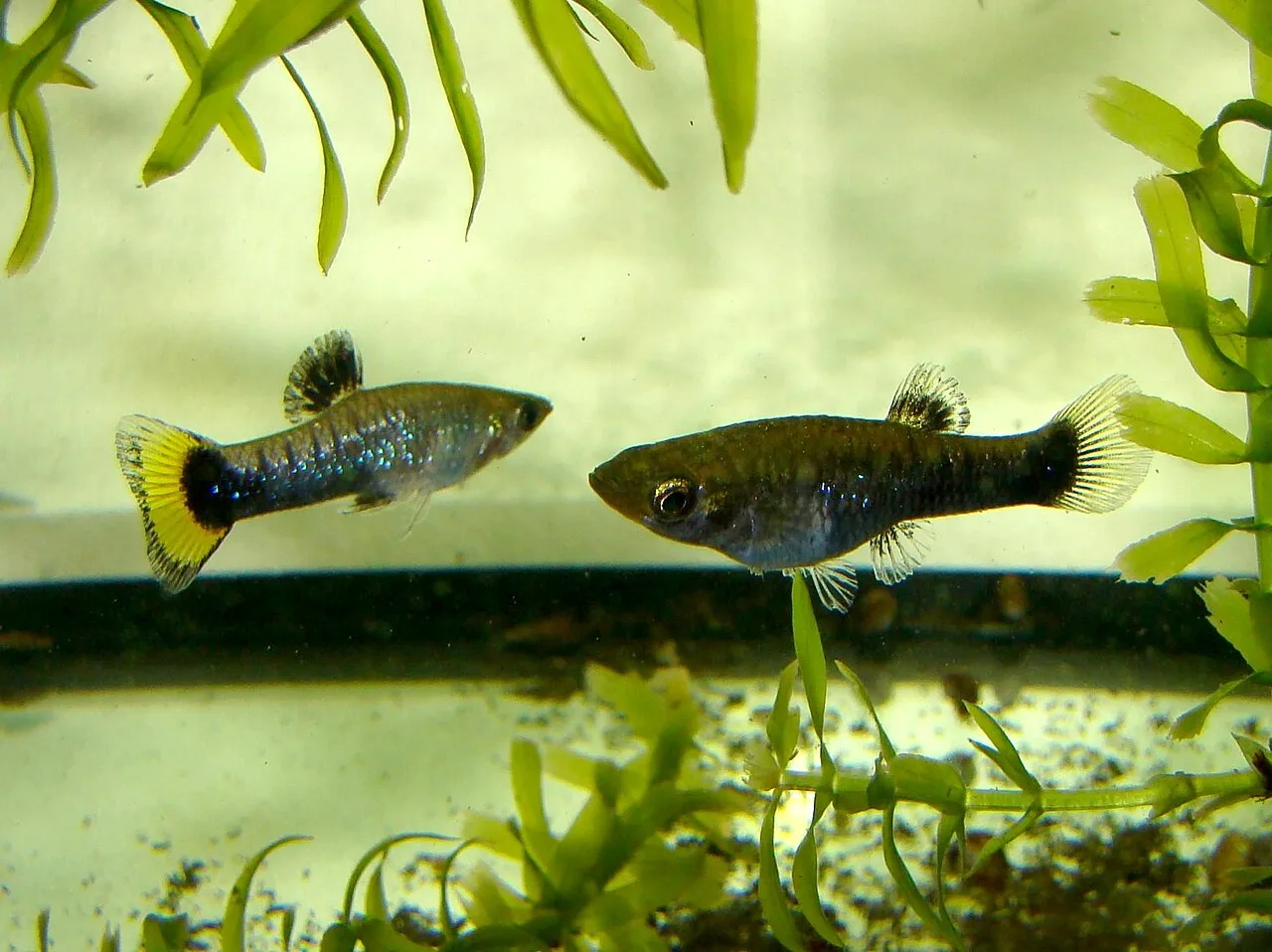
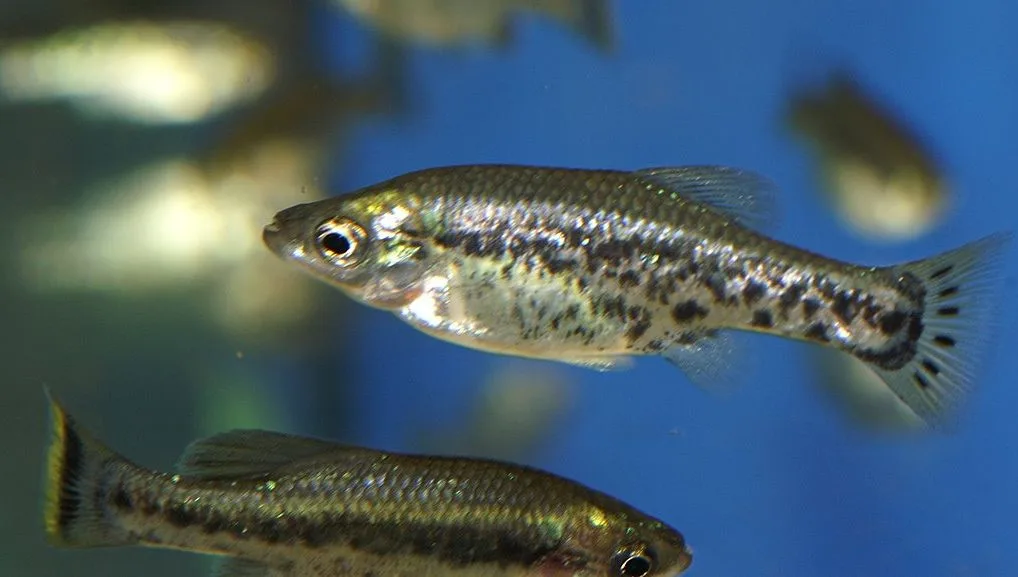

Similar water needs
Species with a similar temperature, a similar pH and a comparable adult size. Whether their behaviour fits as well is what the compatibility check is for.