Freshwater angelfish
Pterophyllum scalare
20 views
Tall cichlid from quiet stretches of South American rainforest rivers. Adults eat fish the size of a neon tetra.
- Temperature
- 26 – 30 °C
- pH
- 6 – 7.5 pH
- General hardness
- 5 – 15 °dH
- Maximum size
- 15 cm
- Minimum tank size
- 200 L
3 min read · 466 words
Fresh water
Quick facts
Further published values
- Lifespan
- 10 a
Place in the aquarium
Highlighted are the water layer and the spots where the species usually stays in the tank.
- Upper water Usually stays in the top third of the tank.
- Middle water Usually stays in the middle of the tank, between bottom and surface.
- Dense plants Looks for dense planting as cover, retreat or grazing ground.
Shrimp in the tank
Not shrimp safe
- Not shrimp safe
- Dwarf shrimp at risk
- Shrimplets at risk
- Shrimp safe
- Adult dwarf shrimp
- At risk
- Shrimplets
- Get eaten
- Safe from shrimp size
- No size is safe
The angelfish eats shrimp. It grows up to 15 cm long and 25 cm high and in the wild hunts small molluscs, insects, insect larvae and small fish. Adults eat fish up to the size of a neon tetra. Dwarf shrimp are far below that limit and are taken deliberately.
Even larger Amano shrimp are not safe, especially when a pair defends a spawning territory and drives everything away from the clutch. Hiding places do not help in the long run. Shrimp do not belong in an angelfish tank but in one of their own.
Home & range
Hatched countries are where the species occurs. It lives in particular waters there, not across the whole country. The points name known waters for orientation, not collection sites.
- Country of origin
- Water for orientation
Native
Overview
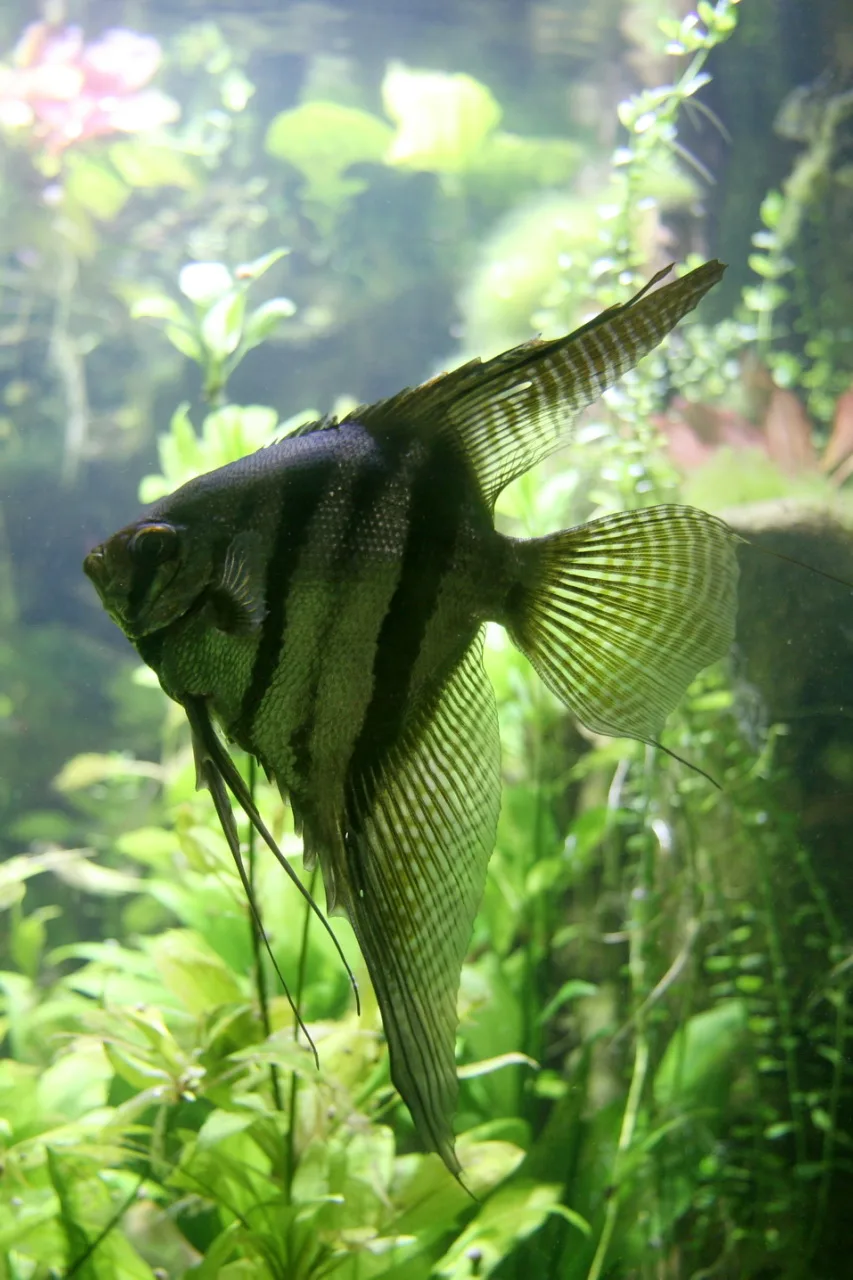
The body is strongly compressed. The dorsal and anal fins run out into long rays. Four dark bars cross the body. The total length reaches 15 cm, the height from the dorsal tip to the anal tip up to 25 cm. Those 25 cm are not body length. Black and veil forms are cultivated. The genus also includes Pterophyllum leopoldi and Pterophyllum altum. Intermediate forms toward altum are not cleanly separated.
Name and original description
Schultze described the species in 1823 as Zeus scalaris, not in a journal but in a sales catalogue of duplicate specimens from the Zoological Museum of Berlin University. In 2002 Paepke and Schindler established Schultze as the actual author, named Friedrich Wilhelm Sieber as the collector and fixed the type locality on the lower Amazon at Óbidos. The genus name combines pteron, fin, with phyllum, leaf. The species name scalare, stepped, refers to the dorsal and anal fins, which begin with very short rays and end with exceptionally long ones. Fin formula: dorsal XI–XIV/21–28, anal V–VII/22–30.
Origin & habitat
This describes the origin, not how to furnish the aquarium.
Named waters are the Ucayali, Solimões, the Brazilian Amazon system, the Rio Negro except its upper course, the Branco, Madeira, Tapajós, Xingu, Araguaia, the Essequibo in Guyana and the Oyapock in French Guiana. Peru, Brazil, Guyana and French Guiana are therefore a coarse origin and are not filled. The individual rivers have no line of their own here. The fish use slow and still stretches, banks and floodplain, in white, black and clear water. They have also been found under floating grass mats and over dead wood.
Care
The angelfish is kept at 26–30 °C and pH 6–7.5 in about 200 litres at 50 cm height. What that text says about keeping: well planted, but with open swimming room. Adults eat smaller fish up to the size of neon tetras. Toward larger tankmates they are peaceful and do not dig. In Austria a rule also says that, besides other fish, at least five angelfish should be kept. That is a legal rule, not a biological minimum for every country.
Legal minimums in Austria
The regulation in force there gives a tank of at least 100 × 40 × 50 cm for angelfish, 24 to 30 °C, 0 to 15 °dGH, pH 5.0 to 8.0 and at most 50 mg/l nitrate. Smaller tanks are allowed for breeding. The species first reached the trade in 1906 or 1907.
Diet
Small molluscs, insects, insect larvae and small fish that they hunt. Flakes alone do not match that. Frozen food and granules remain the practical equivalent.
Behavior
In the habitat they live in groups. For breeding they form pairs that hold a spawning territory. In the aquarium it therefore lives in pairs, not as a permanent school.
Reproduction
Open substrate spawner. The pair tends eggs and young for a long time. Leaves are not the only substrate. Breeding in a community tank fails as soon as the other fish can reach the spawn.
Gallery
More species in this group

Similar water needs
Species with a similar temperature, a similar pH and a comparable adult size. Whether their behaviour fits as well is what the compatibility check is for.