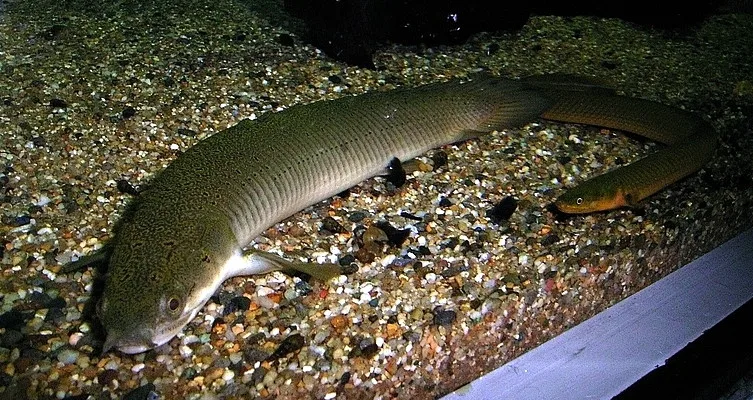
Pike topminnow
Belonesox belizanus
21 views
The largest livebearing toothcarp. Males average 10 cm, females 15 cm, old females to 20 cm. Belonesox belizanus maxillosus is a disputed subspecies and not a second profile.
- Temperature
- 25 – 30 °C
- pH
- 6.5 – 7.35 pH
- General hardness
- 3 – 16 °dH
- Maximum size
- 20 cm
- Minimum tank size
- 100 L
3 min read · 503 words
Quick facts
Place in the aquarium
Highlighted are the water layer and the spots where the species usually stays in the tank.
- Water surface Stays just below the surface. The top needs a calm current and a cover.
- Upper water Usually stays in the top third of the tank.
- Dense plants Looks for dense planting as cover, retreat or grazing ground.
Shrimp in the tank
Not shrimp safe
- Not shrimp safe
- Dwarf shrimp at risk
- Shrimplets at risk
- Shrimp safe
- Adult dwarf shrimp
- At risk
- Shrimplets
- Get eaten
- Safe from shrimp size
- No size is safe
The pike topminnow is a specialised predator and eats shrimp of any size. Females grow to 20 cm, and the deeply split, highly extensible mouth takes unusually large prey for its body size. The species lies in wait, stalks or chases its prey. Even the young eat small crustaceans such as water fleas in their first weeks before switching to fish. Dwarf shrimp have no chance, and Amano or fan shrimp are at risk too. Shrimp do not belong in a tank with pike topminnows.
Home & range
Hatched countries are where the species occurs. It lives in particular waters there, not across the whole country. The points name known waters for orientation, not collection sites.
- Country of origin
- Introduced
- Water for orientation
Native
Introduced
- Florida
- Released since 1957, including the Everglades. Not the native range and not the whole country.
Overview
Long and slender, blackish at night, otherwise brown, olive-brown or grey-yellow. A round black, pale-edged spot at the tail base, often faded in females. The nearest relatives are Gambusia and Heterophallus.
Names and genus
Other German names translate as livebearing pikehead, garfish killifish and needle pike. In English it is called pike topminnow or pike killifish. The species is the only one in the genus Belonesox. The genus name joins the Greek belone for arrowhead with the Latin esox for pike. The Austrian ichthyologist Rudolf Kner described the species in 1860 and gave Belize as the type locality, hence the specific name.
Body and head
The slightly compressed body is covered with very many small scales. Chest and belly are dirty white, in reflected light the body shimmers bronze, and rows of dark dots may run along the sides. Juveniles up to about 5 cm carry a black-brown longitudinal band or are almost entirely black. There is no lateral line, and the sensory canals lie only on the head.
The head is pointed and large and ends in a beak-like, deeply split mouth. Both jaws carry several rows of pointed teeth that grow longer towards the inside. Because the pincer-like jaws are curved, the mouth never closes completely and the teeth remain visible. The lower jaw is longer than the upper. The mouth opens surprisingly wide, and the throat and sac-like stomach are very stretchable. The upper jaw is extremely flexible, which lets the species take very large prey for its size.
The dorsal fin sits far back. Males are smaller and have a gonopodium and dorsal fin rays that extend beyond the fin membrane. A typical total length is 9.7 cm.
Origin & habitat
This describes the origin, not how to furnish the aquarium.
The Caribbean side of Central America, from Laguna San Julian north of Veracruz across the Yucatan to the border of Nicaragua and Costa Rica. Belize belongs to the range. Mexico, Belize and Nicaragua stay coarse. Costa Rica is only the border and is not mapped. Released in Florida since 1957, including the Everglades. That is not the native range.
Care
It needs warmth, without a degree figure. Fresh and brackish water, also polluted, low-oxygen water. Small fish are prey, not tankmates.
The pike topminnow is not an easy aquarium fish, especially compared with other livebearers.
Diet
Almost exclusively smaller fish. The young eat small crustaceans such as daphnia for two to three weeks, then fish.
Unlike most livebearers, which are generalists or micropredators, the pike topminnow is a highly specialised predator. It lies in wait and strikes like a pike, stalks slowly using cover, or chases its prey. When striking it lowers its slightly upturned mouth a little, because prey fish tend to flee downwards away from the surface.
Behavior
An ambush hunter in the upper water.
Pike topminnows stay mainly in the upper water layers. At night they turn blackish.
Reproduction
Gestation 30 to 50 days. 20 to 80, at most 100 young, 14 to 18 mm at birth, 35 mm according to another statement.
In classification the species belongs to the tribe Belonesocini within the livebearing toothcarps.
Gallery
More species in this group

Similar water needs
Species with a similar temperature, a similar pH and a comparable adult size. Whether their behaviour fits as well is what the compatibility check is for.