Firemouth cichlid
Thorichthys meeki
22 views
A cichlid of 15 to 16 cm with a red throat. The species lives up to about 12 years and is kept in pairs.
- Temperature
- 23 – 30 °C
- pH
- 6.5 – 8 pH
- General hardness
- 8 – 20 °dH
- Maximum size
- 16 cm
- Minimum tank size
- 200 L
4 min read · 526 words
Fresh water
Quick facts
Further published values
- Lifespan
- 12 a
Place in the aquarium
Highlighted are the water layer and the spots where the species usually stays in the tank.
- Middle water Usually stays in the middle of the tank, between bottom and surface.
- Near the bottom Mostly stays just above the bottom. Food has to reach the substrate.
- Substrate Sifts through the substrate or burrows into it. Fine, rounded sand without sharp edges suits it.
Shrimp in the tank
Not shrimp safe
- Not shrimp safe
- Dwarf shrimp at risk
- Shrimplets at risk
- Shrimp safe
- Adult dwarf shrimp
- At risk
- Shrimplets
- Get eaten
- Safe from shrimp size
- No size is safe
The firemouth cichlid is no fish for shrimp. It grows to 15 to 16 cm, eats anything it can get as an omnivore and is described as intolerant and nippy. During spawning the pair defends its territory very aggressively. Dwarf shrimp are eaten, and larger shrimp are chased and not safe either.
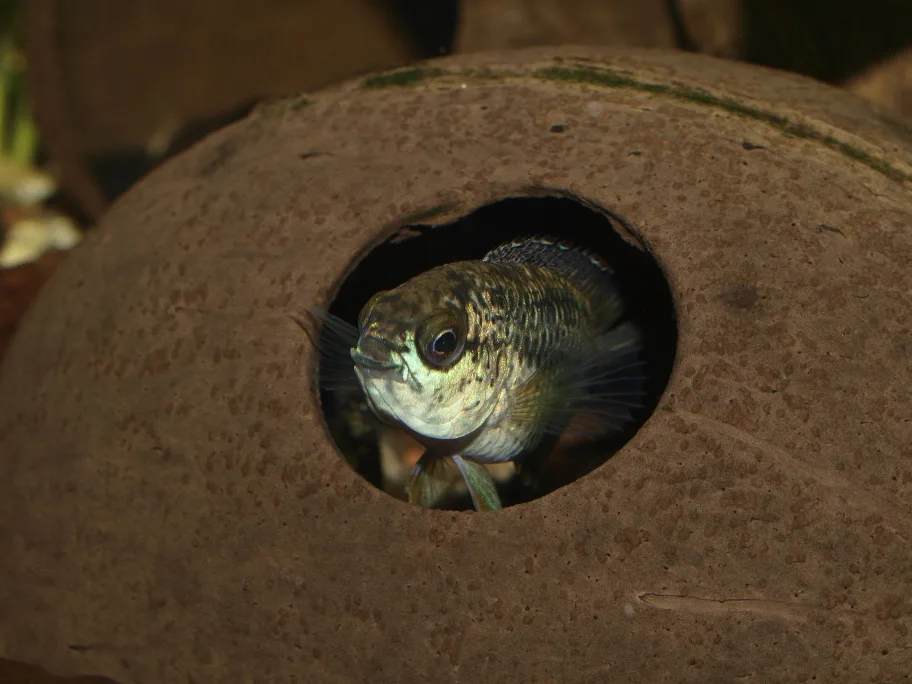
Shrimp belong in a separate tank. The firemouth suits robust Central American fish in a tank with sand, stones and hiding places such as upturned flower pots.
Home & range
Hatched countries are where the species occurs. It lives in particular waters there, not across the whole country. The points name known waters for orientation, not collection sites.
- Country of origin
- Water for orientation
Native
- Mexico
- Range: the rivers of the Yucatán Peninsula in Mexico.
- Guatemala
- Range: northern Guatemala.
Overview
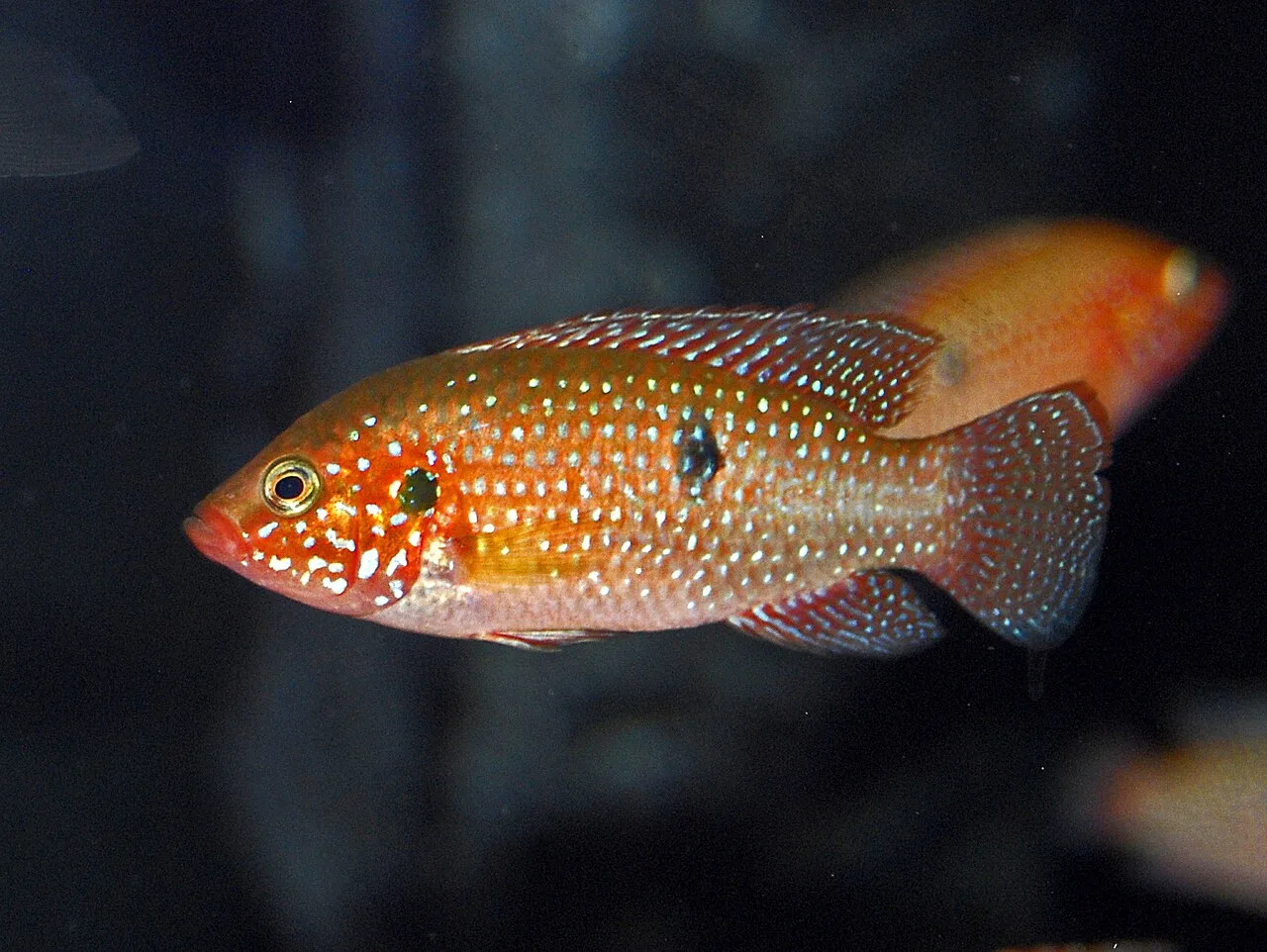
The body is deep and the mouth pointed. The fish are blue-grey, the belly orange to yellow-olive, the throat brick red to bright red. Five to seven bars and often a dark horizontal band mark the flank. A jet-black, gold-edged spot sits on the gill cover. Females stay smaller.
Features and name
The gill cover carries a gold-edged, glossy black spot. The scales have red edges, so the flanks look covered with a red net. Males are larger, up to 15 cm, brighter and redder on the throat and have more pointed dorsal and anal fins. The name firemouth refers to the orange-red underside of the jaw. Brind described the species in 1918, and the specific name honours the ichthyologist Seth Eugene Meek, who described the genus Thorichthys. Cichlasoma meeki and Herichthys meeki are older names.
Origin & habitat
This describes the origin, not how to furnish the aquarium.
The species comes from the Belize River, the adjacent south-east of Mexico, Guatemala between the Río Grijalva and Usumacinta, and Yucatán. It lives in the lower and middle reaches of rivers with little current over sand or mud, in Yucatán also in cenotes and their underground connections. Typical is shallow, slow, often turbid water with pH 6.5 to 8.0 and 23 to 30 °C. The IUCN lists the species as least concern.
Care
Length is 15 to 16 cm. They should be kept as pairs because they are intolerant and prone to bite. Hiding places are called essential. They eat aquarium plants. Plant food is necessary.
A territory with a red throat
The firemouth reaches about 12 to 15 cm. The red throat is the male’s threat colour, not a permanent state. 24 to 28 °C, pH 6.5 to 8, tanks from about 200 litres and 100 cm. Rockwork, caves, sand. A pair. Further conspecifics need clearly more length.
Outside breeding the species is reserved for a cichlid. At spawning time it defends a zone and digs. Tankmates have to be able to leave that zone. Very small fish fit in the mouth.
Diet
Flakes, tablets, frozen food and live food, plus plant matter. They also eat the plants in the tank.
Omnivore with a liking for frozen food and granules. The portions also have to reach the fish that are not standing directly in front of the cave. A pure flake feed at the surface misses the fish on the bottom.
Behavior
Keep them as a pair. Intolerant and prone to bite. Cover is necessary.
Males flare their gill covers and show the red throat to drive rivals out of their territory. The species is described as intolerant and nippy and is kept in pairs, and hiding places such as upturned flower pots are important. Plant-based supplementary food is needed, otherwise aquarium plants are eaten. The species can live in community tanks but becomes very aggressive when spawning. Because it can protrude its jaw only by about 6 percent of standard length, it catches little evasive prey.
Reproduction
Maximum age is about 12 years. Females stay smaller.
The firemouth is an open spawner with brood care and lives in stable pairs. 100 to 500 eggs are laid on flat stones, large leaves or roots. The male mainly defends the territory, the female is more involved with the young, and both lead them to food.
Gallery
More species in this group


Similar water needs
Species with a similar temperature, a similar pH and a comparable adult size. Whether their behaviour fits as well is what the compatibility check is for.