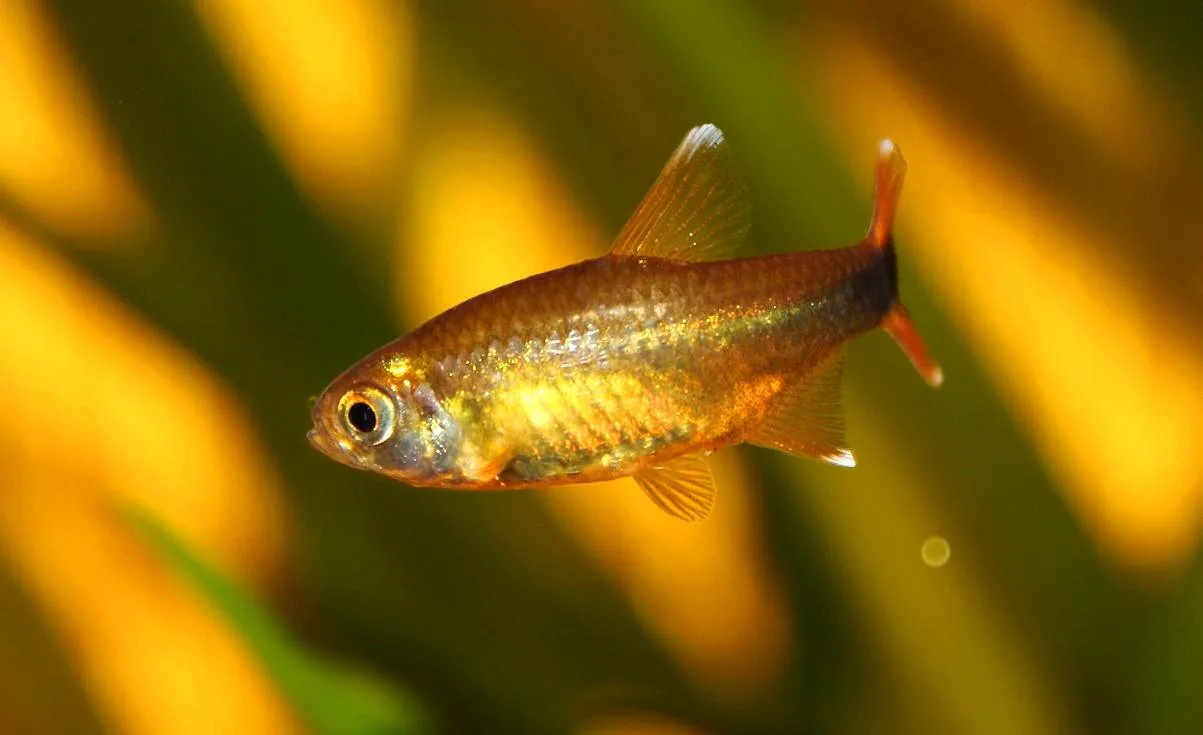
X-ray tetra
Pristella maxillaris
20 views
A South American tetra. It lives in densely vegetated waters at 24 to 28 °C.
- Temperature
- 24 – 28 °C
- pH
- 6 – 8 pH
- General hardness
- 2 – 20 °dH
- Maximum size
- 4.5
- Minimum group size
- 8
- Minimum tank size
- 40 – 60 L
3 min read · 420 words
Fresh water
Quick facts
Place in the aquarium
Highlighted are the water layer and the spots where the species usually stays in the tank.
- Middle water Usually stays in the middle of the tank, between bottom and surface.
- Dense plants Looks for dense planting as cover, retreat or grazing ground.
Shrimp in the tank
Shrimplets at risk
- Not shrimp safe
- Dwarf shrimp at risk
- Shrimplets at risk
- Shrimp safe
- Adult dwarf shrimp
- Safe
- Shrimplets
- Get eaten
- Safe from shrimp size
- about 1.5 cm
Adult dwarf shrimp are safe with the X-ray tetra. Females reach about 4.5 cm, males at most 3.5 cm, and the species feeds mainly on small invertebrates. Shrimp from about 1.5 cm are too large for it. Juvenile shrimp are exactly that kind of prey, however, and are eaten in a community tank.
The peaceful school stays mostly in midwater. Moss, leaf litter and fine-leaved plants on the bottom let enough young survive for Neocaridina to hold their own.
Home & range
Overview
Also called the water goldfinch. It is kept for its pattern and its uncomplicated demands.
Systematics
Albert B. Ulrey described the species in 1894 as Aphyocharax maxillaris. Carl H. Eigenmann set up the genus Pristella in 1908, at first for Holopristes riddlei, which Seth Eugene Meek had described a year earlier. Holopristes riddlei turned out to be a synonym, so the genus held only one species for a long time. In 2019 and 2021 Pristella ariporo from the Río Meta basin in Colombia and Pristella crinogi from the Tocantins and São Francisco in Brazil were added. Hyphessobrycon axelrodi from Trinidad may also belong to the genus. The genus name comes from the Greek pristis, saw. The species name refers to the full set of teeth on the maxilla. The species now belongs to the family Acestrorhamphidae.
Features
Females reach about 4.5 cm, males at most 3.5 cm. The body is strongly compressed, translucent yellow-green and silvery in the light. The dorsal, anal and pelvic fins each carry a black spot, lemon yellow towards the body and white at the tip. In strongly coloured fish the caudal fin is reddish. The dorsal fin has 11 rays, the anal fin 20 to 24. Males are slimmer and have little or no marking on the anal and pelvic fins.
Origin & habitat
This describes the origin, not how to furnish the aquarium.
The range runs from the lower Amazon to the Orinoco, in smaller still or slow waters of northern South America, with dense plants and 24 to 28 °C. That describes the habitat, not a separate aquarium recipe.
In the wild the X-ray tetra feeds mainly on small invertebrates.
Care
No tank volume and no pH are given.
Translucent, and in a school
The X-ray tetra reaches about 4 to 5 cm. The body is translucent, a black spot sits behind the gill cover, the fins carry yellow and black markings. 22 to 28 °C, pH 6 to 7.5, a school from eight, tanks from about 60 litres. The species is peaceful and one of the tougher small tetras, as long as the group is right and the water stays clean.
A single fish loses the effect and stands shy. A dark bottom and plants make the spot and the fins visible.
Diet
Fine prepared food. Flakes, small granules, cyclops. Several small feeds. Food that is too coarse is spat out.
Behavior
A peaceful schooling fish. Its colouring and modest needs make it well suited to the aquarium.
Reproduction
An egg scatterer without brood care. Spawning takes place in the early morning. A female releases 300 to 400, occasionally up to 800 small, transparent eggs. The larvae hatch after 24 to 30 hours and swim freely 3 to 4 days later.
More species in this group



Similar water needs
Species with a similar temperature, a similar pH and a comparable adult size. Whether their behaviour fits as well is what the compatibility check is for.