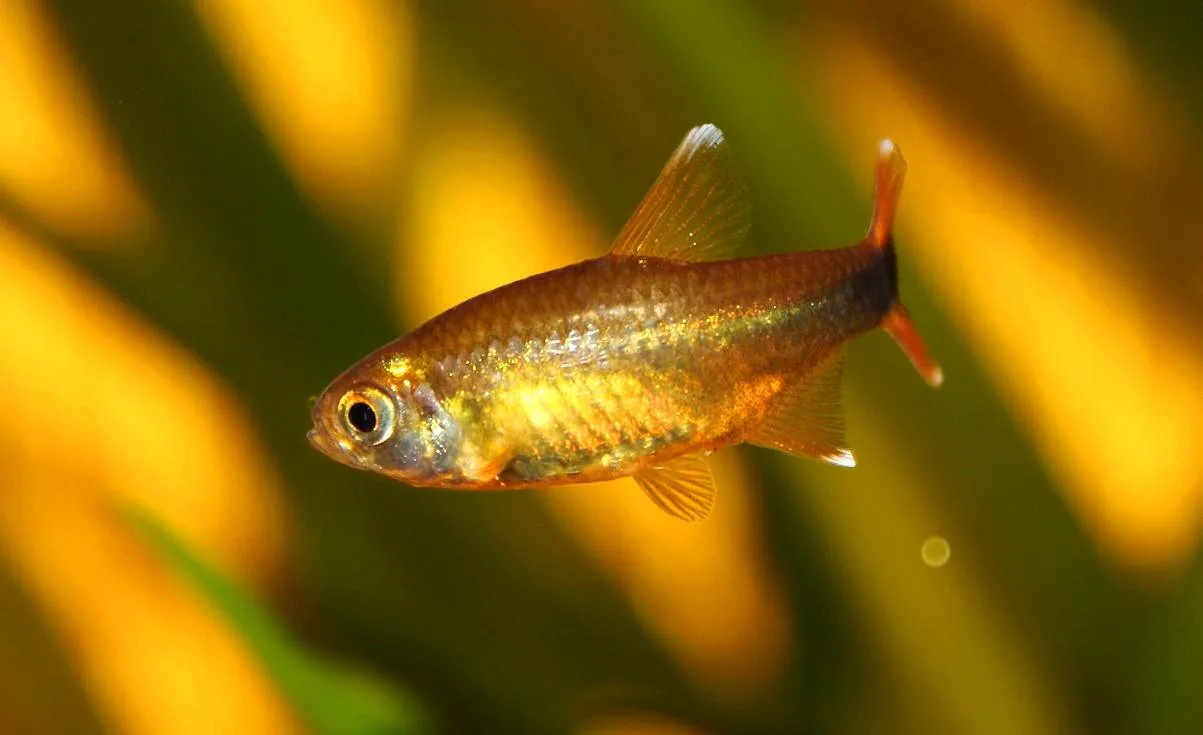
Cockatoo dwarf cichlid
Apistogramma cacatuoides
30 views
A dwarf cichlid whose males carry a fan-like dorsal fin. The species is so far known only from near Pucallpa in Peru.
- Temperature
- 24 – 28 °C
- pH
- 6 – 7.5 pH
- General hardness
- 2 – 15 °dH
- Maximum size
- 8 cm
- Minimum tank size
- 100 L
4 min read · 590 words
Fresh water
Quick facts
Place in the aquarium
Highlighted are the water layer and the spots where the species usually stays in the tank.
- Near the bottom Mostly stays just above the bottom. Food has to reach the substrate.
- Dense plants Looks for dense planting as cover, retreat or grazing ground.
- Rocks and caves Needs caves, crevices or rockwork as hiding place, territory or spawning site.
Shrimp in the tank
Dwarf shrimp at risk
- Not shrimp safe
- Dwarf shrimp at risk
- Shrimplets at risk
- Shrimp safe
- Adult dwarf shrimp
- At risk
- Shrimplets
- Get eaten
- Safe from shrimp size
- about 4 cm
The cockatoo dwarf cichlid is risky for dwarf shrimp. Males grow to 8 cm, the mouth is large for the body size, and the species eats animal food. Males and females too defend territories on the bottom, exactly where shrimp live. Young shrimp are certainly eaten, and adult Neocaridina or Caridina often as well. Larger shrimp from about 4 cm are usually safe. Anyone who wants to keep both needs a large, densely planted tank with many hiding places and must expect losses.
Home & range
Hatched countries are where the species occurs. It lives in particular waters there, not across the whole country. The points name known waters for orientation, not collection sites.
- Country of origin
- Water for orientation
Native
- Peru
- Brazil is not named in this text.
Overview
Males of Apistogramma cacatuoides reach eight centimetres. Females stay at five and have shorter fins. The body is only slightly elongated and moderately deep. The mouth is large for the body and has thick lips. Three to four wavy stripes on the lower belly occur in both sexes. Aquarium breeding appears to secure the species, while fish bred over many generations show colours clearly different from the wild form.
Colour of the sexes
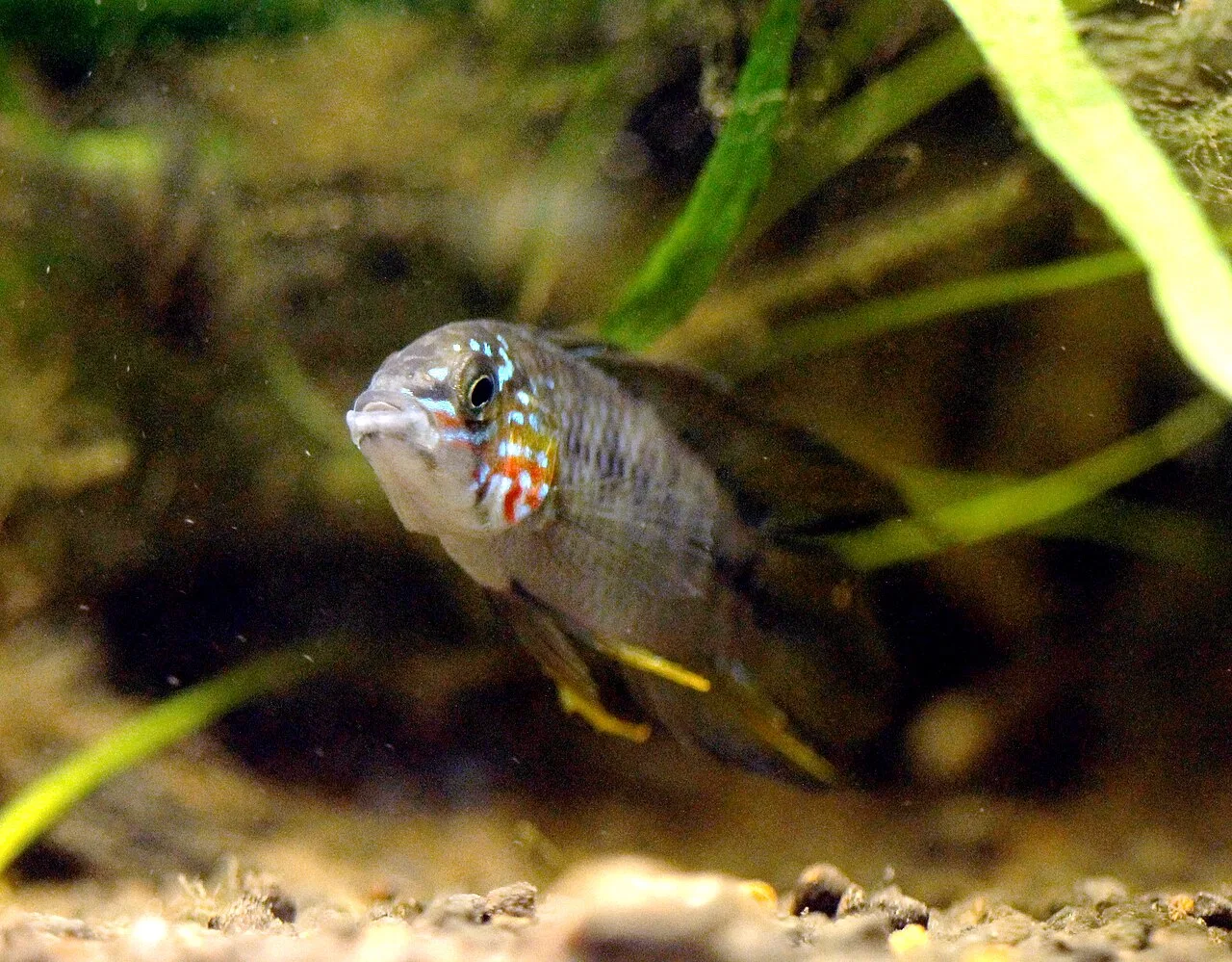
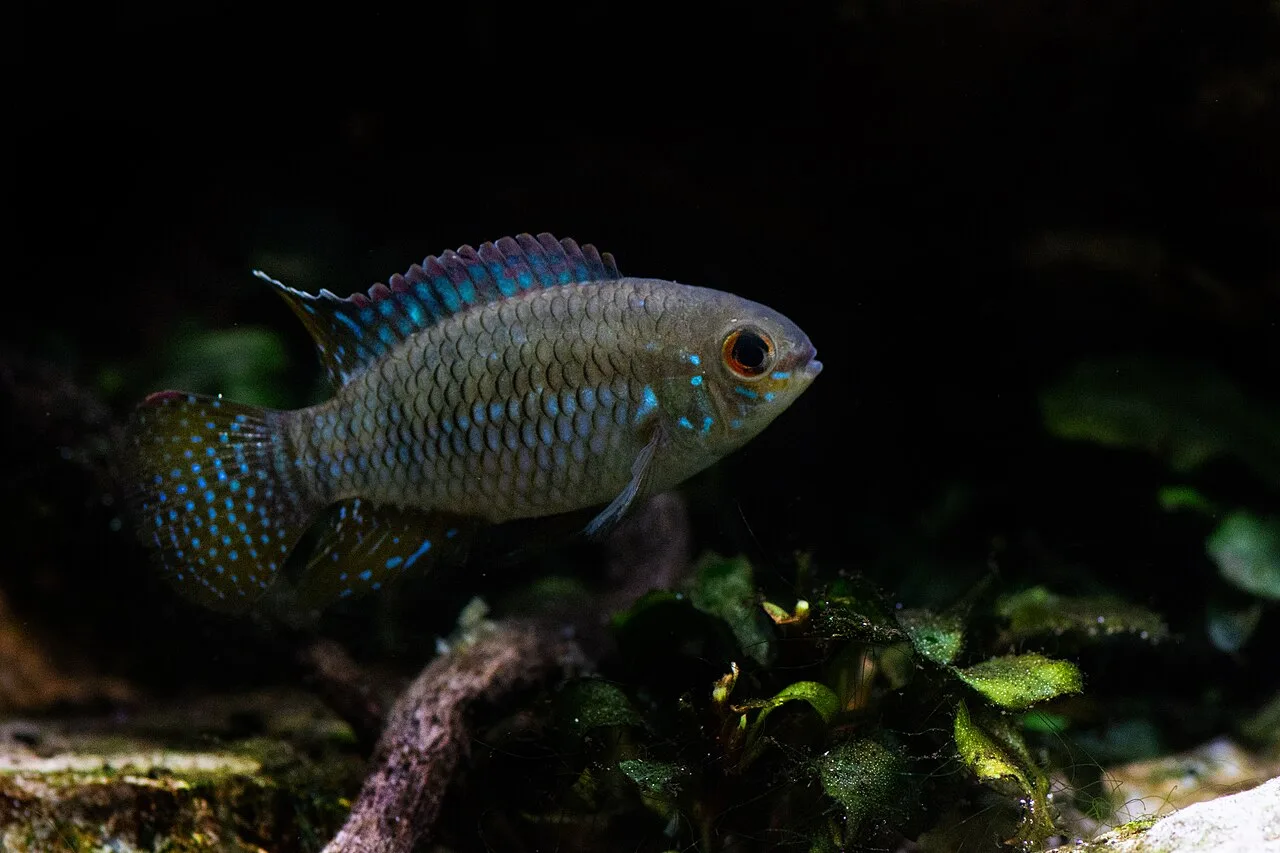
The cockatoo dwarf cichlid is the Apistogramma species most commonly bred in captivity. The male is more colourful than the female and usually has red to orange dorsal and tail fins. The front three or four hard rays of the dorsal fin are elongated and form the cockatoo-like crest, and the pelvic fins are clear. The female is pale yellowish with a clear black longitudinal line, but turns bright yellow when mating and guarding the brood. She lacks the elongated dorsal rays, and her pelvic fins have a black leading edge. Both sexes have a dark line from the eye to the lower edge of the gill cover. Blue, yellow and some red colour forms already occur in the wild.
Aquarium strains
The strains are: albino with a light body and red eyes, double red with red-and-black dorsal and tail fins, triple red with a patterned anal fin as well, and orange flash with orange dorsal, tail and anal fins.
Origin & habitat
This describes the origin, not how to furnish the aquarium.
So far the species is recorded only near the Peruvian city of Pucallpa on the Río Ucayali. The habitat is small, shallow streams or lagoon-like pools in rainforest. The fish stay in very shallow zones at 24 to 28 °C. A thick leaf layer is typical, with underwater plants and stones as cover. Water at the sites is described as soft to medium-hard and slightly basic. That is a habitat statement, not a separate aquarium calculation.
The range is larger than just the area around Pucallpa: tributaries of the Ucayali, Amazon and Solimões from the Río Pachitea to Tabatinga in Peru and Colombia.
Care
A keeping range of 24 to 28 °C matches the temperature in the habitat. Males hold territories. A pair, or one male with two females, is recommended. The rather shy fish should be kept only with very quiet tankmates.
Keeping
The species is regarded as one of the cichlids best suited to planted tanks. It is kept as a pair, a trio of one male and two females, or a harem with several females, together with peaceful tankmates such as tetras. In very large tanks several males can live together if wood, dense planting and caves create enough territories. Females can also be highly territorial, not only during brood care. For more than one pair the tank should hold over 120 litres, because a female defends a radius of about 30 cm. pH 6.5 to 8.0 is recommended. As one of the few South American dwarf cichlids, the species tolerates alkaline water.
Behavior
Males are territorial. No finer social structure is described outside breeding.
Reproduction
The female lays the eggs on the ceiling of a cave or under the undersides of leaves. She tends the brood alone. The male defends the breeding territory.
The eggs are salmon-coloured. Notable are so-called sneaker males: a subordinate male develops neither the full crest fin nor the full colouring, passes himself off as a female and takes chances to mate. If the dominant male dies, the subordinate one develops the full finnage. In a community tank fast-swimming fish disturb the brood, because they pick off the young from the female.
Gallery
More species in this group
Similar water needs
Species with a similar temperature, a similar pH and a comparable adult size. Whether their behaviour fits as well is what the compatibility check is for.