
African butterfly cichlid
Anomalochromis thomasi
19 views
A West African cichlid of 6 to 8 cm. Not the South American butterfly cichlid.
- Temperature
- 22 – 28 °C
- pH
- 6 – 7.5 pH
- General hardness
- 2 – 15 °dH
- Maximum size
- 8 cm
2 min read · 334 words
Fresh water
Quick facts
Place in the aquarium
Highlighted are the water layer and the spots where the species usually stays in the tank.
- Near the bottom Mostly stays just above the bottom. Food has to reach the substrate.
- Dense plants Looks for dense planting as cover, retreat or grazing ground.
- Rocks and caves Needs caves, crevices or rockwork as hiding place, territory or spawning site.
Shrimp in the tank
Dwarf shrimp at risk
- Not shrimp safe
- Dwarf shrimp at risk
- Shrimplets at risk
- Shrimp safe
- Adult dwarf shrimp
- At risk
- Shrimplets
- Get eaten
- Safe from shrimp size
- about 4 cm
The Thomas's cichlid is a risk for dwarf shrimp. It grows 6 to 8 cm long and eats small animals, small fish, algae and especially snails. Despite its small mouth it also manages larger snails. Adult dwarf shrimp and juveniles fit that prey range. Larger shrimp from about 4 cm are usually safe.
When breeding, both parents defend the clutch and the young. In a large tank with many hiding places Amano shrimp can fit. Dwarf shrimp are better kept separately.
Home & range
Hatched countries are where the species occurs. It lives in particular waters there, not across the whole country. The points name known waters for orientation, not collection sites.
- Country of origin
- Water for orientation
Native
Overview
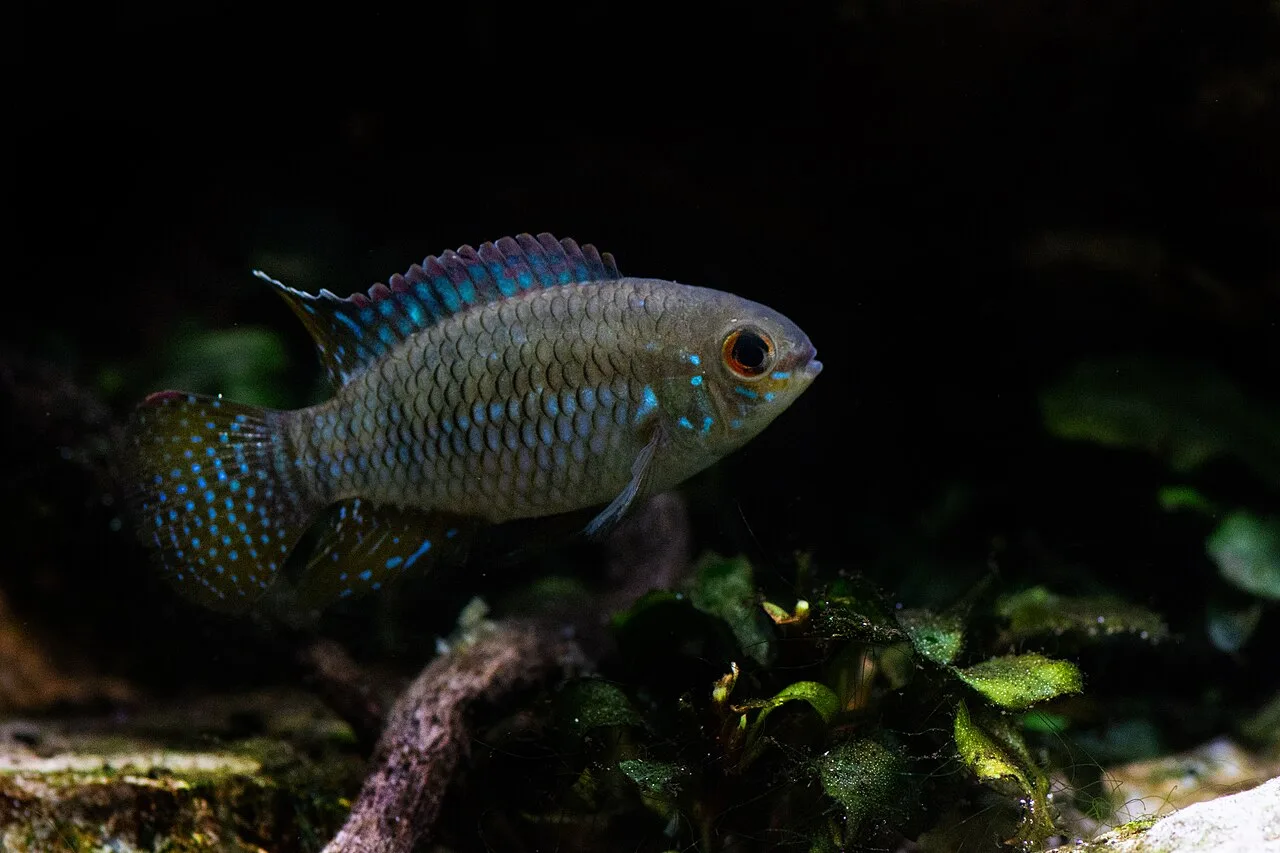
Light brown, beige to yellow, with rows of pale blue spots. The most contrasting fish come from southern Sierra Leone and adjacent Liberia. Several local forms.
Systematics
George Albert Boulenger described the species in 1915 as Paratilapia thomasi. The species name honours N. W. Thomas, who caught the type specimens. In German the fish is also called the African butterfly cichlid. In 1985 Peter Humphry Greenwood set up the genus Anomalochromis, which contains only this species. The name combines the Greek anomalos, irregular, with Chromis and refers to a peculiarity of the lateral line canal on the gill cover and lower jaw.
The species belongs to the tribe Hemichromini. Its closest relatives are Hemichromis and Rubricatochromis. The genera differ in the structure of the throat teeth. It is not closely related to the South American butterfly cichlid Mikrogeophagus ramirezi.
Body and sexes
The body resembles Hemichromis but stays smaller. Dorsal and anal fins end slightly pointed, the caudal fin is rounded. Fin formula: dorsal XIV–XV/8–10, anal III/7–9. The sexes are hard to tell apart and only as adults. Females are often more contrastingly coloured and smaller than males.
Origin & habitat
This describes the origin, not how to furnish the aquarium.
Small coastal rivers and streams from Guinea to western Liberia, and Sierra Leone in the colour description. Clear, soft and acidic. The three countries stay coarse.
The home waters flow through rainforest and bush and are usually rich in oxygen.
Diet
Small animals, small fish, algae and especially snails. Even larger snails, despite the small mouth.
Reproduction
Monogamous open spawners on large leaves or stones. The female defends the eggs.
Brood care
The species is a monogamous open brooder with pronounced brood care. It prefers to spawn on large leaves or stones, and the clutch holds up to 500 eggs. The female defends it against every kind of enemy. After hatching, the parents move the larvae several times between pits they have dug in the bottom. Both parents keep guarding the young even after they swim freely.
The species is on the IUCN Red List, assessed by P. Lalèyè in 2006.
Gallery
More species in this group

Similar water needs
Species with a similar temperature, a similar pH and a comparable adult size. Whether their behaviour fits as well is what the compatibility check is for.




