
Bolivian ram
Mikrogeophagus altispinosus
24 views
A pair-forming dwarf cichlid. Males reach 9 cm, females 7 cm. The fish live about 5 years.
- Temperature
- 22 – 26 °C
- pH
- 6 – 7.5 pH
- General hardness
- 3 – 10 °dH
- Maximum size
- 9 cm
- Minimum tank size
- 80 L
4 min read · 565 words
Fresh water
Quick facts
Further published values
- Lifespan
- 5 a
Place in the aquarium
Highlighted are the water layer and the spots where the species usually stays in the tank.
- Near the bottom Mostly stays just above the bottom. Food has to reach the substrate.
- Substrate Sifts through the substrate or burrows into it. Fine, rounded sand without sharp edges suits it.
Shrimp in the tank
Dwarf shrimp at risk
- Not shrimp safe
- Dwarf shrimp at risk
- Shrimplets at risk
- Shrimp safe
- Adult dwarf shrimp
- At risk
- Shrimplets
- Get eaten
- Safe from shrimp size
- about 4 cm
The Bolivian ram endangers even adult dwarf shrimp. It grows to about 8 to 9 cm and sifts the bottom for small animals and plant matter. Young shrimp certainly fall victim, and adult Neocaridina and Caridina often as well. Larger shrimp such as Amano shrimp from about 4 cm are usually safe.
A separate tank suits dwarf shrimp better. With Amano shrimp, keeping works in a tank with dense planting and bogwood that gives both shelter.
Home & range
Hatched countries are where the species occurs. It lives in particular waters there, not across the whole country. The points name known waters for orientation, not collection sites.
- Country of origin
- Water for orientation
Native
Overview
The species lives mostly near the bottom and forms pairs. Males have a longer second dorsal ray. Females often show a little red on the belly and, just before spawning, a short ovipositor.
Features
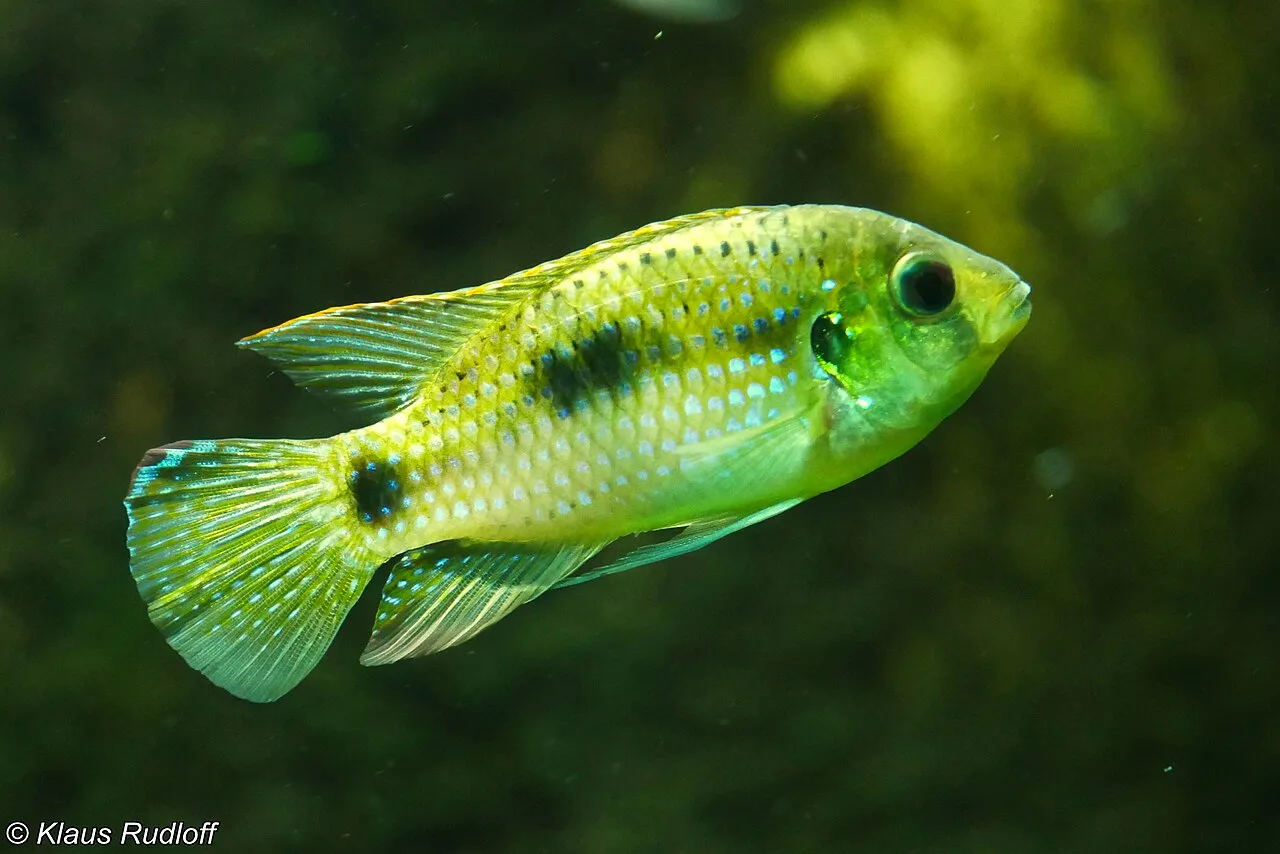
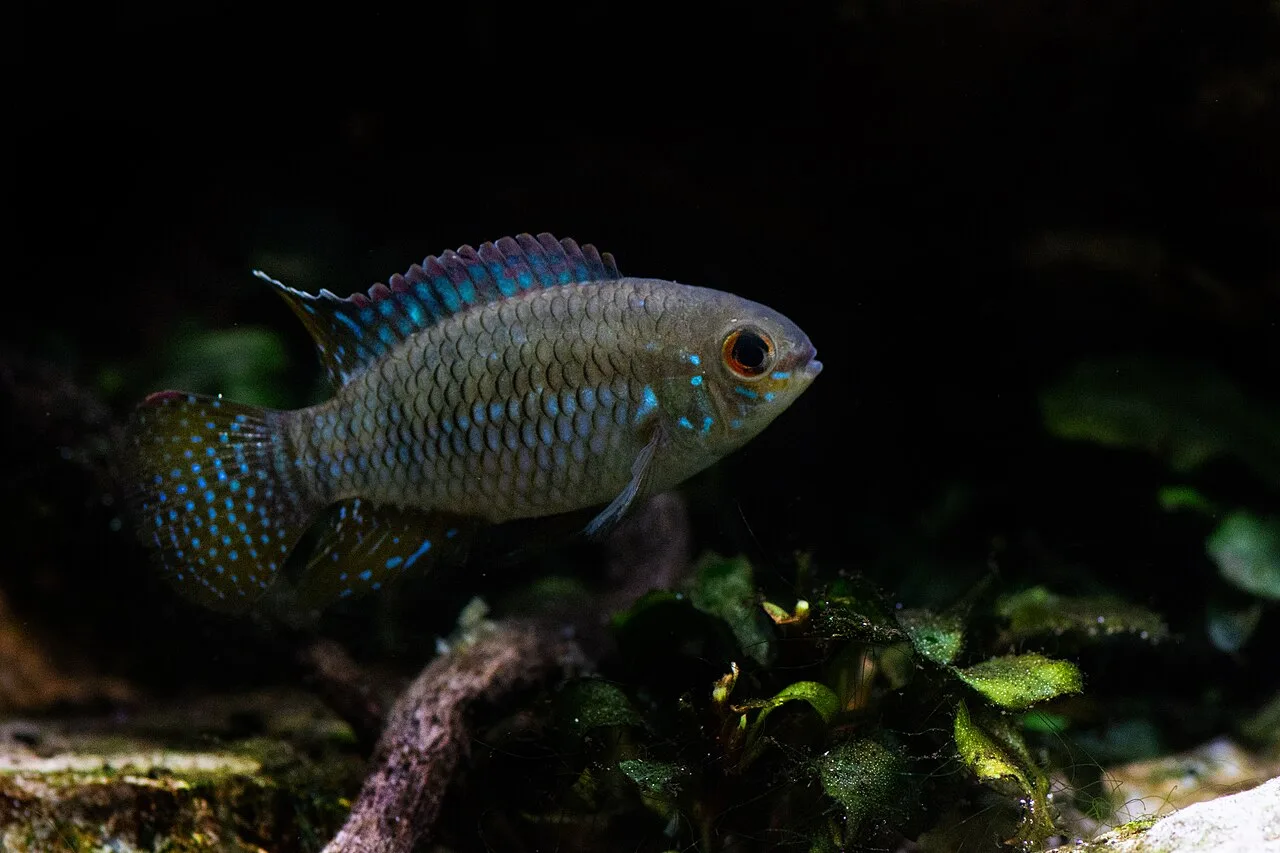
The profile resembles larger eartheaters. Reported sizes range from about 8 cm to 9 cm for males, while females stay smaller at 7 cm. Head and front half are yellow, fading to olive-grey at the rear. A black band runs vertically through the eye, and there are six faint bars, the third with a dark centre. The first dorsal rays are black, and the dorsal and tail fins are edged pinkish red. Anal and pelvic fins are uniformly red with bright blue rays and dots. Mature males are slightly larger and sometimes have longer extensions on the tail and rear dorsal fin.
Taxonomy
John Diederich Haseman described the species in 1911 as Crenicara altispinosa. Papiliochromis altispinosus is a synonym. The form known in the trade as two-patch, from the Pindaituba in the upper Guaporé area, was described in 2022 as the separate species Mikrogeophagus maculicauda.
Origin & habitat
This describes the origin, not how to furnish the aquarium.
It occurs in the Río Iténez in Bolivia and southwestern Brazil, and in the Río Mamoré in Bolivia.
The species lives in soft, nearly neutral, warm water at pH 6.3 to 7.6 in the Mamoré and lower Guaporé drainages in Bolivia and Brazil. The type locality is the Mamoré at San Joaquín in Beni Department. The IUCN lists the species as least concern.
Care
Lengths are up to 9 cm for males and 7 cm for females.
Warmer than a community average, cooler than the ram
The Bolivian ram reaches about 8 cm and is tougher than Mikrogeophagus ramirezi. 24 to 28 °C is enough. It does not need a permanent 30 °C. pH 6 to 7.5. From about 80 litres for a pair, with sand, a cave or a leaf and hiding places. A pair that does not get on is separated.
While breeding both parents guard. Tankmates have to be able to leave the spawning zone. Shrimp are then eaten. Outside breeding the species is reserved.
Diet
Frozen food, brine shrimp and granules that also reach the bottom. Varied food holds the colour better than a single food.
Behavior
Pair-forming and bottom-oriented.
The species is rather shy and swims in typical stop-and-go movements. It feeds mainly on the bottom but can also feed in midwater or at the surface. As an omnivore it sifts the substrate for plant matter and small animals. It tolerates lower temperatures of 22 to 26 °C and a wider range of water values than M. ramirezi. Soft, acidic water, hiding places from dense planting or bogwood and at least 80 litres are recommended. Hectic or greedy tankmates do not suit.
Reproduction
Sex shows in the second dorsal ray, belly colour and the ovipositor. Age is given as about 5 years.
Open spawner with pits
Both parents care for the brood. In the aquarium mainly the male courts with head shaking, quivering and digging shallow pits, which takes about 48 hours. The female lays about 100 to 200 oval, brownish eggs in rows on a flat stone, rarely on a leaf, and the male fertilises each row. At 27 °C the larvae hatch after about 60 hours. The female fans the clutch and often sprinkles sand on it, possibly as camouflage. The parents carry the larvae in their mouths to the male's pits and move them several times. After seven days the young swim freely and are led in a dense school.
Gallery
More species in this group

Similar water needs
Species with a similar temperature, a similar pH and a comparable adult size. Whether their behaviour fits as well is what the compatibility check is for.

