
Bronze corydoras
Corydoras aeneus
25 views
Sociable bottom fish. Since 2024 it has been listed as Osteogaster aenea. The catalogue keeps the familiar name Corydoras aeneus.
- Temperature
- 22 – 26 °C
- pH
- 6 – 7.5 pH
- General hardness
- 2 – 30 °dH
- Maximum size
- 7 cm
- Minimum group size
- 6
- Minimum tank size
- 80 L
5 min read · 813 words
Fresh water
Quick facts
Further published values
- Lifespan
- 10 a
Place in the aquarium
Highlighted are the water layer and the spots where the species usually stays in the tank.
- Near the bottom Mostly stays just above the bottom. Food has to reach the substrate.
- Substrate Sifts through the substrate or burrows into it. Fine, rounded sand without sharp edges suits it.
Shrimp in the tank
Shrimplets at risk
- Not shrimp safe
- Dwarf shrimp at risk
- Shrimplets at risk
- Shrimp safe
- Adult dwarf shrimp
- Safe
- Shrimplets
- Get eaten
- Safe from shrimp size
- about 1.5 cm
The bronze corydoras leaves adult dwarf shrimp alone. It grows to about 7 cm and eats worms, small crustaceans, insect larvae and detritus, which it collects from the bottom with its underslung mouth. It cannot eat shrimp from about 1.5 cm. Young shrimp foraging on the bottom may be taken in at the same time. Because corys constantly comb the bottom in groups, moss cushions, plants and leaf litter are important as refuges. Then both species thrive well in the same tank.
Home & range
Hatched countries are where the species occurs. It lives in particular waters there, not across the whole country. The points name known waters for orientation, not collection sites.
- Country of origin
- Water for orientation
Native
Overview
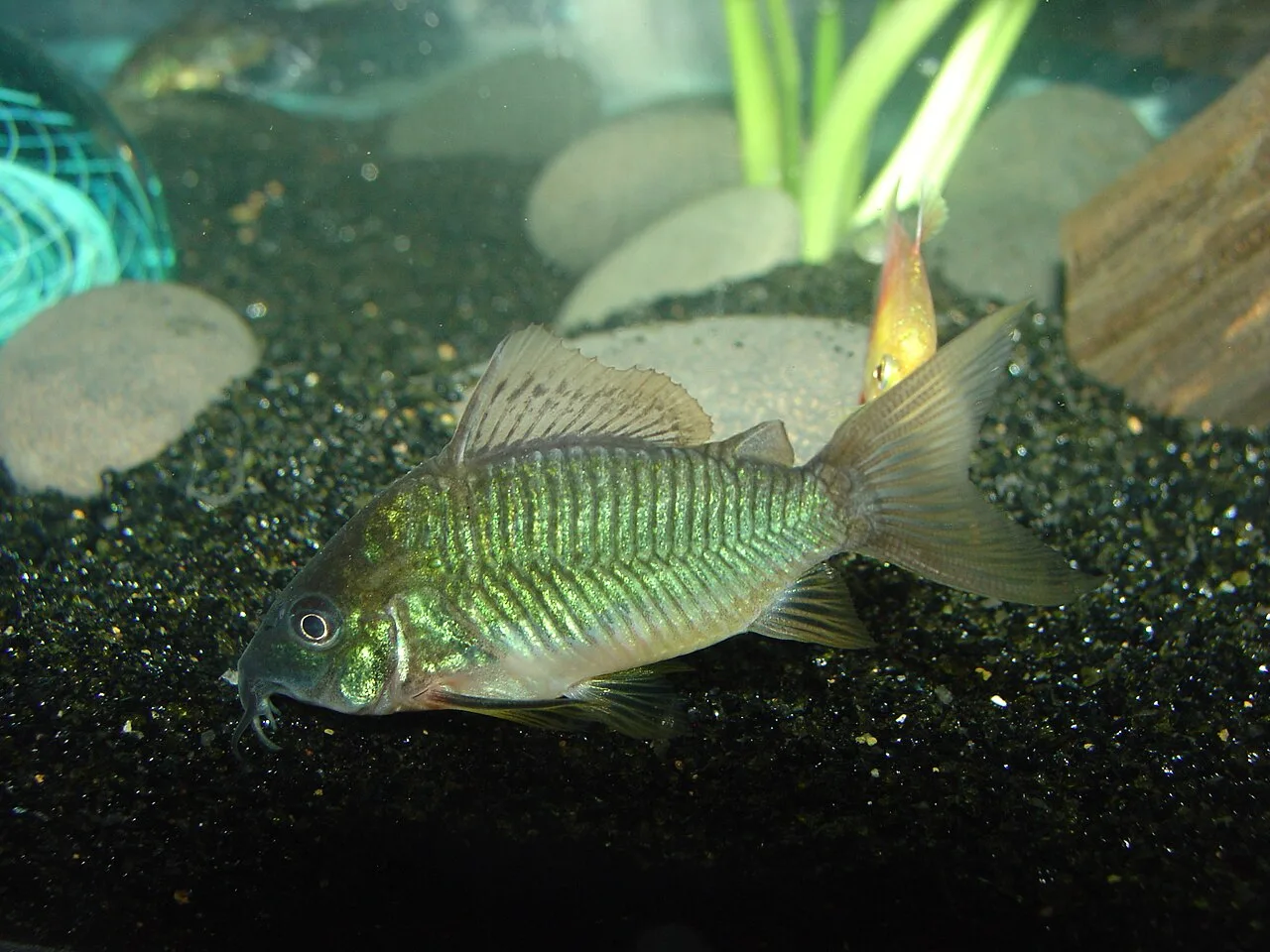
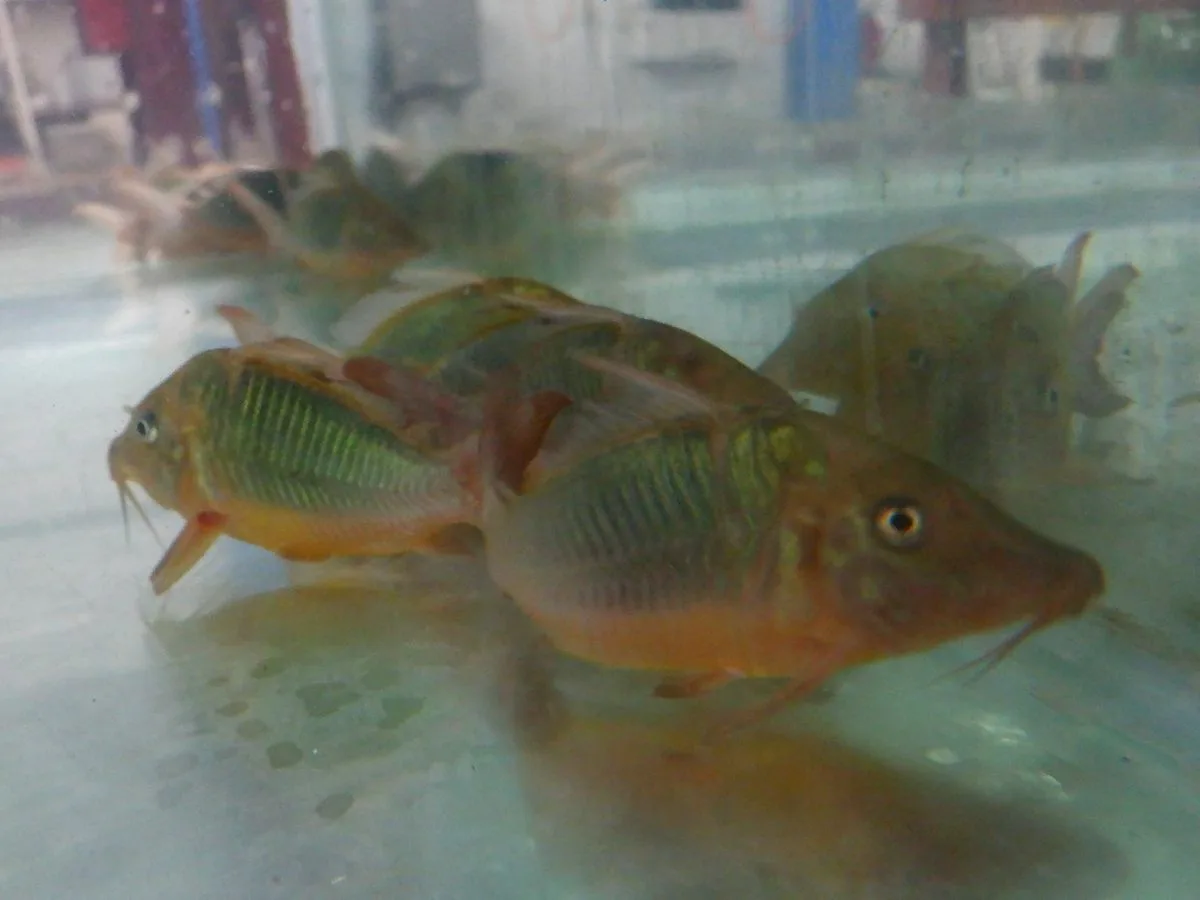
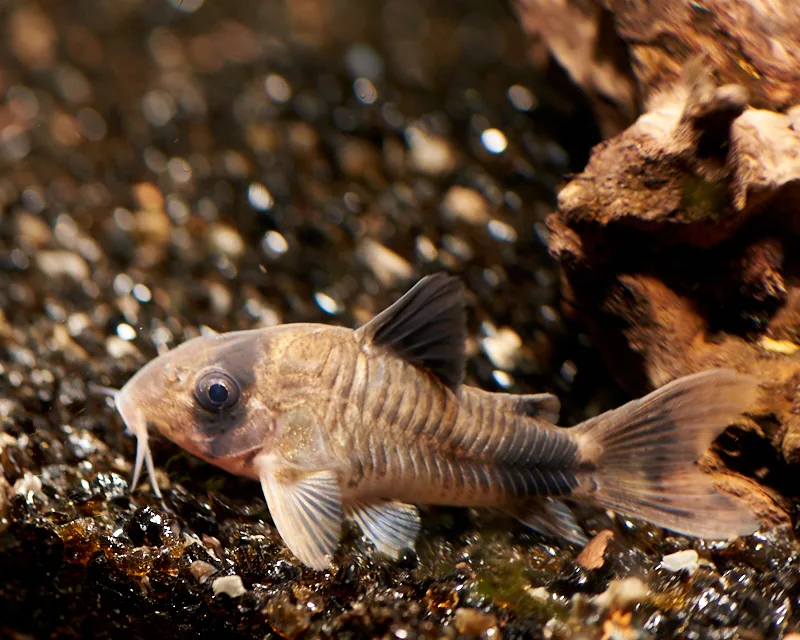
About 7 cm, males usually smaller. The ground colour runs from yellowish brown to a slight red, the upper half is darker, and a narrow yellowish band runs from the gill cover under the dorsal fin. The species is regarded as a group of closely related forms, not one uniform fish. The type locality is Trinidad. In the European trade the deeper-bodied type from the Paraná and Paraguay systems is said to be the usual one, not every fish sold under this name. Albino and veil forms are cultivated. The fish does not replace a filter and must not live on leftovers.
Name, group and forms
In German the bronze corydoras is also called gold-stripe cory, and the Latin aeneus means bronze or copper, referring to the metallic sheen. The fins are translucent yellowish to reddish brown. It gave its name to the Corydoras aeneus group, for which Cope proposed the name Osteogaster as early as 1871. The group also includes Osteogaster eques, O. melanotaenia, the rusty cory O. rabauti and O. zygatus. Since June 2024 Osteogaster has been a valid genus. In English the species is also called green corydoras, bronze catfish or wavy catfish.
Forms described as separate species, such as C. macrosteus, C. schultzei and C. venezulanus, were later merged with aeneus again. Fish from Trinidad grow 6 to 7 cm and shine so strongly that the dark side colouring is hardly visible. The venezulanus type from the Orinoco is somewhat smaller and has a black side spot often edged in reddish brown. The schultzei form from the Amazon basin, the true gold-stripe cory, has a broad golden stripe above the pectoral fins. From 1990 albinos came onto the market, later also blackish and veil-finned forms from Eastern Europe. Some albinos are said to be almost blind and the males partly sterile, possibly due to heavy inbreeding.
Body
Males grow to 6.5 cm and females to 7 cm, and females are slightly deeper-bodied. The average lifespan is ten years. The dorsal, pectoral and adipose fins carry an extra sharp barb with a mild poison.
Origin & habitat
This describes the origin, not how to furnish the aquarium.
It lives in a wide area east of the Andes: Argentina, Paraguay, Bolivia, Brazil, Colombia, Peru, Venezuela, Guyana, Suriname, French Guiana and Trinidad. These countries are a coarse origin and are not filled. A South America polygon would be larger than the list and is not drawn.
The species lives in quiet, shallow waters with soft bottoms, which can be heavily clouded by stirred-up mud, but also in running waters. In the habitat the water has 25 to 28 °C, pH 6.0 to 8.0 and 5 to 19 °dGH. Like most corys it uses its gut for breathing besides the gills and takes air at the surface for this.
Care
The keeping frame is 22–26 °C, pH 6–7.5, fine sand, groups from six and tanks from about 80 litres. Those tank figures are not in the origin account. In the wild the fish move in schools of 20 to 30. That is the habitat group, not a new tank minimum. Fine sand fits, because they search the bottom.
The bronze corydoras is probably the most popular cory and is bred in large quantities in the United States, Europe and Singapore. Wild imports are said to be harder to breed. It makes few demands on the water: 20 to 28 °C, pH 6.0 to 8.0 and 2 to 30 °dGH are regarded as suitable, and no salt should be added. Dense planting with hiding places is appreciated. Groups of five or more are recommended.
Diet
Worms, small crustaceans, insect larvae and detritus. Tablets and frozen food have to reach the substrate. Food at the surface misses this species.
Behavior
A peaceful group. Short trips to the surface happen and are not a sign of illness if the fish then search the bottom again.
Reproduction
With the rains, up to 20 eggs are laid per spawning, and 100 to 400 over the season. The larvae hatch after about three days. Fine rearing food remains the practical follow-up once larvae are there.
Unusual fertilisation
In laboratory observations the male presents his belly to the female, the female attaches her mouth to his genital opening and forms the well-known T-position. She drinks the sperm, which passes quickly through her gut and is released with the eggs into a pouch formed by the pelvic fins. A whole clutch is thus fertilised by the sperm of a single male, although females spawn with several males. Males form no territories and do not compete for females, and females do not choose. A male's reproductive success therefore depends on how often he courts.
The eggs carry small villi-like projections that make them stick. This is probably related to the turbid habitat. In the aquarium the female attaches the eggs to a chosen surface using her pelvic fins. After several spawning acts over two to three hours there are up to 200 eggs. Often a female spawns with two males, because one cannot fertilise all the eggs.
Gallery
More species in this group
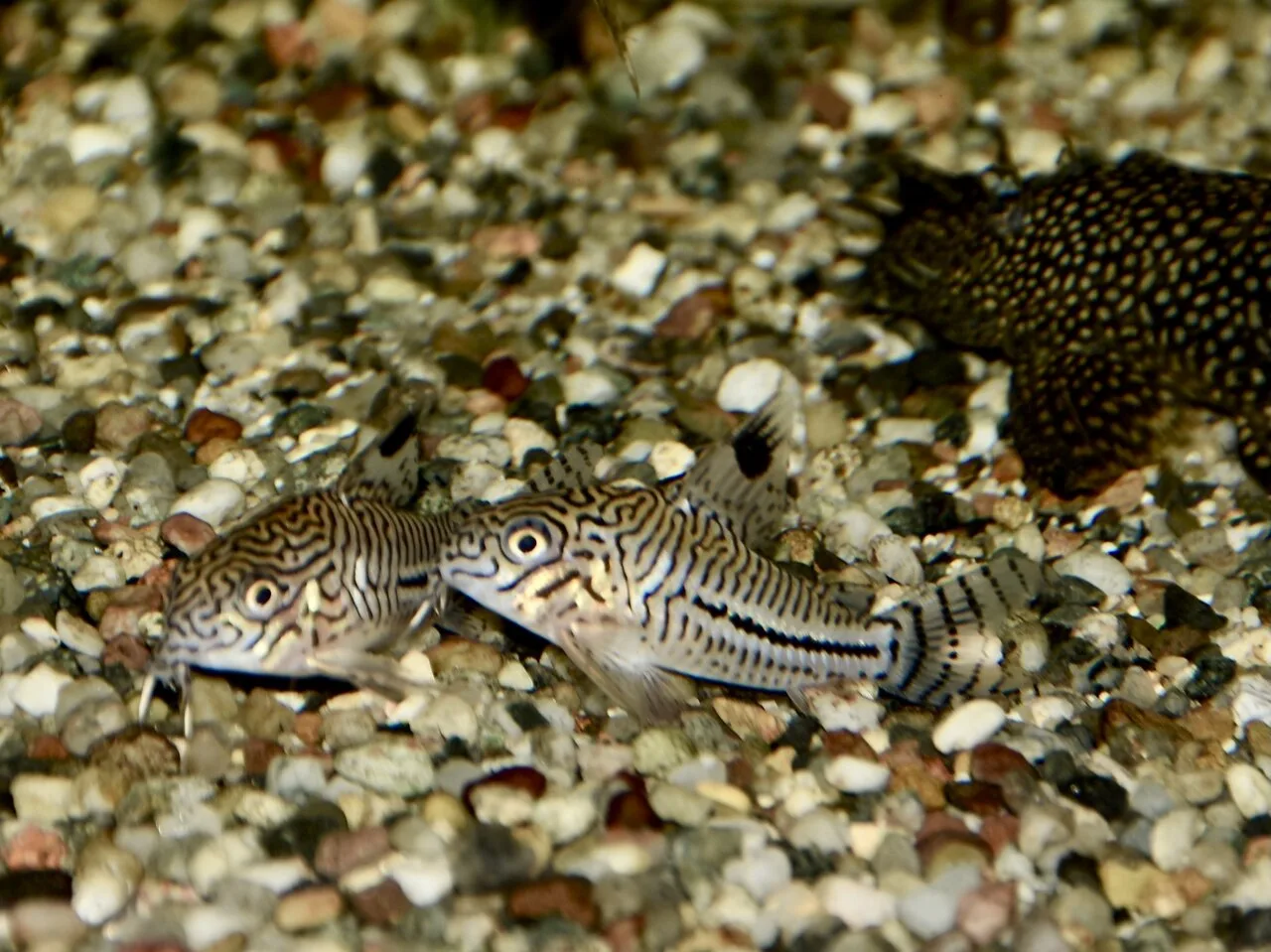
Similar water needs
Species with a similar temperature, a similar pH and a comparable adult size. Whether their behaviour fits as well is what the compatibility check is for.
