
Dwarf corydoras
Gastrodermus hastatus
2 views
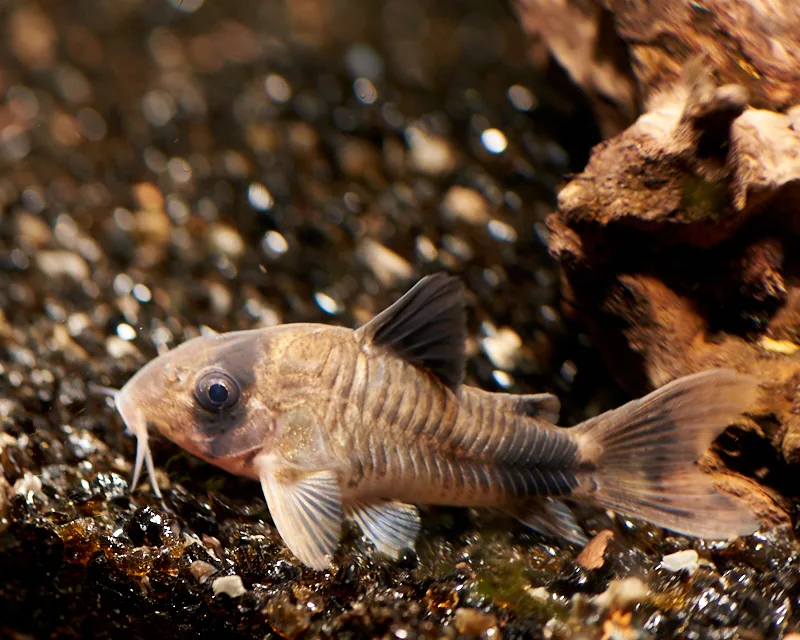
A tiny corydoras that hovers in a school in open water. A dark spot at the tail base carries a pale edge.
- Temperature
- 22 – 28 °C
- pH
- 6 – 7.5 pH
- General hardness
- 2 – 12 °dH
- Maximum size
- 3 cm
- Minimum group size
- 10
- Minimum tank size
- 60 L
2 min read · 212 words
Quick facts
Place in the aquarium
Highlighted are the water layer and the spots where the species usually stays in the tank.
- Middle water Usually stays in the middle of the tank, between bottom and surface.
- Dense plants Looks for dense planting as cover, retreat or grazing ground.
Shrimp in the tank
Shrimp safe
- Not shrimp safe
- Dwarf shrimp at risk
- Shrimplets at risk
- Shrimp safe
- Adult dwarf shrimp
- Safe
- Shrimplets
- Mostly safe
- Safe from shrimp size
- Any size
The dwarf corydoras is harmless to shrimp. It reaches only about 3 cm, the mouth is tiny, and it eats fine food on the bottom and in midwater. Adult shrimp are too large for it, and even juveniles are hardly taken.
The species suits a shrimp tank well. Both share the bottom without disturbing each other. All that matters is that enough food reaches the ground for both.
Home & range
Hatched countries are where the species occurs. It lives in particular waters there, not across the whole country. The points name known waters for orientation, not collection sites.
- Country of origin
- Water for orientation
Native
Overview
Gastrodermus hastatus reaches about 3 cm. The body is grey to olive, and a black spot with a pale border sits at the tail base, resembling an arrowhead. Unlike most corydoras the species often stands in midwater and schools there. It was formerly called Corydoras hastatus.
It is not the pygmy corydoras Gastrodermus pygmaeus, which wears a longitudinal band along the body. The dwarf corydoras has only the spot at the tail. Both stay tiny and need a large group.
Origin & habitat
This describes the origin, not how to furnish the aquarium.
Shallow, plant-rich waters in the Paraguay and Paraná drainages. The countries stay a coarse origin. Calm water with many plants matches that.
Care
Group
22 to 28 °C, pH 6 to 7.5. At least ten fish, tanks from about 60 litres. Fine sand, many plants, open space in midwater.
Company
Only very small, calm fish. Larger tetras and cichlids push them aside or eat them.
Diet
Fine food. Brine shrimp, cyclops, fine granules, crushed tablets. It has to reach midwater and the bottom.
Behavior
A calm school that spends time in open water and on the bottom. Single fish waste away. The larger the group, the more it shows itself.
Reproduction
The eggs are stuck one by one to plants and glass. The parents give no brood care and eat spawn. Young grow up in a separate tank on fine food.
More species in this group

Similar water needs
Species with a similar temperature, a similar pH and a comparable adult size. Whether their behaviour fits as well is what the compatibility check is for.


