
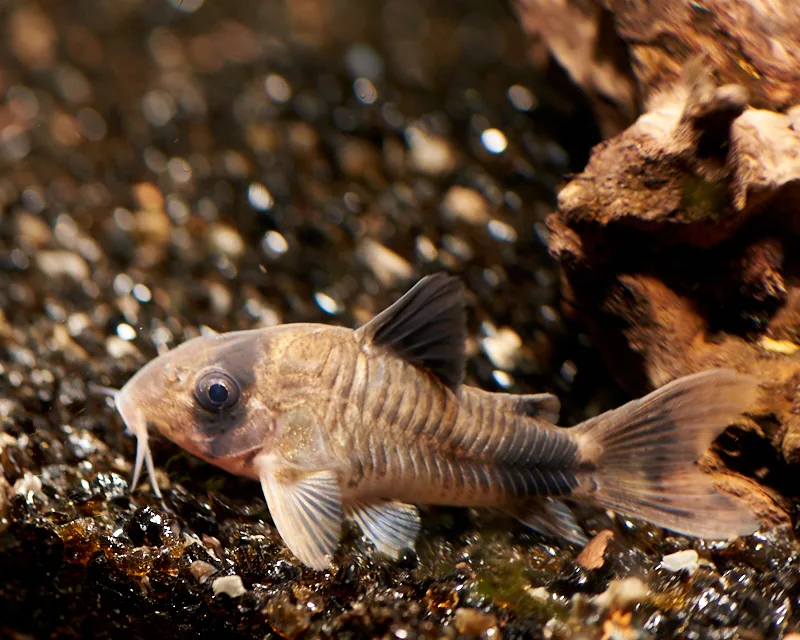
Banded corydoras
Scleromystax barbatus
24 views
One of the largest corydoras species, to 12 cm, from eastern Brazil.
- Temperature
- 20 – 28 °C
- pH
- 6 – 8 pH
- General hardness
- 2 – 25 °dH
- Maximum size
- 12 cm
- Minimum tank size
- 150 L
2 min read · 322 words
Fresh water
Quick facts
Place in the aquarium
Highlighted are the water layer and the spots where the species usually stays in the tank.
- Near the bottom Mostly stays just above the bottom. Food has to reach the substrate.
- Substrate Sifts through the substrate or burrows into it. Fine, rounded sand without sharp edges suits it.
Shrimp in the tank
Dwarf shrimp at risk
- Not shrimp safe
- Dwarf shrimp at risk
- Shrimplets at risk
- Shrimp safe
- Adult dwarf shrimp
- At risk
- Shrimplets
- Get eaten
- Safe from shrimp size
- about 4 cm
The banded corydoras can endanger small dwarf shrimp. At up to 12 cm it is among the largest corydoras and on the bottom eats worms, benthic crustaceans, insects and plant matter.
While foraging it finds baby shrimp and small Neocaridina or Caridina and eats them. Larger shrimp such as Amano shrimp from about 4 cm are usually safe. Moss and plants protect the young only partly, and a separate shrimp tank is more reliable. Anyone who wants to add shrimp should choose robust, larger species and introduce them only once the tank is well run in and densely planted.
Home & range
Hatched countries are where the species occurs. It lives in particular waters there, not across the whole country. The points name known waters for orientation, not collection sites.
- Country of origin
- Water for orientation
Native
Overview
Males clearly more colourful than females. Smaller schools, mostly on the bottom, but not only there. An intestinal breather, so the surface must stay free.
Size and sexes
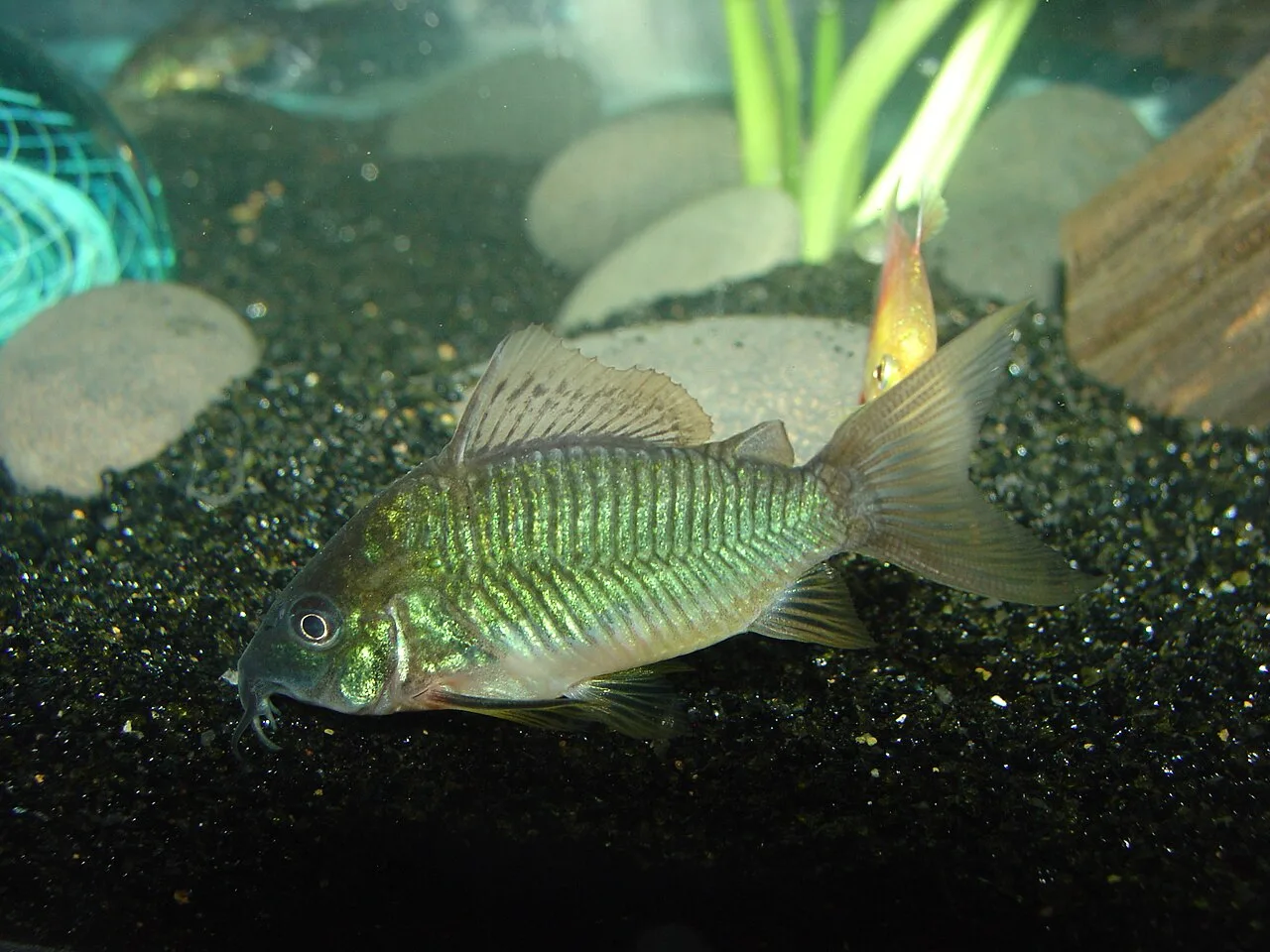
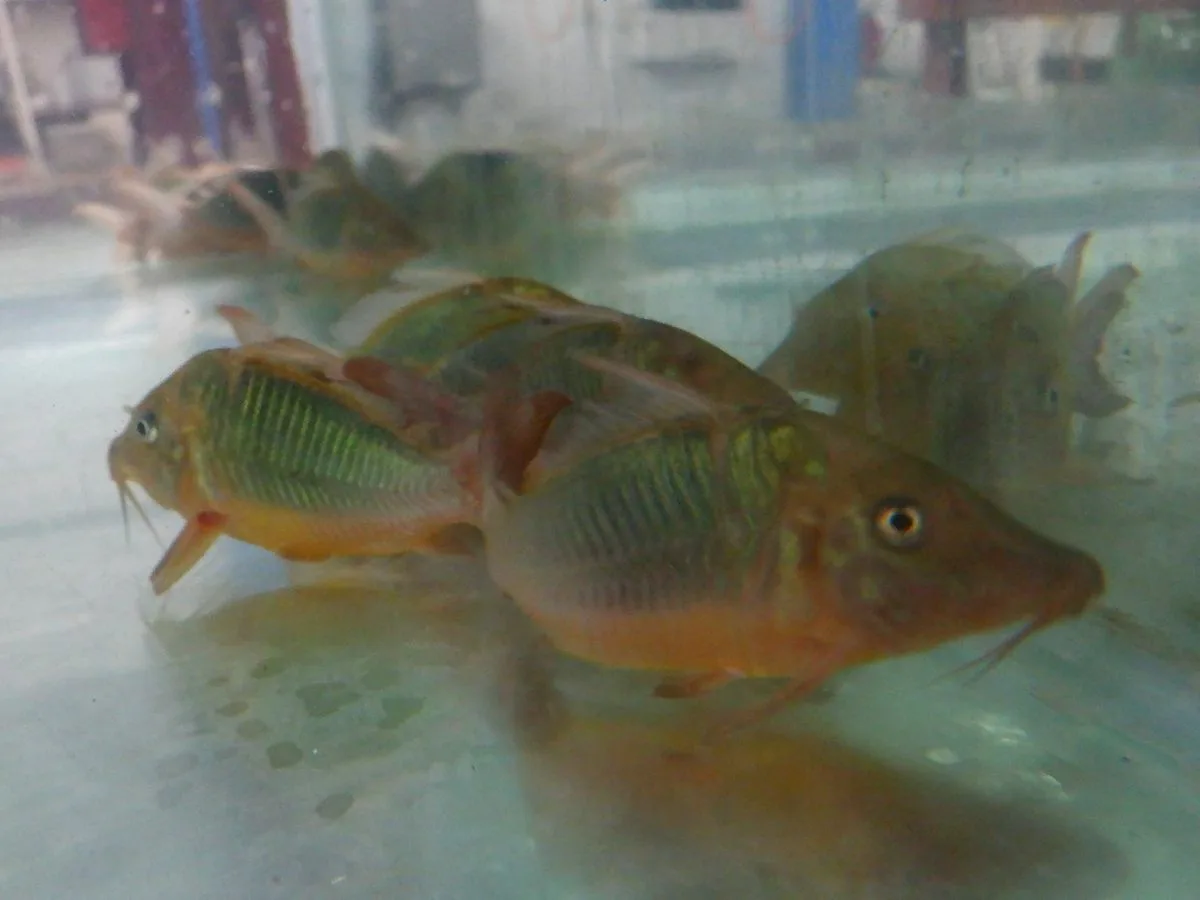
The banded corydoras, at up to 12 cm, is regarded as the largest known corydoras, while other figures give 9.8 cm. The sexes differ clearly. Males are much more colourful, and their dorsal and pectoral fins reach or almost reach the caudal peduncle. Fully grown males carry well-developed odontodes set in fleshy tissue over much of the sides of the snout.
Taxonomy
Quoy and Gaimard described the species in 1824 as Callichthys barbatus. Later it stood in Corydoras as Corydoras barbatus, a name still used in the trade. In 2003 it was placed in Scleromystax. Synonyms are Corydoras eigenmanni and Corydoras kronei. The IUCN lists it as least concern.
English names are banded corydoras and bearded catfish. The species belongs to the subfamily Corydoradinae of the Callichthyidae and is commercially important in the ornamental fish trade.
Origin & habitat
This describes the origin, not how to furnish the aquarium.
Eastern Brazil. Brazil stays coarse.
The species lives in eastern Brazil in the coastal rivers from Rio de Janeiro to Santa Catarina, in a subtropical climate. For its water pH 6 to 8, 2 to 25 °dGH and 20 to 28 °C are given.
Care
Peaceful and suited to aquariums if the swimming room matches the size.
The species is peaceful and suits aquaria, but because of its size it needs enough swimming room and fits small tanks less well. It lives in small schools mostly, but not only, on the bottom. As an intestinal air breather it needs free access to the surface.
Diet
The diet consists of worms, bottom-dwelling crustaceans, insects and plant matter.
Reproduction
A school, not a single fish.
The eggs are laid in dense vegetation and not guarded. In aquaria the female sinks to the bottom to spawn, rests on one pectoral fin and fans with the other. Some eggs pass into the pouch formed by the pelvic fins and are apparently fertilised there.
Gallery
More species in this group

Similar water needs
Species with a similar temperature, a similar pH and a comparable adult size. Whether their behaviour fits as well is what the compatibility check is for.




