
Emerald cory
Brochis splendens
16 views
A sturdy cory of 7 to 8 cm. The species is kept at 22 to 28 °C and pH 6 to 8 in groups of at least eight.
- Temperature
- 22 – 28 °C
- pH
- 6 – 8 pH
- General hardness
- 2 – 25 °dH
- Maximum size
- 8 cm
- Minimum group size
- 8
- Minimum tank size
- 112 L
3 min read · 454 words
Fresh water
Quick facts
Further published values
- Lifespan
- 10 – 15 a
Place in the aquarium
Highlighted are the water layer and the spots where the species usually stays in the tank.
- Near the bottom Mostly stays just above the bottom. Food has to reach the substrate.
- Substrate Sifts through the substrate or burrows into it. Fine, rounded sand without sharp edges suits it.
Shrimp in the tank
Shrimplets at risk
- Not shrimp safe
- Dwarf shrimp at risk
- Shrimplets at risk
- Shrimp safe
- Adult dwarf shrimp
- Safe
- Shrimplets
- Get eaten
- Safe from shrimp size
- about 1 cm
The emerald catfish is considered very peaceful and can be kept with shrimp. It grows 7 to 8 cm long and searches the bottom for algae, detritus, small animals and plant parts. Adult shrimp from about 1 cm are safe. Juvenile shrimp sitting in the sand while it sifts may be taken along, however.
Moss cushions and plant islands away from the sand area give the young a refuge. That way Neocaridina breed even next to a group of these catfish.
Home & range
Hatched countries are where the species occurs. It lives in particular waters there, not across the whole country. The points name known waters for orientation, not collection sites.
- Country of origin
- Water for orientation
Native
Overview
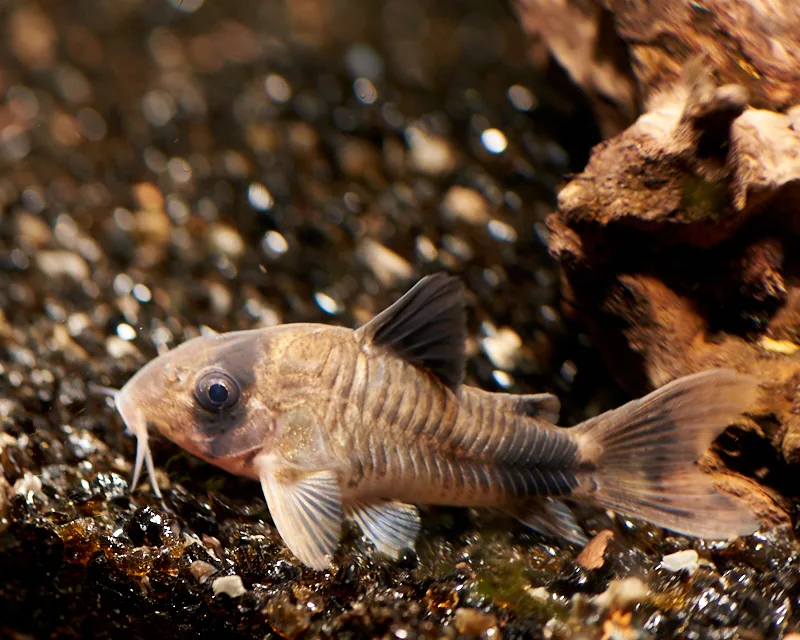
Emerald corys are told by the olive to gold sheen and a higher dorsal-ray count. They are intestinal breathers and take air at the surface in low-oxygen water. Females are deeper and larger than males.
Name
Francis de La Porte de Castelnau described the species in 1855; a synonym is Corydoras splendens. The Latin splendens means shining. Fin formula: dorsal 1/11–12, anal 2/5, pectoral 1/8–9, ventral 1/5. It shares the high number of dorsal fin rays with Brochis britskii and Brochis multiradiatus. Males are smaller and slimmer. Life expectancy is 10 to 15 years.
Origin & habitat
This describes the origin, not how to furnish the aquarium.
The species lives in rivers and streams of tropical South America with white water and soft, muddy ground, in Brazil, Ecuador, Colombia and Peru, in the Amazon, Ucayali, Ampiyacu, Tocantins, Paraguay, Nanay and the Napo system. The water there has pH 6 to 8, 2 to 25 °dGH and 22 to 28 °C.
Care
pH 6 to 8, GH 2 to 25 °dH, KH 2 to 15°, 22 to 28 °C. At least eight fish, tanks from 112 litres, soft substrate without sharp edges. It is very peaceful, including toward smaller fish and shrimp.
Larger than an ordinary cory
The emerald cory reaches about 7 to 8 cm and needs fine sand, a group from six and a tank from about 100 litres. 22 to 26 °C, pH 6 to 7.5. The green sheen shows on the sand and in dim light, not on coarse gravel under a glaring lamp.
The fish search the bottom and are not a waste disposal. Food has to arrive below. A group that hangs at the surface all the time has too little oxygen.
Diet
Omnivore on the bottom. It eats Artemia, mosquito larvae, grindal worms, Cyclops, tablets and flakes.
Sinking tablets, frozen food and a share that reaches the substrate. Several small feeds in the evening, when the fish become more active.
Behavior
A school of at least eight, very peaceful. Shrimp are named as compatible.
In the wild the species searches the bottom and the zone just above it for algae, detritus, small animals and plant parts, digging up to 10 mm into the substrate.
Reproduction
Breeding is called moderately easy. One female and three males, triggered by large water changes. About 500 to 800 eggs. At 24 °C the larvae hatch in three to four days, then need fine food.
In the wild the fish spawn after the rainy season, when the water has warmed and carries many suspended particles and prey animals. The male circles the female and twitches strongly. The eggs are 1.5 mm and are attached to stones, leaves or, in the aquarium, the glass. They should be separated from the parents soon after laying. Breeding is harder than with other corydoras. Two to three days after hatching, when the yolk sac is used up, the very small, almost transparent larvae get egg powder, infusoria, powder food or liquid food, later brine shrimp nauplii.
Gallery
More species in this group

Similar water needs
Species with a similar temperature, a similar pH and a comparable adult size. Whether their behaviour fits as well is what the compatibility check is for.




