
Julii cory
Hoplisoma julii
18 views
A cory from Brazil. Corydoras julii is the synonym. Not the three-stripe cory and not the leopard cory.
- Temperature
- 22 – 26 °C
- pH
- 6 – 7.5 pH
- General hardness
- 2 – 15 °dH
- Maximum size
- 6 cm
- Minimum group size
- 5
- Minimum tank size
- 80 L
4 min read · 611 words
Fresh water
Quick facts
Further published values
- Lifespan
- 5 – 10 a
Place in the aquarium
Highlighted are the water layer and the spots where the species usually stays in the tank.
- Near the bottom Mostly stays just above the bottom. Food has to reach the substrate.
- Substrate Sifts through the substrate or burrows into it. Fine, rounded sand without sharp edges suits it.
Shrimp in the tank
Shrimplets at risk
- Not shrimp safe
- Dwarf shrimp at risk
- Shrimplets at risk
- Shrimp safe
- Adult dwarf shrimp
- Safe
- Shrimplets
- Get eaten
- Safe from shrimp size
- about 1.5 cm
The julii cory is compatible with adult dwarf shrimp. It grows to 5 to 6 cm and sifts small invertebrates from the substrate. It cannot eat shrimp from about 1.5 cm with its underslung mouth. Young shrimp searching for food on the bottom, however, occasionally end up in its mouth. Because corys search the whole bottom in groups, moss cushions, plant islands and leaf litter should be present for the young to retreat into. In this way enough shrimp still grow up in a shared tank.
Home & range
Hatched countries are where the species occurs. It lives in particular waters there, not across the whole country. The points name known waters for orientation, not collection sites.
- Country of origin
- Water for orientation
Native
Overview
Males to 5 cm, females to 6 cm. More finely spotted than Hoplisoma trilineatum. Age 5 to 10 years.
Telling it apart from the three-stripe cory
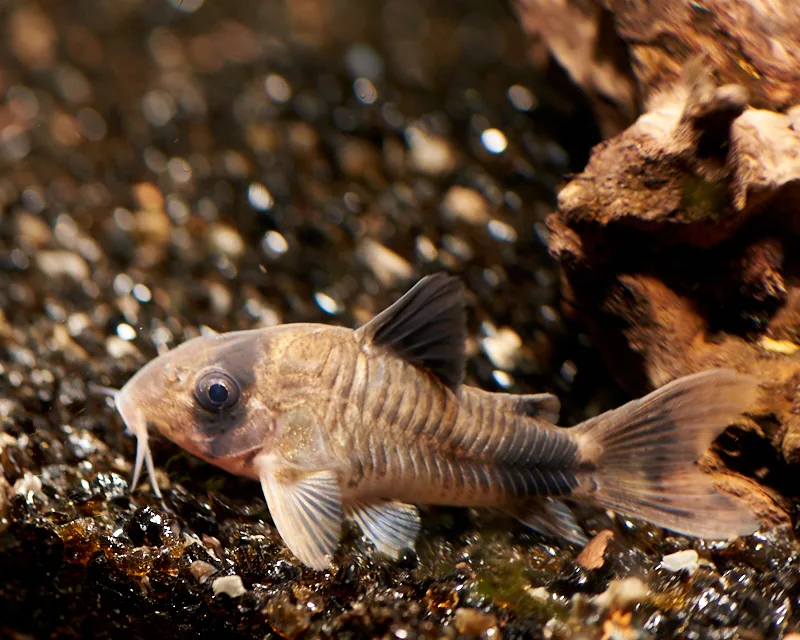
The skin is translucent whitish grey with fine black spots. A horizontal stripe along the mid-body reaches only to the level of the front base of the dorsal fin. This is the main difference from Hoplisoma trilineatum, which has larger reticulations instead of spots and a longer mid-body stripe. The spotted head pattern also points to julii, but occasionally appears in the three-stripe cory too. Size figures go up to at most 5.2 cm. Females are usually larger and rounder than males. Dorsal and anal fins each have one hard and seven soft rays.
The species belongs to the subfamily Corydoradinae of the armoured catfishes. In English it is called julii cory or leopard catfish.
Origin & habitat
This describes the origin, not how to furnish the aquarium.
Side arms of the Amazon, Maranhão on the Parnaíba and rivers in Pará. Brazil only, coarse.
The range is larger: the Parnaíba basin in the states of Ceará, Piauí and Maranhão, the coastal rivers of Maranhão and the lower Amazon. The species may be limited to the Maranhão-Piauí ecoregion. There are, however, records from streams in north-eastern Pará in the Maracanã and Marapanim basins. Further reports come from the Marañón, Tigre, Huallaga and Ucayali in Peru and from the Leticia area in Colombia.
Care
At least five fish, cover, 22 to 26 °C, pH 6.0 to 7.5, KH 2 to 5, GH 2 to 15, from 80 litres.
Spots and sand
The julii cory reaches about 5 to 6 cm and wears a fine pattern of spots and lines. 22 to 26 °C, pH 6 to 7.5, fine sand, a group from six, tanks from about 80 litres. Coarse gravel chafes the barbels. The species is mixed in the trade with similarly marked corys. The pattern separates them better than the name at the till.
Peaceful, bound to the bottom, not a waste disposal. Food has to arrive below. A short gulp of air at the surface is normal.
Diet
Algae, detritus, small animals and plant parts.
Like almost all Hoplisoma, the species searches for food on the bottom. It sifts small invertebrates from the substrate and expels sand and sediment through the gill openings. In the aquarium, sinking foods rich in insect and invertebrate protein suit it, as well as live or frozen foods such as bloodworms, daphnia, brine shrimp, tubifex and blackworms.
Behavior
A group, not a single fish. H. trilineatum is described as hardier.
Reproduction
At 26 to 28 °C the larvae hatch after about five days. That is the hatching temperature, not the keeping span. Then Artemia.
Breeding modelled on the rainy season
In the wild the corys spawn after the rainy season, when the water warms again and carries much suspended matter and prey. The rain makes the water much softer, and a conductivity of about 60 μS suits breeding. In the aquarium a one- to three-day cooling by two to three degrees with rich feeding and subsequent rewarming helps. Breeding groups of two males to one female have proved successful.
The male circles the female and twitches strongly. As in related species the fish form a T-position: the female swims to the male's belly and takes in his sperm, which passes quickly through the gut and fertilises the eggs in the cloaca. The female cleans glass or leaf undersides and attaches about 100 small, white, firm eggs to them. The parents eat eggs, so these are separated. Once the yolk sac is used up, two to three days after hatching, the tiny, almost transparent larvae get newly hatched brine shrimp and later the finest flake food. Breeding is regarded as extremely difficult, because the fish are only strong enough under very specific water conditions.
More species in this group

Similar water needs
Species with a similar temperature, a similar pH and a comparable adult size. Whether their behaviour fits as well is what the compatibility check is for.
