Serpae tetra
Hyphessobrycon eques
26 views
A reddish tetra from southern South America.
- Temperature
- 23 – 27 °C
- pH
- 6 – 7.5 pH
- General hardness
- 2 – 15 °dH
- Maximum size
- 4 cm
- Minimum group size
- 10
- Minimum tank size
- 100 L
4 min read · 605 words
Fresh water
Quick facts
Further published values
- Lifespan
- 3 – 5 a
Place in the aquarium
Highlighted are the water layer and the spots where the species usually stays in the tank.
- Middle water Usually stays in the middle of the tank, between bottom and surface.
- Dense plants Looks for dense planting as cover, retreat or grazing ground.
Shrimp in the tank
Shrimplets at risk
- Not shrimp safe
- Dwarf shrimp at risk
- Shrimplets at risk
- Shrimp safe
- Adult dwarf shrimp
- Safe
- Shrimplets
- Get eaten
- Safe from shrimp size
- about 2 cm
Adult dwarf shrimp are usually safe from the serpae tetra. It grows to at most 4 cm, and its mouth is too small for shrimp from about 2 cm. It is, however, less peaceful than many relatives and tends to bite when food is scarce. Freshly hatched young are eaten, and weak or freshly moulted shrimp may be pecked at.
Generous feeding, dense plants and moss help. For a stable shrimp colony, a separate tank is the better choice.
Home & range
Hatched countries are where the species occurs. It lives in particular waters there, not across the whole country. The points name known waters for orientation, not collection sites.
- Country of origin
- Introduced
- Water for orientation
Native
Introduced
Overview
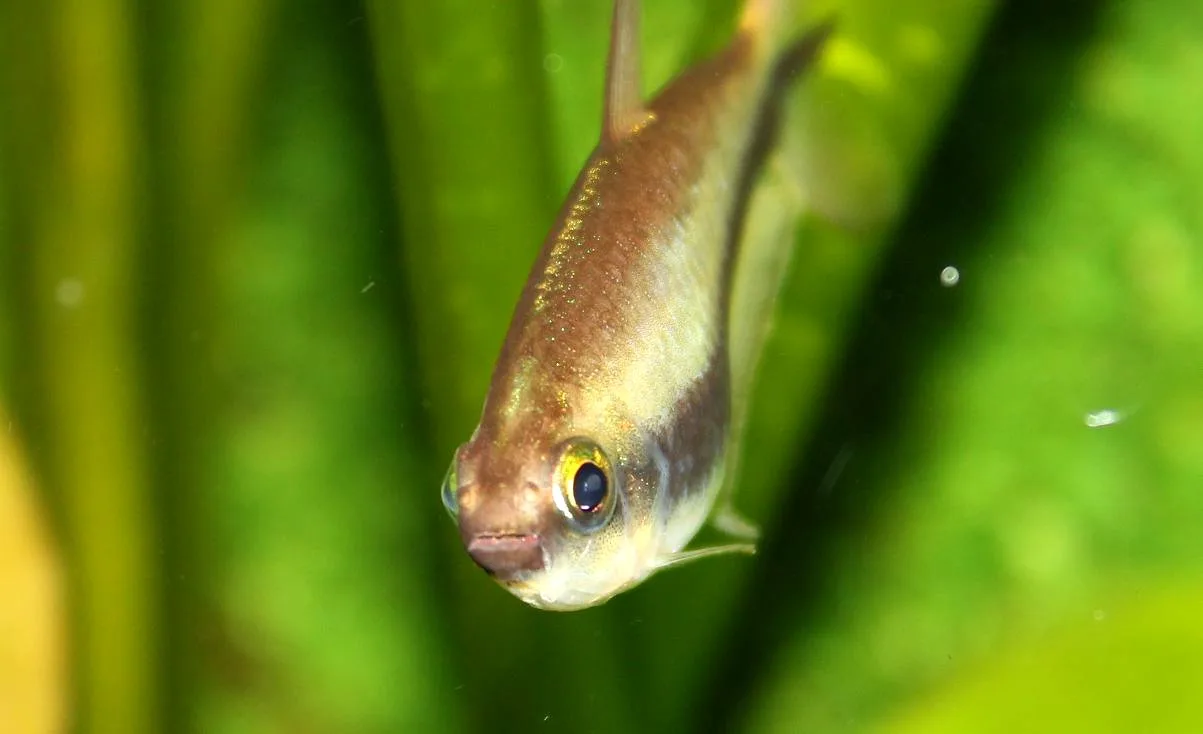
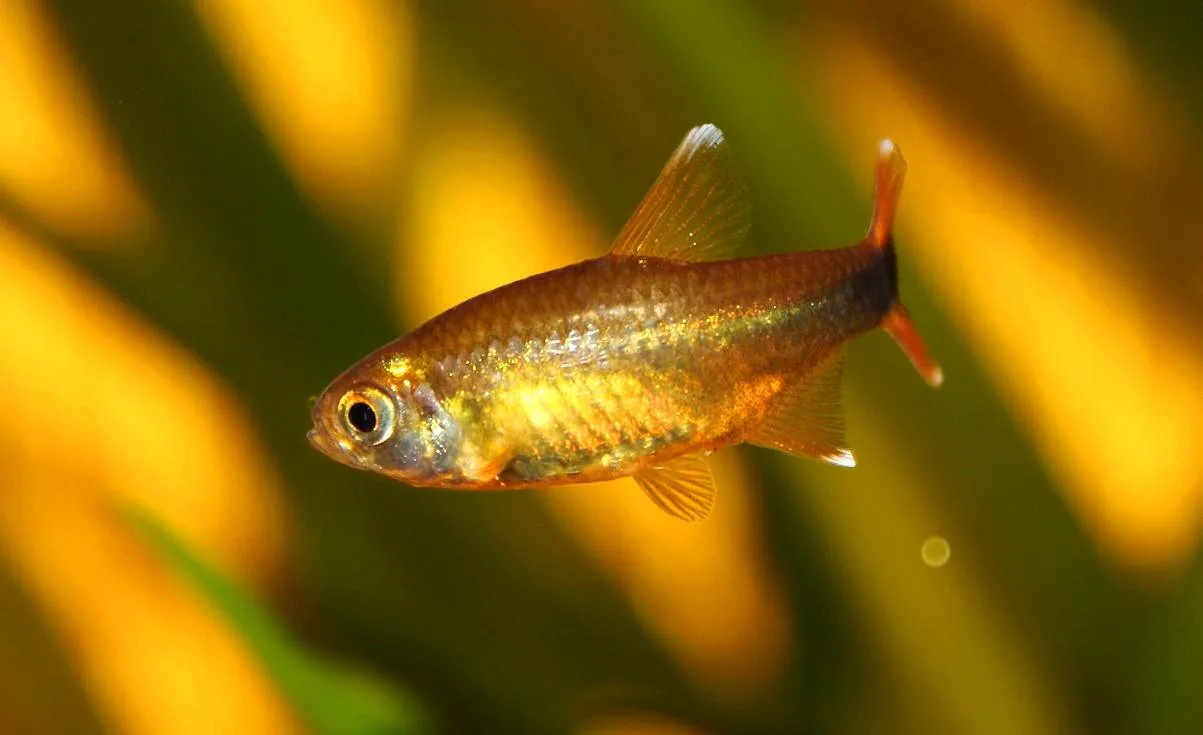
The serpae tetra was described in 1882 by Franz Steindachner as Chirodon eques. The type locality is Óbidos in the Brazilian Amazon. Later descriptions as Tetragonopterus callistus (Corumbá) and Hyphessobrycon serpae (Itacoatiara) are treated as synonyms. In September the rosy-tetra group was split off as the separate genus Megalamphodus. The catalogue name here remains Hyphessobrycon eques. The body is elongated, moderately deep and strongly compressed. Females are deeper-bodied. Length is four centimetres. Besides the reddish ground colour there is a drop-shaped black shoulder spot that can fade in older fish. The dorsal fin is red at the base and otherwise black with a white upper edge. The anal fin is red with a broad black margin and white leading rays. The other fins are red. The name “Serpa tetra” is incorrect for this species.
Features
The body is elongated, moderately deep and strongly compressed, at most 4 cm long, and females are deeper-bodied. A black, teardrop-shaped shoulder spot can fade in old fish. The dorsal fin is red at the base, otherwise black with a white upper edge, and the anal fin is red with a broad black margin and white first rays. Since 2024 the species has been placed in the genus Megalamphodus. The genus name comes from Greek and means roughly with spacious ways, perhaps after the large fontanelles. Eques means horseman and may refer to saddle-like marks.
Origin & habitat
This describes the origin, not how to furnish the aquarium.
The species lives in the Amazon basin, the lower Río Paraguay, the Rio Guaporé, the upper Río Paraná and tributaries of the Río Uruguay, in southern Brazil, Bolivia, Paraguay and Argentina. French Guiana is an introduction, not the native range. The fish prefer unshaded, lake-like waters and creeks in swampy floodplains, near plants along the bank but where the surface stays largely open. When threatened they flee into vegetation. Site measurements gave pH 5.5 to 7.6, carbonate hardness from below detection to about 7 °dH, and conductivity of 10 to 240 µS/cm. Tropical readings were mostly 24 to 30 °C. One Argentine site measured 6.3 °C in winter. That is a single field reading, not a keeping recommendation.
The species lives in the Amazon basin, the lower Río Paraguay, the Rio Guaporé, the upper Paraná and tributaries of the Uruguay, in southern Brazil, Bolivia, Paraguay and Argentina. It has been introduced to French Guiana. It prefers unshaded, lake-like waters and streams of wide swampy floodplains and stays in the shore zone near lush vegetation. Measured values were pH 5.5 to 7.6, carbonate hardness up to about 7 dH, 10 to 240 µS/cm and mostly 24 to 30 °C, in Argentina in winter even 6.3 °C. The IUCN lists the species as least concern.
Care
Community-tank care is usually unproblematic. Compared with other Hyphessobrycon the species is not always peaceful and shows aggression within the group. Weaker fish can be bitten, and eyes can be lost in fights. Causes are poor feeding or overcrowding: the fish are social and still need distance. An Austrian regulation is mentioned with a minimum of five fish. Most trade fish come from German breeding or Asian imports.
Diet
The husbandry passage names inadequate feeding as one explanation for bite injuries.
Behavior
Serpae tetras are group fish that still keep a minimum distance. Crowding and scarce food are linked with biting.
In a community tank the serpae tetra is usually unproblematic but less peaceful than related tetras. Occasionally there are fights among conspecifics in which weaker fish are bitten and may lose eyes. The usual causes are insufficient feeding or overstocking. The fish are gregarious but need distance from each other. In Austria at least five fish are required. Most fish in the trade come from German captive breeding or from Asia.
Gallery
More species in this group






Similar water needs
Species with a similar temperature, a similar pH and a comparable adult size. Whether their behaviour fits as well is what the compatibility check is for.