Emperor tetra
Nematobrycon palmeri
18 views
A tetra of about 5 to 8 cm. Care is comparatively straightforward.
- Temperature
- 23 – 27 °C
- pH
- 6.5 pH
- General hardness
- 3 – 15 °dH
- Maximum size
- 8 cm
- Minimum group size
- 8
- Minimum tank size
- 60 L
4 min read · 614 words
Fresh water
Quick facts
Place in the aquarium
Highlighted are the water layer and the spots where the species usually stays in the tank.
- Middle water Usually stays in the middle of the tank, between bottom and surface.
- Dense plants Looks for dense planting as cover, retreat or grazing ground.
Shrimp in the tank
Shrimplets at risk
- Not shrimp safe
- Dwarf shrimp at risk
- Shrimplets at risk
- Shrimp safe
- Adult dwarf shrimp
- Safe
- Shrimplets
- Get eaten
- Safe from shrimp size
- about 2 cm
Adult dwarf shrimp are usually safe from the emperor tetra. It grows to 5 to 8 cm and eats animal and plant food, from flakes to mosquito larvae. Shrimp from about 2 cm are too large for it. Young shrimp, however, are eaten when they get into midwater or onto open surfaces. Because the species eats its own eggs and fry survive only in dense growth, the same applies to young shrimp: Java moss and fine plants are a must in a shared tank.
Home & range
Hatched countries are where the species occurs. It lives in particular waters there, not across the whole country. The points name known waters for orientation, not collection sites.
- Country of origin
- Water for orientation
Native
- Colombia
- Range: the Chocó region with the Río San Juan and Río Atrato.
Overview
Adults reach about 5 to 8 cm. The trade is said to be supplied mostly by captive breeding. Dominant males can hold a territory. Do not combine them with very busy or aggressive fish.
Genus, name and features
The emperor tetra belongs to the family Acestrorhamphidae. It is the type species of the genus Nematobrycon, which Carl H. Eigenmann established in 1911. The genus is marked by the combination of a three-lobed tail fin with the absence of the adipose fin typical of characins. The species is named after Mervyn George Palmer, an English traveller who collected in Central and South America for the British Museum and caught the type specimen.
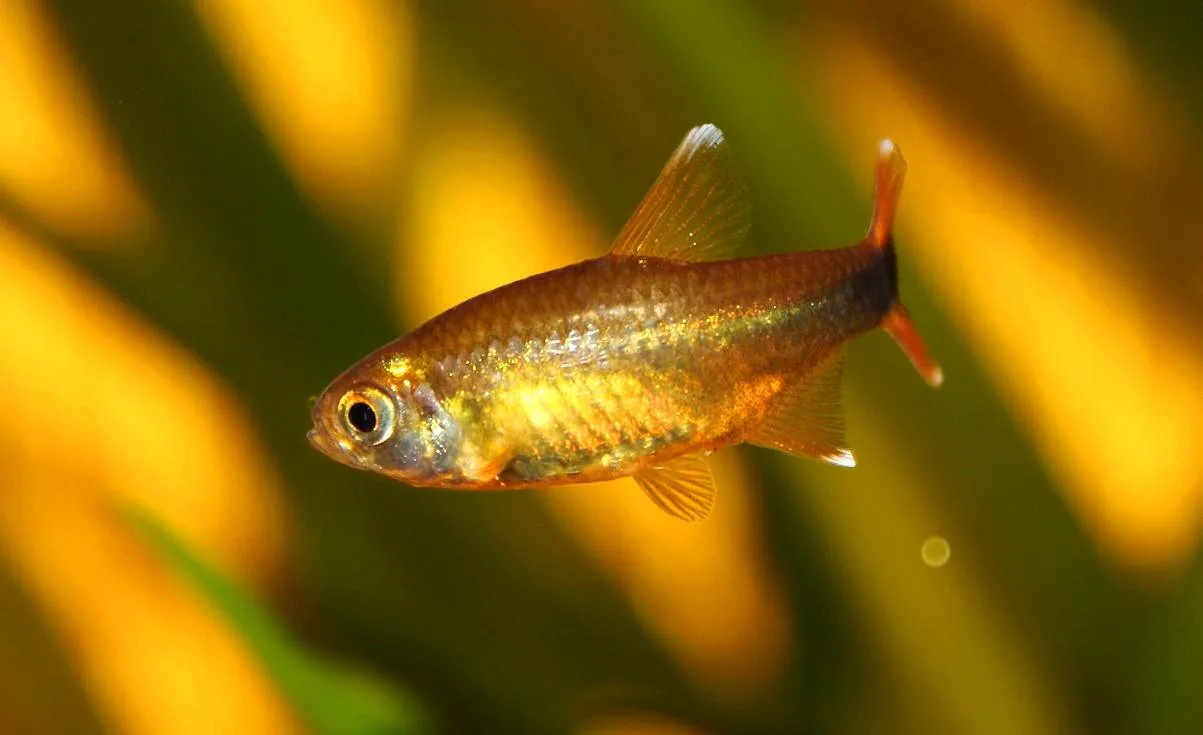
Above the lateral line runs an iridescent blue stripe with a black line inside it, which glows strongly depending on the fish's condition. The dorsal, pectoral and anal fins are yellow, and the dorsal fin is sickle-shaped. During courtship the male's belly glows purple-red. The violet tone shows better under floating plants and subdued light, while yellow dominates in light that is too bright.
Sexes
The iris is the most reliable sign: males have metallic blue eyes, females metallic green. Males also carry a three-pronged tail fin whose middle black stripe usually extends beyond the rest. In females it ends in the clear part of the fin. This feature sometimes misleads, because the middle prong can be damaged in territorial fights and dominant females occasionally grow an extension too. Males are larger and have longer anal fins.
Relatives and confusion
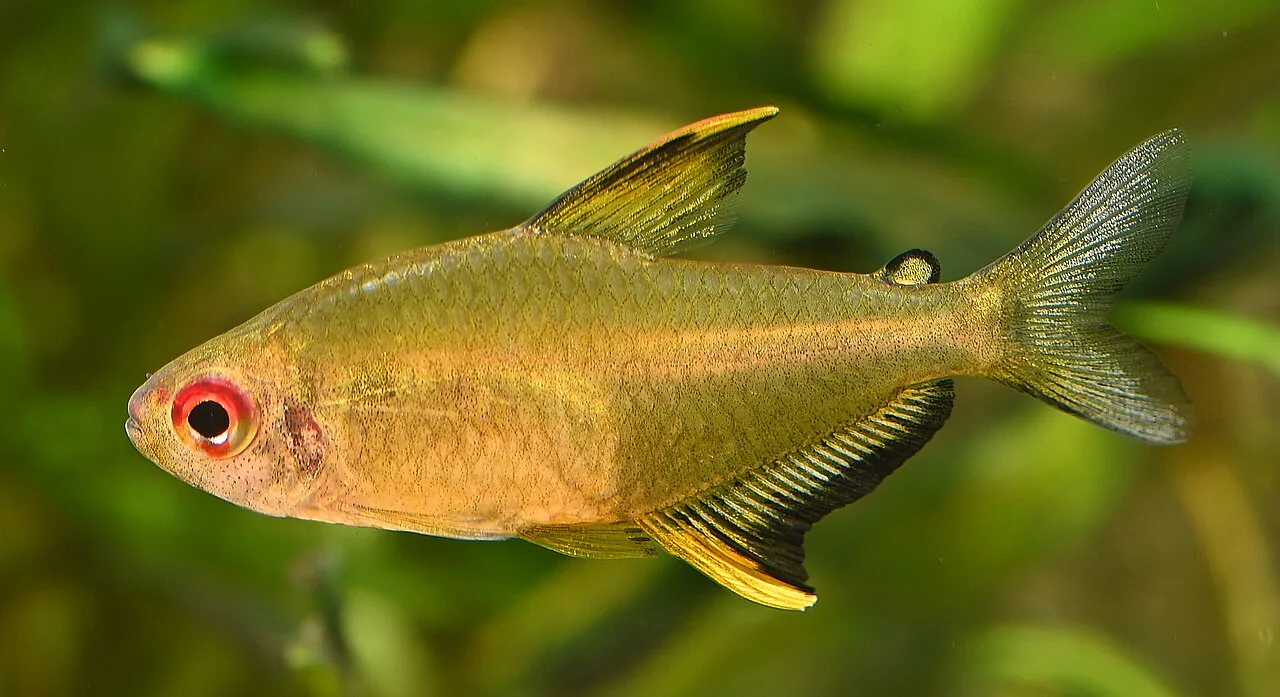
The genus has only one other species, the red-eyed emperor tetra Nematobrycon lacortei. Nematobrycon amphiloxus, described as a third species, is now regarded as a dark colour variant of palmeri. Albino forms also occur. The emperor tetra should not be confused with the royal tetra Inpaichthys kerri, which looks similar and carries similar names.
Origin & habitat
This describes the origin, not how to furnish the aquarium.
Origin and habitat
The species comes from the Chocó region of western Colombia and lives in the Río San Juan, the Río Atrato and their tributaries. Nematobrycon species inhabit small forest pools that connect to the upper reaches of rivers only during floods. Other accounts name the mouth areas of these river systems. Unknown populations are suspected in south-western Colombia.
Care
Groups of 8 to 12, a tank at least 70 cm long, and 23 to 27 °C.
pH 6.5, carbonate hardness of 3 to 6 °dKH and 23 to 27 °C are recommended. It describes the emperor tetra as a placid fish that is disturbed by more boisterous species. In the late 1950s the importer William A. Kyburz rediscovered the species, and from 1960 it reached the United States.
Diet
The emperor tetra eats animal and vegetable food. Flakes, pellets or food tablets suit as a staple, supplemented with live or frozen brine shrimp, daphnia and mosquito larvae.
Behavior
The group is the social unit. Some males are territorial. Very busy tankmates are discouraged.
The species schools less readily than most tetras, and a pair often seems more content. After a water change with fresh, cooler water, however, a larger group sometimes schools across the tank for minutes.
Reproduction
Breeding is described as relatively straightforward for a tetra, which is why captive-bred fish supply the trade. A spawning protocol is not given.
Breeding
Breeding works best in a densely planted, lightly stocked species tank with soft water. Well-fed pairs lay single eggs on plants after a courtship dance. Because the parents eat spawn, eggs and young survive better in dense growth such as Java moss. The young, about 2 mm long, are raised on fine dust food, and in large planted tanks they also find protozoa and algae, later sieved daphnia. Alternatively a courting pair goes into a small, densely planted spawning tank and is removed afterwards.
Gallery
More species in this group






Similar water needs
Species with a similar temperature, a similar pH and a comparable adult size. Whether their behaviour fits as well is what the compatibility check is for.