Lemon tetra
Hyphessobrycon pulchripinnis
18 views
A tetra for tanks from 80 cm, at 23 to 28 °C and in soft water at pH 5.5 to 7.5.
- Temperature
- 23 – 28 °C
- pH
- 5.5 – 7.5 pH
- General hardness
- 0 – 8 °dH
- Maximum size
- 5
- Minimum group size
- 6
- Minimum tank size
- 60 L
4 min read · 545 words
Fresh water
Quick facts
Further published values
- Lifespan
- 6 – 8 a
Place in the aquarium
Highlighted are the water layer and the spots where the species usually stays in the tank.
- Middle water Usually stays in the middle of the tank, between bottom and surface.
- Dense plants Looks for dense planting as cover, retreat or grazing ground.
Shrimp in the tank
Shrimplets at risk
- Not shrimp safe
- Dwarf shrimp at risk
- Shrimplets at risk
- Shrimp safe
- Adult dwarf shrimp
- Safe
- Shrimplets
- Get eaten
- Safe from shrimp size
- about 1.5 cm
The lemon tetra is compatible with adult dwarf shrimp. It grows to 5 cm and eats almost any food in the aquarium, especially live bloodworms. Shrimp from about 1.5 cm are too large for it. Young shrimp, on the other hand, are eaten, as these tetras even eat the eggs of their own kind. In a shared tank dense, fine-leaved plants and moss cushions help, as the young retreat into them. Anyone who wants to breed shrimp deliberately is better off raising the young in a separate tank.
Home & range
Hatched countries are where the species occurs. It lives in particular waters there, not across the whole country. The points name known waters for orientation, not collection sites.
- Country of origin
- Water for orientation
Native
- Brazil
- Range: the Rio Tapajós and the Amazon near Santarém.
Overview
Suitable are at least 80 cm of tank length, 23 to 28 °C and soft water at pH 5.5 to 7.5. A dark substrate and peat filtration, keeping the pH slightly acidic, makes the colour stronger.
Name
In German Hyphessobrycon pulchripinnis is mostly called Zitronensalmler.
Features
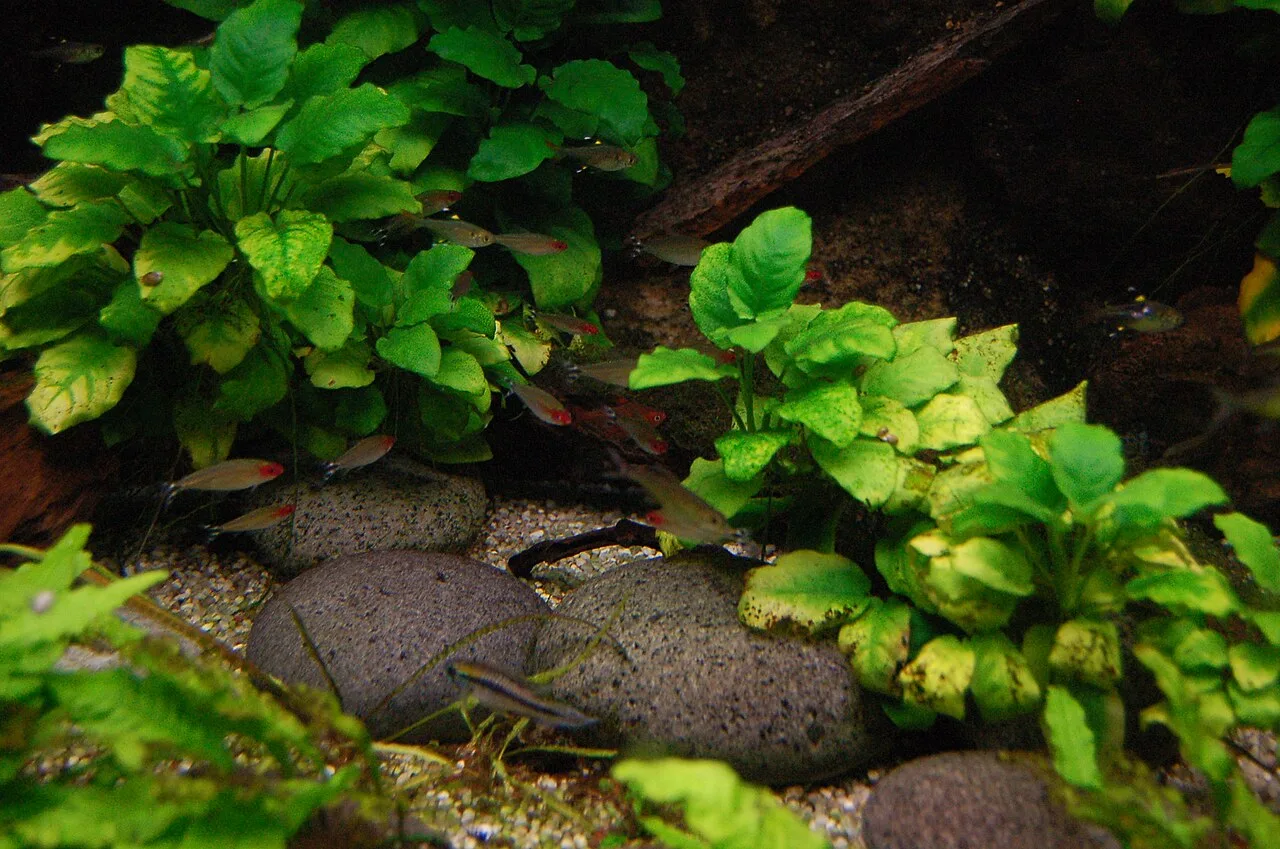
The species belongs to the family Acestrorhamphidae, grows to 5 cm and has been in the hobby since 1932. The base colour is a translucent yellow, with a pearly lustre in fine specimens. The anal fin is glass-clear with a black outer margin, and its front three or four rays are bright lemon yellow. The dorsal fin is mostly black with a yellow central patch. The upper half of the iris is a striking intense red. If this red fades or turns grey, it indicates serious disease.
The only reliable sex difference is the black border of the anal fin. In females it is a fine line, in males clearly wider. In courting dominant males it can cover up to a third of the fin.
Origin & habitat
This describes the origin, not how to furnish the aquarium.
Origin
The species was first collected in the basin of the Rio Tapajós near Santarém in Brazil. It lives in the Tapajós and the adjoining stretches of the Amazon where the two rivers meet. The waters are clear, moderately flowing, slightly acidic and low in minerals. The fish stay in shallow water near plant stands and form shoals of several thousand. The black and yellow pattern makes it hard for predators to follow a single fish.
Care
Tank length from 80 cm, 23 to 28 °C, soft water, pH 5.5 to 7.5. No volume in litres is given. Dark substrate and slightly acidic water are recommended for colour.
Keeping
The species does best in a planted tank in a group of six or more, and larger shoals are preferable. In a planted tank it colours up much more strongly. Soft water under 8 °dH at about pH 6.6 is preferred. The species is hardy, however, and tolerates pH 6.0 to 7.4 and 21 to 28 °C. High pH from 8 upwards and hard water mean dangerous stress. In the aquarium the fish live up to eight, typically about six years. Like other freshwater fish they are susceptible to white spot and fungal infections when water quality, food or stocking density are not right.
Diet
The lemon tetra readily eats any food offered. Live daphnia suit for conditioning, and live bloodworms are taken with particular relish.
Behavior
In a group the species shows its natural schooling behaviour. During courtship several males often chase one female and switch partners, which leads to wild pursuits in the tank.
Reproduction
Spawning
In the wild tens of thousands of pairs spawn at the same time in thickets of fine-leaved plants. To reduce competition for their own offspring, pairs eat the eggs of neighbouring pairs. In the aquarium this instinct turns against their own eggs. The male courts with quivering and a head-down posture in a sheltered spot. A large female can lay up to 300 eggs.
The breeding tank needs good filtration and aeration, fine-leaved plants and an egg trap. The temperature is raised slowly over a few days to 28 °C, and morning sunshine is a known trigger. At 28 °C the larvae hatch after about 72 hours and swim freely after another 24 to 48 hours. Then come infusoria and frequent small water changes, and after seven days newly hatched brine shrimp.
Gallery
More species in this group






Similar water needs
Species with a similar temperature, a similar pH and a comparable adult size. Whether their behaviour fits as well is what the compatibility check is for.