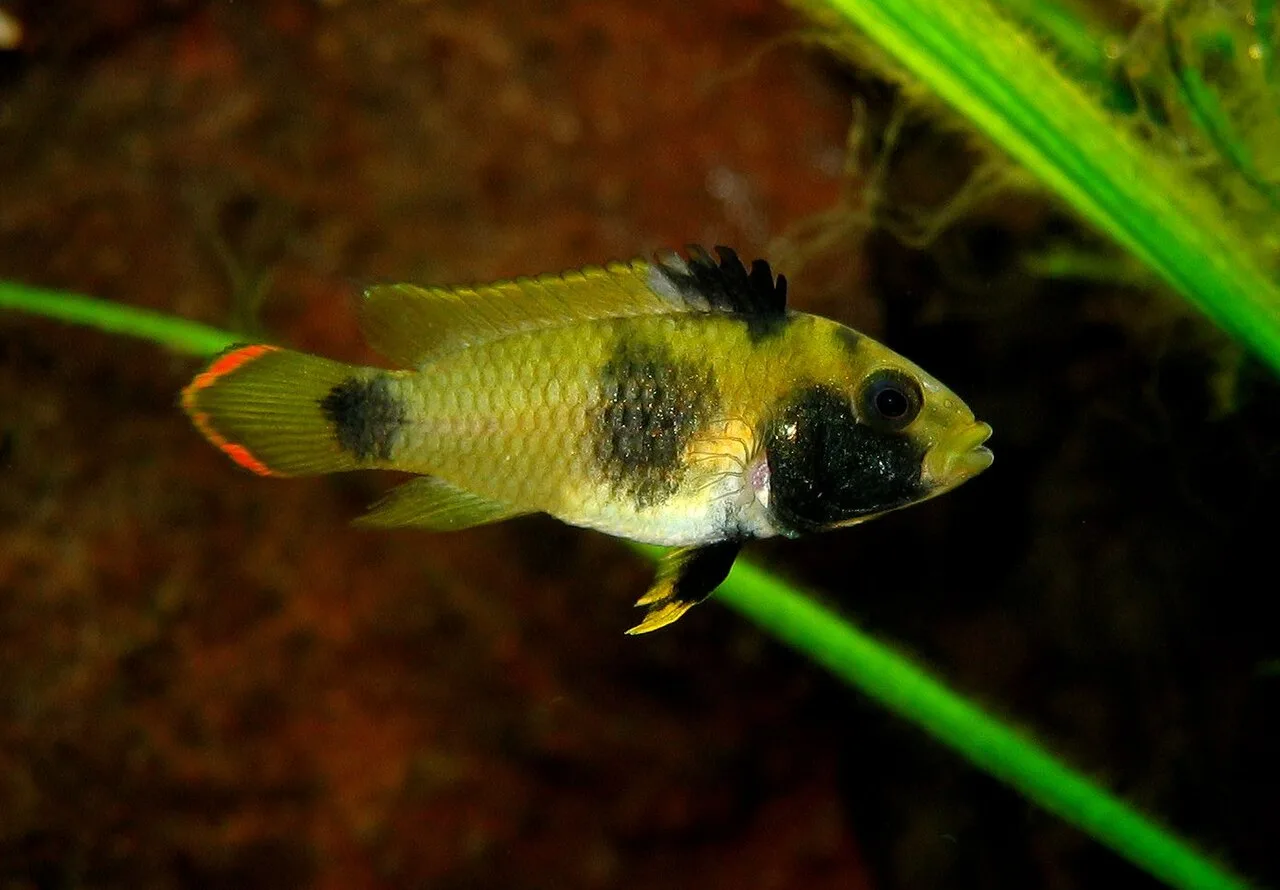
Marbled hatchetfish
Carnegiella strigata
17 views
Family values are not used as water values for this species.
- Temperature
- 24 – 28 °C
- pH
- 5.5 – 7 pH
- General hardness
- 2 – 10 °dH
- Maximum size
- 4 cm
- Minimum group size
- 6
- Minimum tank size
- 80 L
5 min read · 700 words
Fresh water
Quick facts
Place in the aquarium
Highlighted are the water layer and the spots where the species usually stays in the tank.
- Water surface Stays just below the surface. The top needs a calm current and a cover.
Shrimp in the tank
Shrimplets at risk
- Not shrimp safe
- Dwarf shrimp at risk
- Shrimplets at risk
- Shrimp safe
- Adult dwarf shrimp
- Safe
- Shrimplets
- Get eaten
- Safe from shrimp size
- about 1.5 cm
The marbled hatchetfish is compatible with adult dwarf shrimp. It grows to at most 3.5 cm and lives almost entirely just below the water surface, where it catches insects and small crustaceans. Shrimp from about 1.5 cm are too large for it, and it hardly searches the bottom anyway. Young shrimp climbing up floating plants or roots may be eaten. In a tank with moss and plants on the bottom the hatchetfish is one of the more shrimp-friendly characins.
Home & range
Hatched countries are where the species occurs. It lives in particular waters there, not across the whole country. The points name known waters for orientation, not collection sites.
- Country of origin
- Water for orientation
Native
Overview
Hatchetfishes are a family of nine species in three genera. The common and scientific names refer to the hatchet-shaped belly line. The back profile is almost level and the mouth is upturned. The shoulder girdle and pectoral muscles are greatly enlarged and can make up a quarter of the body weight. Carnegiella, unlike the other two genera, has no adipose fin. Family length is about 30 to 90 mm depending on the species. The fish can leave the surface. High-speed recordings contradict the idea of active flight with the pectoral fins: during the start the pectorals strike the water, the caudal fin provides thrust, and in the air it was mainly the caudal fin that moved. Whether that explains the distances seen in nature is unclear. The jump is treated as escape, not hunting.
Details on the species itself
In English Carnegiella strigata is called the marbled hatchetfish. Albert Günther described the species in 1864 as Gasteropelecus strigatus, without a locality. Carl H. Eigenmann placed it in the new genus Carnegiella in 1909 and made it the type species. The name honours Margaret Carnegie, the only daughter of Andrew Carnegie, whose museum co-funded Eigenmann's expedition to British Guiana in 1908. Strigata means furrowed and probably refers to four dark bands radiating from the middle of the throat.
The species reaches at most 3.5 cm standard length. The triangular body is golden silver, a pale stripe runs from head to tail, and a dark brown marbled pattern lies over it. Markings, body depth and fin ray counts vary between populations. In 1977 Jacques Géry reduced the described subspecies to two forms: the nominate form with a V pattern from the Guianas and the northern Amazon basin, and C. s. fasciatus with a Y pattern from most of the Amazon basin. There are intermediate forms in the Orinoco and Rio Negro.
A species swarm
In 2013 it emerged that the marbled hatchetfish is a swarm of closely related species that can hardly be told apart externally. The smaller blackwing hatchetfish sits genetically within this swarm and is more closely related to the population near Barcelos than that population is to the one in Acre. C. strigata will therefore have to be split into several species in future.
Origin & habitat
This describes the origin, not how to furnish the aquarium.
The family lives in South and Central America. Panama is named only for Gasteropelecus maculatus, not for Carnegiella. The other species occupy northern and central South America south to the Río de la Plata. Chile is absent. That is a family statement. Streams, rivers and floodplain waters are named, always close under a largely plant-free surface and near cover from plants or driftwood. Soft, mineral-poor, acid water with pH below 5 is common, but not universal: Carnegiella myersi also lives at about 15 °dH and pH up to 7.7. Temperatures can lie below 20 and above 30 °C depending on species and season. Those spans are not adopted as keeping values for C. strigata.
The species lives in the Amazon, the Orinoco and the coastal rivers of the Guianas, with records from Brazil, Bolivia, Peru, Ecuador, Colombia, Venezuela, Guyana, Suriname and French Guiana. The species apparently lives only in blackwater. In the Rio Negro system these are waters with dense, often overhanging bank vegetation and a bed covered with branches, roots and leaf litter. The water is acidic, soft, of low conductivity and stained brown by humic substances.
Care
What is documented is the tie to the surface and leaving the water when disturbed. A closed tank follows as a practical consequence. A litre figure does not.
Diet
The family hunts mainly small insects and spiders that fall on the surface, and insect larvae near the surface.
The species eats crustaceans and insects.
Behavior
Hatchetfishes live socially in larger groups, at times in schools.
The marbled hatchetfish lives in open water in groups near the surface. In the rainy season the fish move upstream into tributaries and the flooded forest to feed and spawn. Most fish in the trade are wild-caught from the Rio Negro in Brazil. The effect of this collecting on the population is unknown.
Reproduction
Egg scatterer. Breeding is uncommon.
Females have larger bellies than males. The eggs fall to the bottom or into the plants and hatch after 36 hours at 25 °C.
Gallery
More species in this group



Similar water needs
Species with a similar temperature, a similar pH and a comparable adult size. Whether their behaviour fits as well is what the compatibility check is for.