Panda dwarf cichlid
Apistogramma nijsseni
17 views
A dwarf cichlid with a very small known site on the Peru-Brazil border. 27.5 °C at that site is one measurement, not a care value.
- Temperature
- 25 – 26 °C
- pH
- 5.5 – 7 pH
- General hardness
- 2 – 10 °dH
- Maximum size
- 8 cm
3 min read · 459 words
Fresh water
Quick facts
Place in the aquarium
Highlighted are the water layer and the spots where the species usually stays in the tank.
- Near the bottom Mostly stays just above the bottom. Food has to reach the substrate.
- Dense plants Looks for dense planting as cover, retreat or grazing ground.
- Rocks and caves Needs caves, crevices or rockwork as hiding place, territory or spawning site.
Shrimp in the tank
Dwarf shrimp at risk
- Not shrimp safe
- Dwarf shrimp at risk
- Shrimplets at risk
- Shrimp safe
- Adult dwarf shrimp
- At risk
- Shrimplets
- Get eaten
- Safe from shrimp size
- about 4 cm
The panda dwarf cichlid is not safe for dwarf shrimp. It is a robust dwarf cichlid with a large head and well-developed jaws, and males reach about 8 cm. As a territorial fish it patrols the bottom around its cave, and shrimp are prey there.
Adult Neocaridina and Caridina are at risk, and baby shrimp are certainly eaten. Larger species such as Amano shrimp from about 4 cm are more likely to be left alone. Anyone who wants to breed dwarf shrimp keeps them separately.
Home & range
Hatched countries are where the species occurs. It lives in particular waters there, not across the whole country. The points name known waters for orientation, not collection sites.
- Country of origin
- Water for orientation
Native
Overview
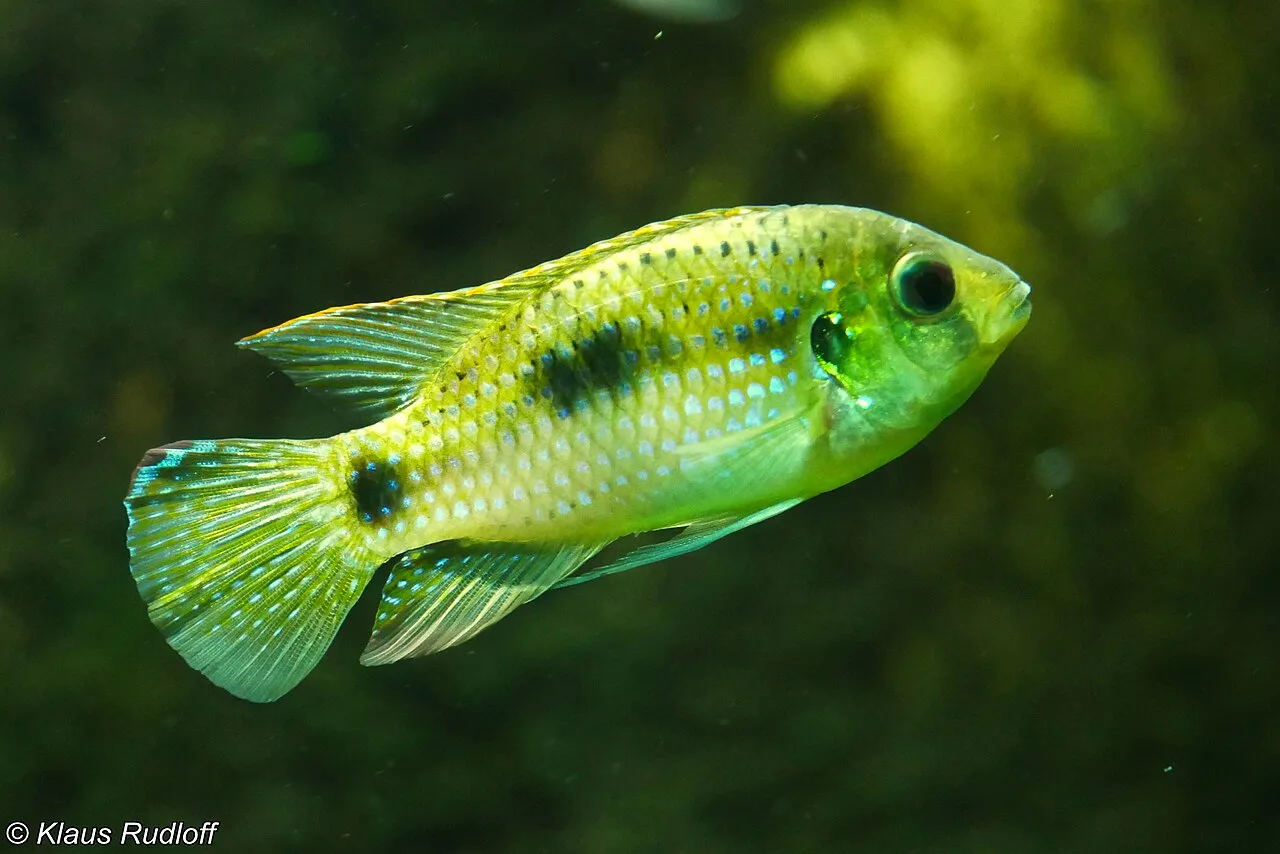
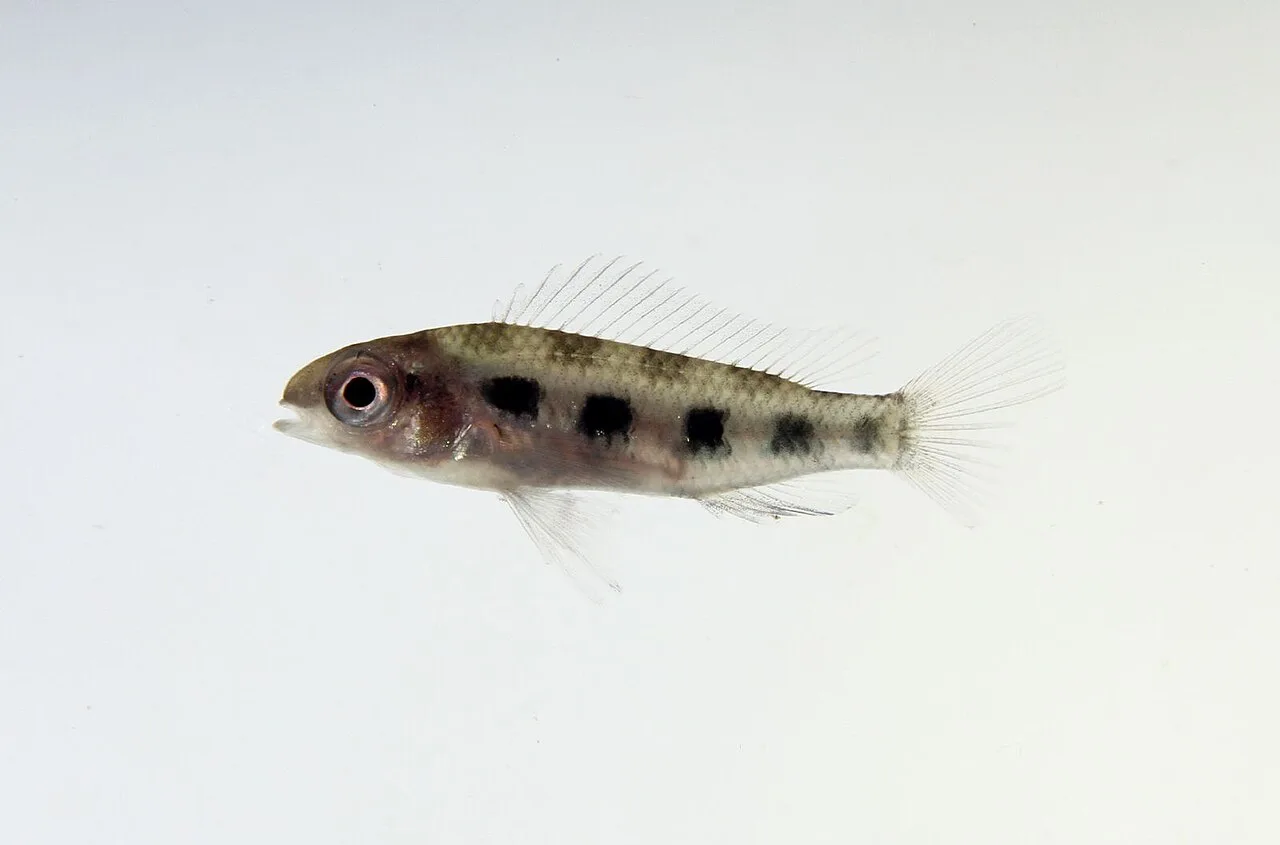
Males to 8 cm, yellow chest, red caudal margin, yellow pelvic fins, blue above. Females about 5 cm, bright yellow with large black spots.
Colour and sexes
The sexes are coloured very differently. Males have a yellow breast and belly, a round tail with a semicircular fiery red edge, bright yellow pelvic fins and a light to gentian-blue upper body. Females are bright yellow with large black patches, shown especially while guarding the eggs. Males can carry a similar pattern, usually hidden under a blue sheen. The lateral band is hardly visible except in juveniles.
Size figures differ: up to 8 cm for males and about 5 cm for females are given, but also only 3.9 cm standard length. The species belongs to the Apistogramma nijsseni group of robust, deep-bodied dwarf cichlids with a large head and fleshy lips. The dark gill membranes are spread in displays to make the head look larger.
Name
Sven O. Kullander described the species in 1979. The name honours the Dutch ichthyologist Han Nijssen of the Zoological Museum Amsterdam, who brought the fish to Kullander's attention. The IUCN lists it as data deficient, because only the type locality is known.
Origin & habitat
This describes the origin, not how to furnish the aquarium.
So far only a border post on the Ucayali. Water to 80 cm deep, leaves on the bottom, no underwater plants, very soft and acidic, 27.5 °C. Peru and Brazil stay coarse.
The species is known from the Río Copal at Jenaro Herrera in the Río Ucayali system, Loreto, Peru. The stream is up to 80 cm deep, the bottom covered in fallen leaves, and aquatic plants are absent. The water is very soft and acidic, and 27.5 °C was measured. Slow-flowing black water is also described.
Care
Rearing is said to stay under 25 °C, or the young are mostly males. That is a rearing note, not the adult keeping span.
The first fish reached Europe in the late 1970s and were bred, but the strains died out in the early 1980s. Only a second import in the 1990s brought the species into the trade for good. When raising the young the temperature should stay below 25 °C, because higher values give clearly more males.
Behavior
Cave spawner. Eggs are preferred on the cave ceiling.
Regan set up the genus Apistogramma in 1913. The name combines Greek apistos, inconstant, and gramme, line, and probably alludes to the variably developed lateral line. The nijsseni group contains at least nine described species and more than a dozen undescribed forms.
Reproduction
The first imports of the late 1970s died out as strains in the early 1980s. A second import followed in the 1990s.
The species is a cave spawner and prefers to lay the eggs on the ceiling of a cave. The female does the brood care and the male defends the territory. The young grow quickly.
Gallery
More species in this group

Similar water needs
Species with a similar temperature, a similar pH and a comparable adult size. Whether their behaviour fits as well is what the compatibility check is for.