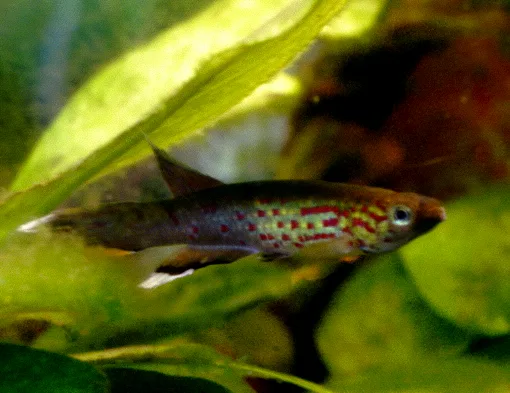
Neon tetra
Paracheirodon innesi
30 views
Small tetra from the western and northern Amazon. Blackwater and clear water, not whitewater.
- Temperature
- 20 – 26 °C
- pH
- 5 – 7 pH
- General hardness
- 6 – 15 °dH
- Maximum size
- 4 cm
- Minimum group size
- 8
- Minimum tank size
- 60 L
4 min read · 592 words
Fresh water
Quick facts
Further published values
- Lifespan
- 3 – 4 a
Place in the aquarium
Highlighted are the water layer and the spots where the species usually stays in the tank.
- Middle water Usually stays in the middle of the tank, between bottom and surface.
- Dense plants Looks for dense planting as cover, retreat or grazing ground.
Shrimp in the tank
Shrimplets at risk
- Not shrimp safe
- Dwarf shrimp at risk
- Shrimplets at risk
- Shrimp safe
- Adult dwarf shrimp
- Safe
- Shrimplets
- Get eaten
- Safe from shrimp size
- about 1.5 cm
Adult dwarf shrimp are safe from the neon tetra. At 3.5 to 4 cm long and with a small mouth it cannot swallow shrimp from about 1.5 cm. Newly hatched young shrimp, on the other hand, fit its prey range exactly, since it eats small invertebrates. In a community tank only part of the young therefore survive. Neon tetras prefer midwater and stay in small groups. Dense moss cushions, fine-leaved plants and leaf litter give the young shrimp enough refuge.
Home & range
Hatched countries are where the species occurs. It lives in particular waters there, not across the whole country. The points name known waters for orientation, not collection sites.
- Country of origin
- Water for orientation
Native
Overview
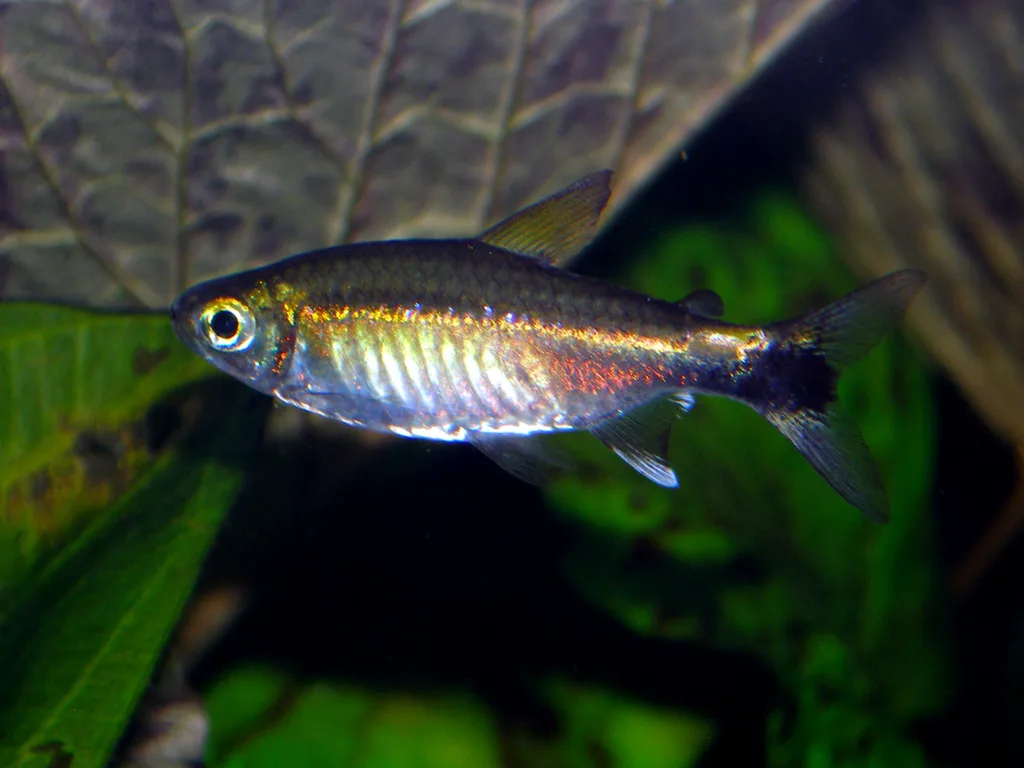
Adults reach about 3.5 to 4 cm. A blue-green stripe runs from the snout to the adipose fin, and the red begins near the middle of the body. At night the stripe darkens and the red fades, which is linked to the iridophores. Farmed fish from Southeast Asia dominate the trade. Veil, gold and albino colours are cultivated forms, not separate species. Calm tankmates fit better than fish that take the food first.
Name, classification and history
In German the neon tetra is also called Neontetra or Neonfisch, and synonyms are Cheirodon innesi and Hyphessobrycon innesi. The species name honours William T. Innes (1874–1969), editor of the magazine The Aquarium. The species belongs to the family Acestrorhamphidae and the subfamily Megalamphodinae, with many species adapted to blackwater. After the goldfish and the guppy it is one of the best-known ornamental fish. The fin formula is dorsal 2/, anal 3/17–18 and pectoral 1/11–12, with 32 to 33 scales along the lateral line.
Auguste Rabaut brought the first fish from Iquitos to Europe in the 1930s. Thirteen live neons reached the Lepant company in Paris and were sold in 1935 for 6,500 US dollars to Hugo Schnell and Walter Griem in Hamburg. In 1936 five fish flew on the Zeppelin Hindenburg to the Shedd Aquarium in Chicago. In the same year George Sprague Myers described the species. Werner Ladiges called it the swimming gold of the Rio Ucayali because of its value. Later the first successful breeding took place in Thuringia.
About two million fish a month are sold in the United States. In the tri-border region near Leticia and Tabatinga the neon tetra is the most common fish species. Besides veil, gold and albino forms there is the diamond-head neon.
Origin & habitat
This describes the origin, not how to furnish the aquarium.
Named waters are the Putumayo, the upper Amazon from Loreto near Iquitos to São Paulo de Olivença, parts of the Purus, and the Ucayali, Marañón, Napo and Caquetá, in Peru, Colombia and Brazil. The fish stand along shaded banks. The habitat spans about 20 to 28 °C and pH 4 to 7.5 at low hardness. That is the habitat, not an aquarium recipe. None of the countries is filled, because no tighter geometry exists. Introduced populations in Singapore and the United States are not mapped.
Care
Keeping is set at 20–26 °C and pH 5–7, tanks from about 60 litres and groups from eight. That sits inside the shared habitat span. The aquarium advice does not agree: one account gives about 22–24 °C, pH 6–7 and tanks from about 38 litres, the other groups of ten to twenty even in 50 litres. Dim light and a partly covered surface fit both. On age, one account says up to six years in captivity, the other usually two to three and rarely up to ten.
Diet
The mouth takes small invertebrates. Flakes, brine shrimp, mosquito larvae and daphnia fit, better as several small feeds than one large meal.
Behavior
Neon tetras form small parties that stay in sight of each other, not a tight ball. Larger crowds appear mainly when the fish are threatened. Males can spar briefly when space is short. Serpae and black-skirt tetras outcompete them for food. Bristlenose catfish and peaceful barbs are named as compatible. The fish use the middle of the water.
Reproduction
Egg scatterer without brood care. For breeding, the water should be under 0.3 °KH, with humic substances and pH 6.2–6.8, spawning at 23–24 °C and then 18–22 °C, often at dusk on fine moss. Other figures give different breeding targets. The parents are removed afterwards. Fish kept for a long time in hard water often stop spawning. Neon tetra disease, caused by Pleistophora, breaks the blue stripe. Affected fish should be separated.
Gallery
More species in this group



Similar water needs
Species with a similar temperature, a similar pH and a comparable adult size. Whether their behaviour fits as well is what the compatibility check is for.