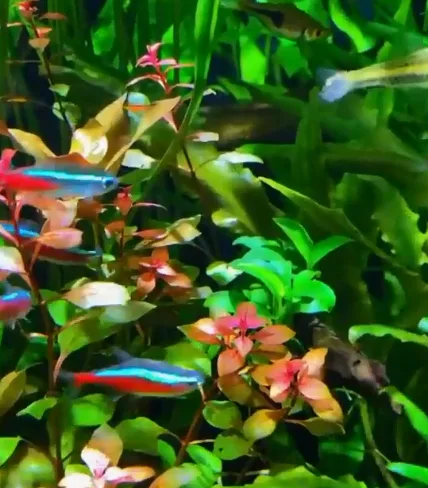
Costello tetra
Hemigrammus hyanuary
19 views
A Hemigrammus, not a Paracheirodon. The trade name green neon means this species here.
- Temperature
- 22 – 26 °C
- pH
- 6 – 7 pH
- General hardness
- 2 – 15 °dH
- Maximum size
- 4 cm
- Minimum group size
- 8
- Minimum tank size
- 60 L
2 min read · 316 words
Fresh water
Quick facts
Further published values
- Lifespan
- 4 – 6 a
Place in the aquarium
Highlighted are the water layer and the spots where the species usually stays in the tank.
- Middle water Usually stays in the middle of the tank, between bottom and surface.
- Open swimming space Needs an open area without plants or decor to swim at length. Tank length matters more than height.
Shrimp in the tank
Shrimplets at risk
- Not shrimp safe
- Dwarf shrimp at risk
- Shrimplets at risk
- Shrimp safe
- Adult dwarf shrimp
- Safe
- Shrimplets
- Get eaten
- Safe from shrimp size
- about 1.5 cm
The green neon tetra is compatible with adult dwarf shrimp. At about 4 cm with a small mouth it cannot eat shrimp from about 1.5 cm. As a peaceful schooling fish in midwater it hardly disturbs the animals on the bottom. Newly hatched young shrimp, however, are welcome live food as soon as they venture into the open. In a shared tank dense moss cushions, roots with Java fern and some leaf litter help enough young to grow up. Anyone who wants to raise many young shrimp keeps them in a separate tank.
Home & range
Hatched countries are where the species occurs. It lives in particular waters there, not across the whole country. The points name known waters for orientation, not collection sites.
- Country of origin
- Water for orientation
Native
Overview
4 cm, deeper-bodied than the true neon tetras. Yellowish to olive, a greenish to yellowish iridescent band, belly silver.
Names and relationships
The green neon is also known as the Costello tetra, and in English as the January tetra, after Lake Hyanuary. Despite its name it does not belong to the neon tetras of the genus Paracheirodon. The dorsal fin has 11 rays and the anal fin 14 to 16. The longitudinal band runs from the upper edge of the gill cover to the base of the tail.
It was described in 1918 by the American ichthyologist Marion Durbin, and the type locality is Lake Hyanuary in Brazil. The genus Hemigrammus is not a natural lineage. Since 2024 its parts have even been assigned to different subfamilies of the Acestrorhamphidae. The green neon is placed in the subfamily Hyphessobryconinae, together with Hemigrammus levis, Moenkhausia ceros and Macropsobrycon xinguensis. The type species of the genus, Hemigrammus unilineatus, belongs to the Pristellinae instead. Older classifications still place the species in the Pristellinae.
Golden sheen in wild fish
Wild-caught fish carry a striking golden sheen on their scales. It is caused by a parasite from the native range. Captive-bred fish do not show this sheen but silvery iridescent scales like many other characins.
Origin & habitat
This describes the origin, not how to furnish the aquarium.
Middle and upper Amazon from Iquitos to São Paulo de Olivença and Lake Hyanuary at Manaus. Peru and Brazil stay coarse.
Care
A peaceful schooling fish, also for community tanks.
The green neon is undemanding and therefore suitable for aquariums without restriction, including community tanks. It is rather uncommon in the trade.
Diet
In the aquarium it is fed flakes, pellets and live food.
Reproduction
Spawns at dusk. The male swims under the female. Hatch after 24 hours, free-swimming after six days.
During courtship the male swims below the female, follows her movements and presses closely against her side during egg laying. After hatching, six days pass before the young swim freely.
More species in this group



Similar water needs
Species with a similar temperature, a similar pH and a comparable adult size. Whether their behaviour fits as well is what the compatibility check is for.