Black tetra
Gymnocorymbus ternetzi
34 views
A deep-bodied, peaceful schooling tetra that reaches about 5.5 cm. The black colour fades with age.
- Temperature
- 24 – 28 °C
- pH
- 6 – 7 pH
- General hardness
- 4 – 20 °dH
- Maximum size
- 5.5 cm
- Minimum group size
- 8
- Minimum tank size
- 80 L
3 min read · 389 words
Fresh water
Quick facts
Place in the aquarium
Highlighted are the water layer and the spots where the species usually stays in the tank.
- Middle water Usually stays in the middle of the tank, between bottom and surface.
- Open swimming space Needs an open area without plants or decor to swim at length. Tank length matters more than height.
Shrimp in the tank
Shrimplets at risk
- Not shrimp safe
- Dwarf shrimp at risk
- Shrimplets at risk
- Shrimp safe
- Adult dwarf shrimp
- Safe
- Shrimplets
- Get eaten
- Safe from shrimp size
- about 2 cm
Adult dwarf shrimp are usually safe with the black tetra. It grows up to 5.5 cm, is a good eater and in the wild takes small crustaceans, insects and worms. Shrimp from about 2 cm are too large for it. Juvenile and very small shrimp are eaten, however.
The school stays in midwater and hardly searches the bottom. Moss, fine plants and leaf litter on the bottom protect the young. For productive shrimp breeding a separate tank is the better choice.
Home & range
Hatched countries are where the species occurs. It lives in particular waters there, not across the whole country. The points name known waters for orientation, not collection sites.
- Country of origin
- Water for orientation
Native
Overview
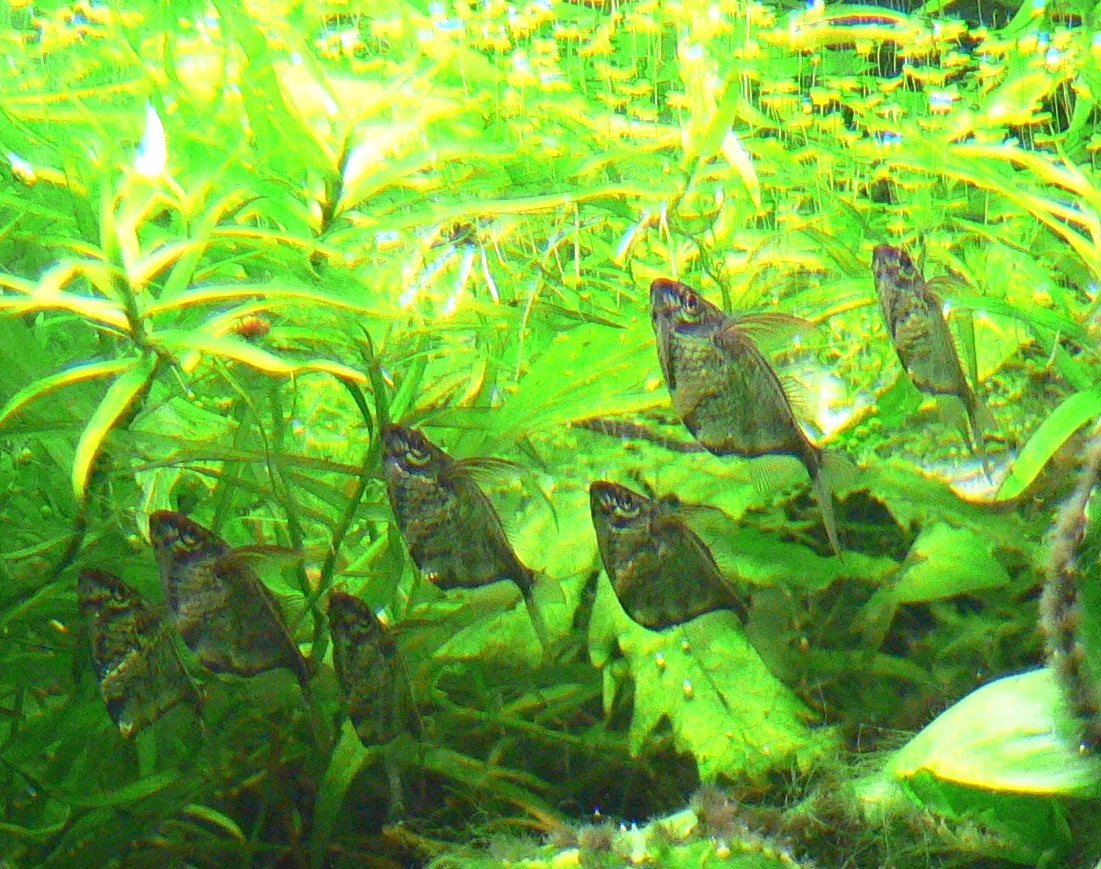
The body is deep and laterally compressed. Males stay smaller. Young fish have a black rear half. With age that black turns grey, often sooner in females. Two dark bars sit on the front half, and another crosses the eye.
Name and features
George Albert Boulenger described the species in 1895. It is named after Carl Ternetz, who first caught the fish. Today it is placed in the family Acestrorhamphidae. The first cross band lies right behind the gill cover, the second level with the start of the dorsal fin. In juveniles not only the rear half of the body but also the dorsal, anal and adipose fins are deep black, while the pelvic and caudal fins are light. The dorsal fin has 11 to 12 rays, the anal fin 40 to 42. The middle longitudinal row has 32 to 36 scales.
Origin & habitat
This describes the origin, not how to furnish the aquarium.
The species occurs in the Paraguay and Guaporé systems in Bolivia and in the middle Paraná in Argentina.
Care
Length is up to about 5.5 cm. They are peaceful schooling fish.
A school, not a single fish
The black tetra reaches about 5 cm and carries the black anal fin that gives it the German name. The colour holds only in a group from eight, at 22 to 26 °C and in a tank from about 80 litres. A single fish turns pale and shy or, the other way, nips long fins. Several males spread the small scuffles.
Dim light, plants at the edge and an open middle show the silvery body and the black fin. In a bare, glaring tank the species looks grey.
Diet
Omnivore. Flakes, fine granules and small frozen food, in several portions, so the fish at the back also arrive. A plant share belongs in the diet. Mosquito larvae alone make the fish fat quickly.
Behavior
Keeping
The species reached Europe as an aquarium fish in 1935 and is now a standard item in the trade. There is a long-finned and a golden breeding form. The fish are good eaters and also swallow small flies. The Austrian animal keeping regulation requires at least five fish and a tank of at least 60 × 30 × 30 cm for this species, with 18 to 28 °C, 0 to 30 °dGH, pH 6.0 to 8.0 and at most 50 mg/l nitrate. These are one country's legal minimums, not a biological recommendation.
Reproduction
Peaceful schooling fish. No minimum number is given.
Breeding is considered not very difficult but needs some preparation.
Gallery
More species in this group





Similar water needs
Species with a similar temperature, a similar pH and a comparable adult size. Whether their behaviour fits as well is what the compatibility check is for.