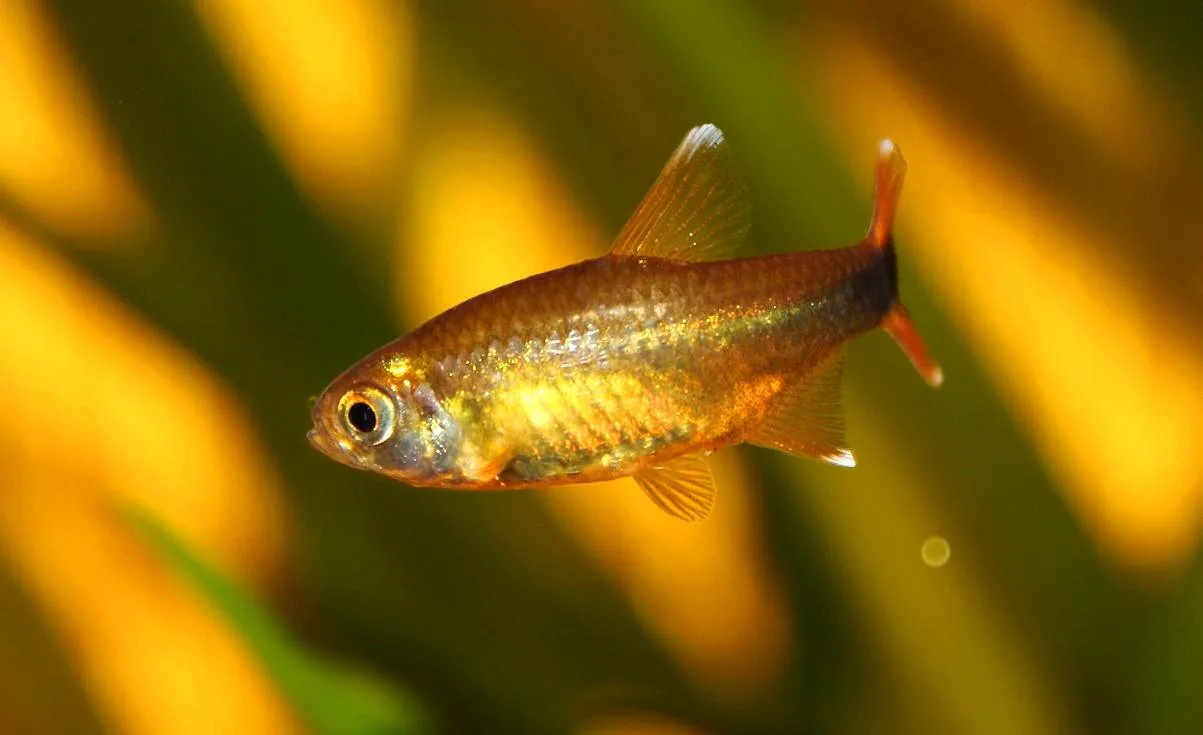
Pearl gourami
Trichopodus leerii
22 views
The most colourful of the eastern gouramis, with a pearly scale pattern and a bubble nest at the surface.
- Temperature
- 24 – 28 °C
- pH
- 6 – 7.5 pH
- General hardness
- 4 – 20 °dH
- Maximum size
- 12 cm
- Minimum tank size
- 150 L
5 min read · 692 words
Fresh water
Quick facts
Place in the aquarium
Highlighted are the water layer and the spots where the species usually stays in the tank.
- Upper water Usually stays in the top third of the tank.
- Middle water Usually stays in the middle of the tank, between bottom and surface.
- Dense plants Looks for dense planting as cover, retreat or grazing ground.
Shrimp in the tank
Dwarf shrimp at risk
- Not shrimp safe
- Dwarf shrimp at risk
- Shrimplets at risk
- Shrimp safe
- Adult dwarf shrimp
- At risk
- Shrimplets
- Get eaten
- Safe from shrimp size
- about 4 cm
The pearl gourami is a risk for dwarf shrimp. It grows to 12 cm and feeds on molluscs, small crustaceans, insects and their larvae. With its pelvic fins, modified into feelers, it searches plants and hiding places. Young shrimp are eaten, and smaller adult dwarf shrimp often too. Larger shrimp from about 4 cm are usually safe. In a large, densely planted tank Amano shrimp can live well with the peaceful gourami, while dwarf shrimp are better kept separately.
Home & range
Hatched countries are where the species occurs. It lives in particular waters there, not across the whole country. The points name known waters for orientation, not collection sites.
- Country of origin
- Water for orientation
Native
- Malaysia
- The origin text names the Malay Peninsula, Sumatra and Borneo.
Overview
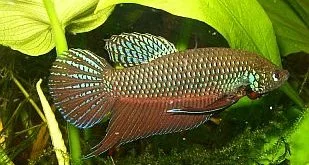
Trichopodus leerii, synonym Trichogaster leerii, reaches twelve centimetres and is the smallest of the five eastern gouramis. Females have a silver-grey throat and belly, a short dorsal fin and rounded unpaired fins. The scales are silvery with a brown edge. The edge grows stronger toward the back, so a mosaic forms and continues into the unpaired fins. An irregular dark-brown band runs from the snout to the caudal base. Males can reflect silver to pale blue. Throat, the pelvic fins transformed into filaments, belly and the spiny part of the anal fin are red-orange. The dorsal fin is longer and can reach the start of the caudal fin. Soft rays of the unpaired fins grow out as filaments.
Males and names
Males are generally larger and more colourful than females. Their throat glows orange and becomes even brighter during courtship. The fins other than the tail fin also carry an orange tinge. Males have longer fins, a more pointed dorsal fin and extended anal fin rays. In English the species is called pearl gourami, lace gourami or mosaic gourami. The fin formula is dorsal V–VII/8–10 and anal XII–XIV/25–30.
Classification
Pieter Bleeker described the species in 1852 as Trichopus leerii from Palembang on Sumatra. The holotype is lost. It is named after his friend, the physician J. M. Leer, who collected the type specimen. According to a ruling of the nomenclature commission, the spelling leeri with only one i is not correct. The genus name means hair foot and refers to the thread-like pelvic fins.
Origin & habitat
This describes the origin, not how to furnish the aquarium.
Because gouramis are food fish in Southeast Asia, people spread them before the scientific description. The original range is therefore no longer certain. Today Borneo, Sumatra and the south of the Malay Peninsula are regarded as the range. The fish occupy shallow zones of still and slow, clear, soft and slightly acid water, shaded or densely weeded. Unlike their sister species they are rarely found in rice fields and irrigation ditches. Malaysia stays a coarse origin, because the peninsula is not the whole national territory. Sumatra and Borneo have no geometry of their own here.
The homeland is Thailand, Malaysia and Indonesia with Sumatra and Borneo, and the habitat acidic lowland swamps.
Care
What is documented is clear, soft, slightly acid water and dense vegetation or shade. Since 1933, the first import by the Härtel breeding farm in Dresden, the fish have been in the trade. What is sold are captive-bred fish from Thailand, Malaysia and Singapore. Very large, especially colourful animals offered occasionally have been treated with growth hormone and are not fertile. Live and freshly dead fish belong to the market supply at home.
Diet
The food consists of molluscs, small crustaceans, insects and their larvae.
Behavior
Breeding males defend a territory around the bubble nest. Outside that time no rank order is known.
Reproduction
The nest consists only of air bubbles coated with a mouth secretion. It rises little above the surface, but during care it can grow to 30 cm² and more. Spawning and fertilisation happen in embraces under the nest. The light eggs rise and the male gathers them in one place. Development takes one to one and a half days. After two to four days the larvae leave the nest and the care, which is done only by the male, ends. Some males spit sand into the nest, and it forms a small mound underneath. In Malaysian breeding farms the species is, according to Dieter Vogt’s report, bred in complete darkness, in shallow tubs with banana leaves under dark sheeting.
Two peculiarities
Two observations set the pearl gourami apart from all other gouramis. Jörg Vierke and Robert Donoso-Büchner both describe some males taking sand into the mouth and spitting it into the bubble nest. The sand trickles to the bottom and forms a small mound beneath the nest. The biologist Dieter Vogt reports that breeders in Malaysia propagate the species in complete darkness: in large tubs with low water, in which banana leaves are placed and which are completely covered with dark sheeting.
In its homeland live and fresh pearl gouramis are part of the daily offer at fish markets.
Gallery
More species in this group

Similar water needs
Species with a similar temperature, a similar pH and a comparable adult size. Whether their behaviour fits as well is what the compatibility check is for.