
Croaking gourami
Trichopsis vittata
21 views
A labyrinth fish that croaks audibly while courting. It stays larger than the sparkling gourami and needs a quiet, planted tank.
- Temperature
- 24 – 28 °C
- pH
- 6 – 7.5 pH
- General hardness
- 5 – 19 °dH
- Maximum size
- 7 cm
- Minimum tank size
- 80 L
6 min read · 951 words
Fresh water
Quick facts
Place in the aquarium
Highlighted are the water layer and the spots where the species usually stays in the tank.
- Middle water Usually stays in the middle of the tank, between bottom and surface.
- Dense plants Looks for dense planting as cover, retreat or grazing ground.
Shrimp in the tank
Dwarf shrimp at risk
- Not shrimp safe
- Dwarf shrimp at risk
- Shrimplets at risk
- Shrimp safe
- Adult dwarf shrimp
- At risk
- Shrimplets
- Get eaten
- Safe from shrimp size
- about 4 cm
The croaking gourami is a risk for dwarf shrimp. It grows to 7 cm and mainly eats insects and insect larvae, as well as zooplankton and crustaceans, and in the aquarium also shrimp meat. It likes to prowl among reeds and under leaves and so comes across shrimp. Young shrimp are eaten, and small adult dwarf shrimp often too. Larger shrimp from about 4 cm are usually safe. A stable group of dwarf shrimp is better kept in a separate tank.
Home & range
Hatched countries are where the species occurs. It lives in particular waters there, not across the whole country. The points name known waters for orientation, not collection sites.
- Country of origin
- Water for orientation
Native
Overview
Trichopsis vittata reaches about 6 to 7 cm. The body is brown with dark longitudinal stripes and blue spots on the fins. Males have the longer anal fin and croak louder. The sound is made by tendons over bone, not by the gills. The thread fins are short but present.
The species is not Trichopsis pumila. The sparkling gourami stays at 4 cm and sparkles more strongly. Anyone who mixes the two gets two sizes and two territories in a tank that was usually planned for one species.
Features
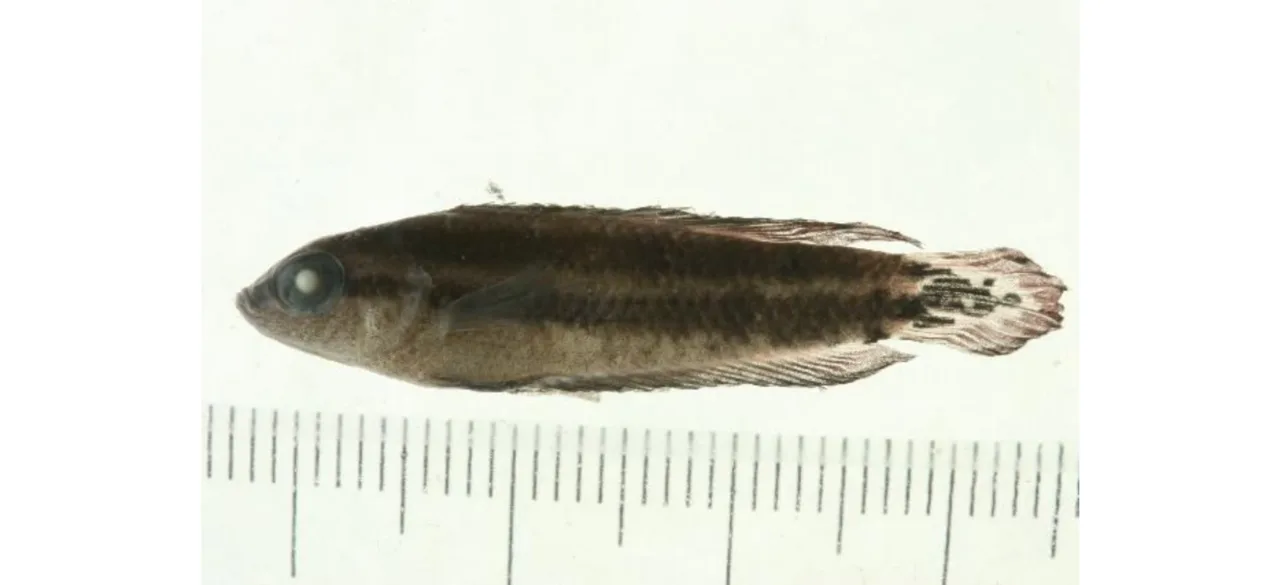
The specific name vittata means banded. At up to 7 cm the croaking gourami is the largest taxon of the genus, but usually stays much smaller. On average the fish grow 3.1 to 3.8 cm. Usually three dark continuous stripes run across the blunt, flat body, the middle one from below the mouth to the tail fin. Some fish have a fourth, shorter stripe below the dorsal hump. A dark line below the eye is regarded as diagnostic. One or two dark spots often sit behind the gill cover.
The base colour is yellowish to brownish, the back darker and the belly yellowish white. Freshly caught wild fish often shimmer emerald green at the rear. The unpaired fins are drawn out, and the anal fin can reach the end of the tail fin. They are reddish to violet or bluish with red and green dots. The iris is bright blue or purple. Females are paler than males.
A species complex
Molecular studies by Panijpan and colleagues in 2015 and by Norén and colleagues in 2017 suggest that up to four cryptic species hide under the name. Populations on Sumatra, Borneo and Java could be a separate species, Trichopsis striatus. According to these studies, the fish traded in Europe come from central and western Thailand. Hybrids between T. vittata females and pygmy gourami males have been documented in the wild.
Origin & habitat
This describes the origin, not how to furnish the aquarium.
Plant-rich ditches, swamps and rice fields in Thailand, Vietnam and the neighbouring countries. Warm, often soft water, little current, a lot of cover at the surface. The countries stay a coarse origin.
The habitat is still. An open current tank with few plants shows a shy fish standing under the filter.
The species is the most widespread taxon of the genus and occurs in Cambodia, Indonesia, Laos, Malaysia, Singapore, Thailand and Vietnam. It prefers shallow, often temporary, plant-rich waters with seasonal flooding. Feral populations in southern Florida, the Philippines and India probably go back to released aquarium fish.
Care
Layout
24 to 28 °C, pH 6 to 7.5. From about 80 litres for a small group or a pair, densely planted, with floating plants and a dark bottom. Weak current, an open surface for breathing, a cover against jumps and against cold draught. Two males need visual barriers.
Company
Calm fish that are not too hectic, or a species tank. Tiger barbs, danios and large corydoras take the food and nip. Mosquito rasboras and small tetras can fit if the tank is long enough that the gourami does not close every corner.
Values and setup
The species tolerates pH 6.0 to 8.0, 5 to 19 °dH and 22 to 28 °C. The tank should hold at least 40 litres, preferably more. The tank should be densely planted and partly shaded by broad leaves or floating plants, because the fish become severely stressed in bare tanks. A dark substrate shows the subtle colours. Because the labyrinth organ takes air from the surface, the cover needs ventilation. Very cold air above the water can infect the labyrinth. Male bettas attack this species and are therefore unsuitable tankmates.
Diet
Fine animal food and a small granule that stays at the top and in midwater. Brine shrimp, cyclops, mosquito larvae. A coarse flake is spat out. Several small feeds, two feeding spots, so one male does not clear everything in front of the nest.
In the wild the croaking gourami eats mainly insects and insect larvae, as well as zooplankton and small crustaceans. In the aquarium flakes suit, supplemented with freeze-dried bloodworms, tubifex, brine shrimp and some algae flakes.
Behavior
Peaceful toward other species, focused on its own male while courting. The croak is audible in a quiet room and is threat and courtship, not a sound of illness. A fish that is hunted all the time needs a second zone or has to come out.
In glaring light without cover the fish stand under the plants. Dim light brings them forward.
The croaking
The sound is produced with specially adapted pectoral fins. Both sexes croak during courtship, and males do so while settling the hierarchy. In a contest two males circle each other with spread fins, dart forward but rarely touch, and croak. The species is regarded as rather shy and peaceful and likes to prowl among reeds and under large leaves.
Reproduction
A bubble nest under a leaf or among floating plants. The male guards the clutch. The larvae are tiny and need infusoria. Little of that survives in a community tank. A breeding setup is a separate, shallow, warm tank.
After spawning the male can drive the female off. A second hiding place is then the keeping, not the decoration.
Bubble nest and rearing
The small bubble nest sits deep below the surface, supported by dense plants. The female lays up to 600 sinking eggs, which she, and sometimes the male, spits into the nest. The young hatch after about 24 hours. For breeding a water level of about 20 cm, hardly any current and around 28 °C suit. The female rolls over in response to the male's dance, followed by the embrace, during which 5 to 10 eggs are released each time. Afterwards the female is removed, and the male too after two to three days. The young first get infusoria, later brine shrimp nauplii and finely ground flakes.
Gallery
More species in this group

Similar water needs
Species with a similar temperature, a similar pH and a comparable adult size. Whether their behaviour fits as well is what the compatibility check is for.



