
Dwarf gourami
Trichogaster lalius
16 views
A small labyrinth fish from planted lowlands in South Asia. The bright males are cultivated forms. The species stays calm when the surface is open and the tank is dense enough.
- Temperature
- 24 – 28 °C
- pH
- 6 – 7.5 pH
- General hardness
- 4 – 12 °dH
- Maximum size
- 6 cm
- Minimum tank size
- 60 L
4 min read · 592 words
Fresh water
Quick facts
Place in the aquarium
Highlighted are the water layer and the spots where the species usually stays in the tank.
- Upper water Usually stays in the top third of the tank.
- Dense plants Looks for dense planting as cover, retreat or grazing ground.
Shrimp in the tank
Dwarf shrimp at risk
- Not shrimp safe
- Dwarf shrimp at risk
- Shrimplets at risk
- Shrimp safe
- Adult dwarf shrimp
- At risk
- Shrimplets
- Get eaten
- Safe from shrimp size
- about 3 cm
The dwarf gourami is only partly suitable for dwarf shrimp. It rarely exceeds 5 cm and in the wild eats insect larvae, molluscs and flying insects. Juvenile shrimp are eaten, and small adult dwarf shrimp too, depending on the individual, especially when a male defends its nest territory. Larger shrimp from about 3 cm such as Amano shrimp are usually safe.
Dense plants and moss on the bottom give the shrimp a refuge. Anyone who wants to breed dwarf shrimp keeps them in a tank of their own.
Home & range
Hatched countries are where the species occurs. It lives in particular waters there, not across the whole country. The points name known waters for orientation, not collection sites.
- Country of origin
- Water for orientation
Native
Overview
Dwarf gouramis usually stay at 5 to 6 cm. Males in breeding colour are red with turquoise spots and bands. Females are silvery and paler. The pelvic fins are long threads used to feel the surroundings. The labyrinth organ takes air at the surface, so an open, quiet water line matters more than deep water.
Veil forms sit beside the shorter wild form in the trade. Long fins suffer from fin-nippers and from rough nets. The species is often confused with the honey gourami, which stays smaller and turns honey-coloured rather than clear red and blue.
Valid name
The valid name of the species is now Trichogaster fasciata. A 2022 study showed that the species described by Bloch and Schneider in 1801 is the dwarf gourami. The name had previously been used for the banded gourami. Under the priority rule the older name takes precedence over Trichogaster lalius from 1822. The species reached Europe in 1903 through the dealer Stüve in Hamburg.
Origin & habitat
This describes the origin, not how to furnish the aquarium.
The species comes from slow and still waters in India, Bangladesh and Pakistan: ditches, rice fields, floodplain and planted banks. The water there is often soft to medium-hard, shaded and full of fine structure. A country outline without a tighter river geometry is not offered as an exact map.
In the wild the fish stand among floating plants and stems, not in open current. The aquarium needs the same cover, or the colours stay pale and the males stay shy.
Care
Temperature and tank
22 to 28 °C is tolerated. A practical window is 24 to 28 °C, pH 6 to 7.5, low to medium hardness. About 60 litres and 60 cm of length are enough for a pair or a small harem if the volume is not empty swimming room. Dense plants, floating plants and a quiet surface are the real layout.
Air and tankmates
The air above the water must not be much colder than the tank. A close cover and a warm air space prevent chilling of the labyrinth. Calm tetras, rasboras and corydoras fit. Tiger barbs, busy danios and other male gouramis in a short tank do not. Two mature males need visual barriers, or the losing fish stays in a corner under the surface.
Diet
Omnivore with a small mouth. Food has to arrive at the surface and in the upper water: fine granules, flakes, brine shrimp, cyclops and mosquito larvae. A plant share, such as blanched spinach or a food with spirulina, supplements the animal part.
Several small feeds beat one large meal that faster tankmates take first. The dwarf gourami rarely searches the bottom. Food that sinks straight into the gravel leaves it hungry beside well-fed corydoras.
Behavior
Peaceful toward other species, clearly male-focused within the species. A male holds a corner under floating plants while courting and drives the female off once the nest is built or she is not ready. Outside spawning they tolerate each other if each has a retreat.
The thread fins are used constantly. Torn threads regrow, but they show that tankmates are nipping or that the net was too coarse.
Reproduction
Bubble-nest builder. The male builds a small nest under a leaf or among floating plants and courts the female. A clutch is often 300 to 800 tiny eggs. The female is then driven off. The larvae hatch after about a day and hang on the nest until they swim free.
Rearing works only in a separate tank, or if the male can actually guard the nest. The young need infusoria or dust-fine food first, then newly hatched brine shrimp. A community tank should not be expected to produce young.
Gallery
More species in this group
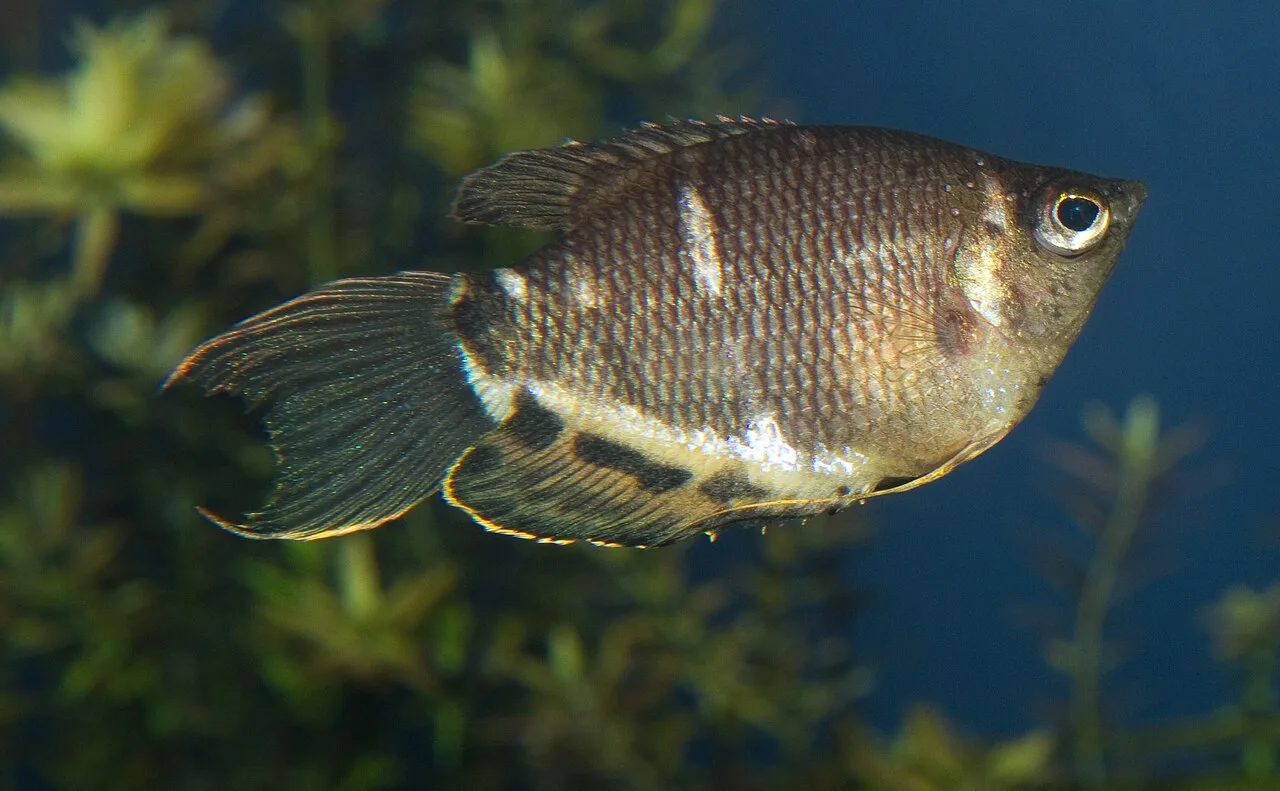
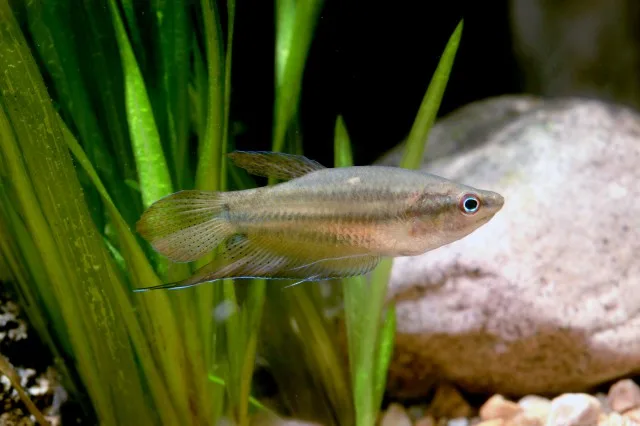

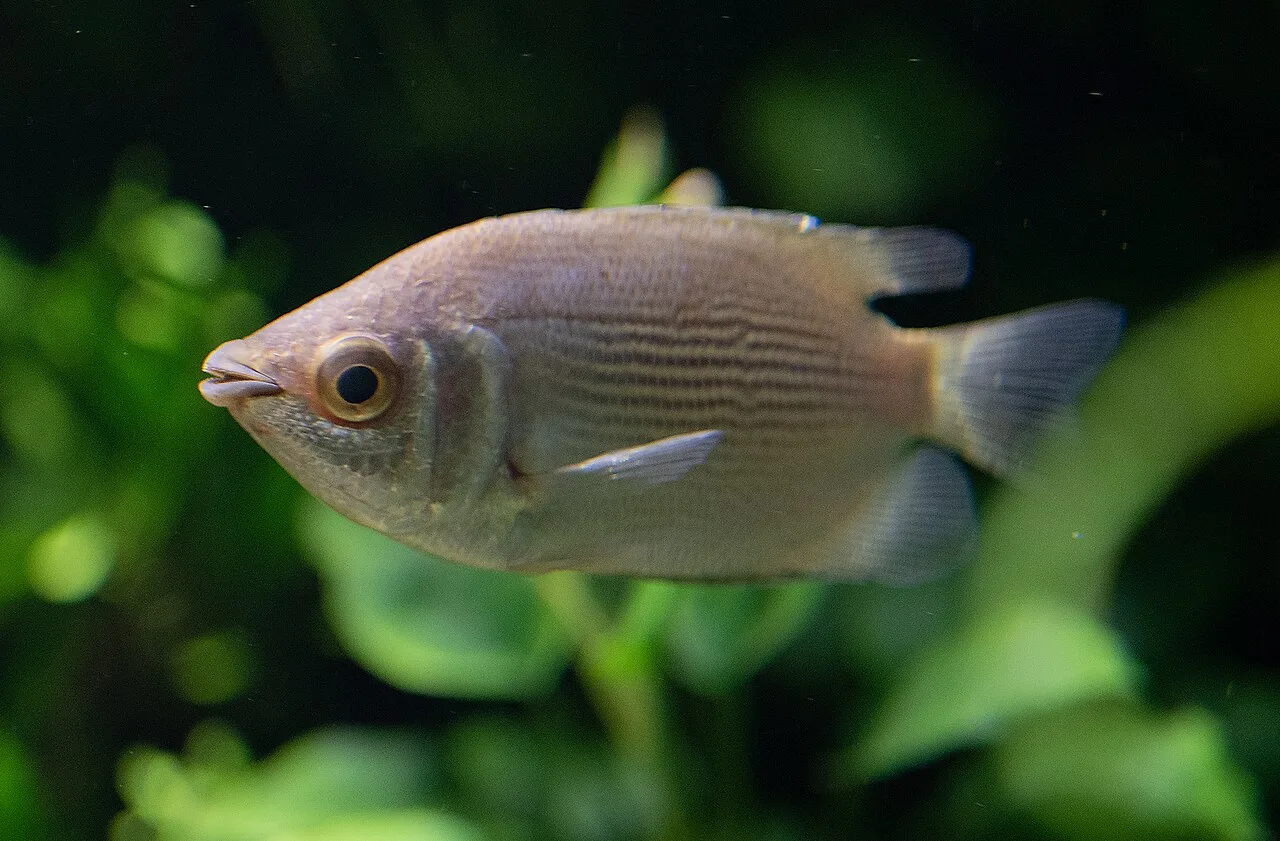
Similar water needs
Species with a similar temperature, a similar pH and a comparable adult size. Whether their behaviour fits as well is what the compatibility check is for.



