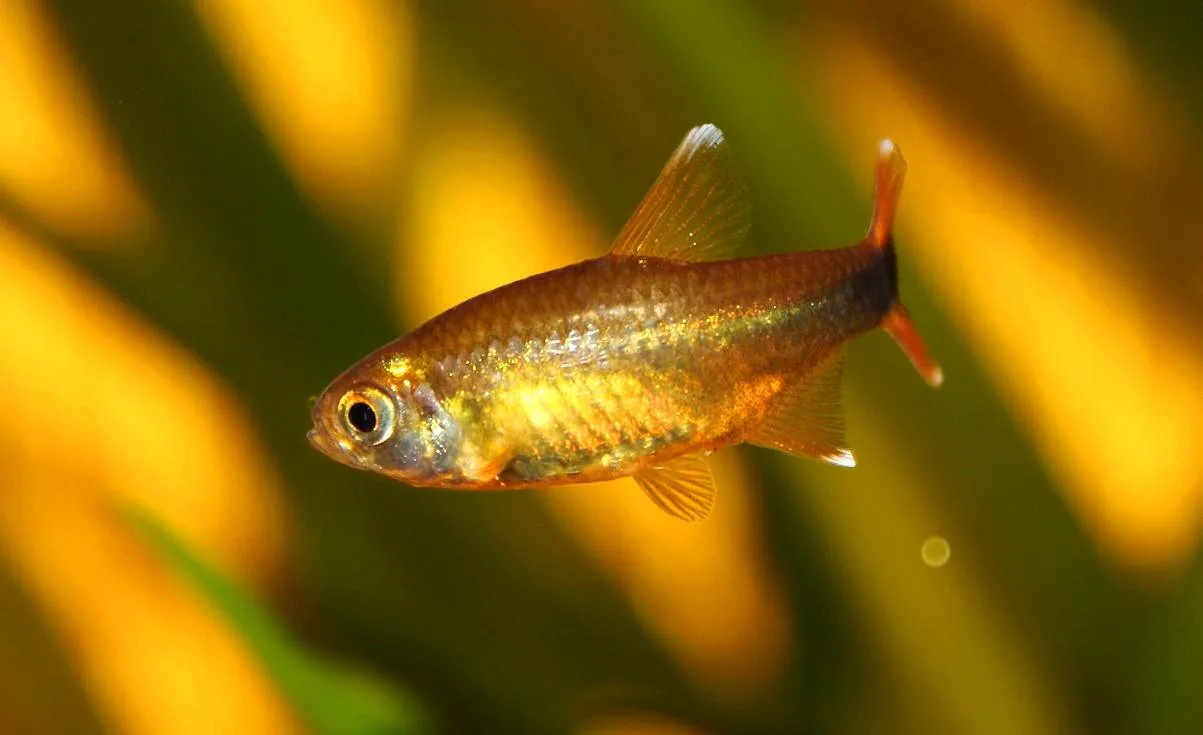
Honey gourami
Trichogaster chuna
29 views
The smallest of the western gouramis, from the lower Ganges and Brahmaputra. Breeding males turn a honey colour.
- Temperature
- 24 – 28 °C
- pH
- 6 – 7.5 pH
- General hardness
- 4 – 15 °dH
- Maximum size
- 5 cm
- Minimum tank size
- 60 L
5 min read · 688 words
Fresh water
Quick facts
Place in the aquarium
Highlighted are the water layer and the spots where the species usually stays in the tank.
- Upper water Usually stays in the top third of the tank.
- Dense plants Looks for dense planting as cover, retreat or grazing ground.
Shrimp in the tank
Shrimplets at risk
- Not shrimp safe
- Dwarf shrimp at risk
- Shrimplets at risk
- Shrimp safe
- Adult dwarf shrimp
- Safe
- Shrimplets
- Get eaten
- Safe from shrimp size
- about 1.5 cm
The honey gourami is one of the few gouramis that get along with adult dwarf shrimp. At about 5 cm it is the smallest gourami, and a large part of its food is flying insects taken from the surface. Shrimp from about 1.5 cm are too large for it. Young shrimp that stray into open water, however, are eaten. The fish mostly stay in the upper water layers and the shrimp on the bottom. Dense plants and moss give the young enough cover for the population to grow.
Home & range
Hatched countries are where the species occurs. It lives in particular waters there, not across the whole country. The points name known waters for orientation, not collection sites.
- Country of origin
- Water for orientation
Native
Overview
Trichogaster chuna was described by Hamilton in 1822, once as a female under chuna and once as a male under sota. There is no type specimen, only a drawing and a short description. Hamilton gives the Ganges as the locality. Menon fixed the name Colisa chuna. The name Trichopodus was preoccupied, so the valid genus name is Trichogaster. The fish reach about five centimetres and are the smallest gouramis. Outside breeding both sexes are ochre brown with a brown band from the upper lip to the caudal base. Territorial males show a lemon-yellow dorsal fin, a blue-black throat and breast, and a brown-red to orange-red body. Females grow slightly larger. A golden cultivated form replaces the beige with yellow and weakens the band. Those males do not develop a black breast. A later form, “FireRed”, shows stronger red in the soft-rayed fin parts. Whether that comes from breeding or from diet is unclear.
A special position in the genus
Within Trichogaster the honey gourami holds a special position. It has more hard rays in the dorsal and anal fins: the dorsal fin has 17 to 19 hard and 6 to 9 soft rays, the anal fin 17 to 22 hard and 11 to 15 soft. It lacks vertical body markings, and its larvae are coloured differently from those of its relatives. Until recently it was placed in the genus Colisa. The large gouramis formerly listed as Trichogaster are now in Trichopodus.
The golden variety probably arose in the late 1980s or early 1990s. Probably through a mutation it lacks much of the dark pigment cells. In the „FireRed“ form known since the late 2000s, males show their breeding colours from half size and then permanently. Synonyms include Colisa sota, Polyacanthus chuna and Trichopodus sota. The genus and species names come from the local language.
Origin & habitat
This describes the origin, not how to furnish the aquarium.
The range is the northeast of the Indian subcontinent, in the lower courses and deltas of the Brahmaputra and Ganges. Uttar Pradesh, Bihar, Jharkhand, West Bengal, Assam and Bangladesh are named. Field reports are scarce and point to shallow banks and floodplains with dense vegetation. Krause names August to October as the breeding season, with water of 26 to 30 °C. Those are breeding-season figures, not a year-round aquarium recommendation.
Care
Labyrinth fish also breathe atmospheric air. The species builds a bubble nest at the surface. At home the fish are used as dried fish or fish meal. The first import to Europe was in 1962.
Surface and quiet
The honey gourami stays one of the more tolerant gouramis as long as the surface is open and nobody nips the fins. 24 to 28 °C, dense plants, floating plants, little current. From about 60 litres for a pair. The air above the water must not draw cold onto the labyrinth. Two males need visual barriers. One male with one or two females is the quieter stocking.
The honey breeding colour comes when the male has a territory and is not standing under a glaring lamp without cover. A pale fish in an empty tank is often only without structure, not without colour food.
Diet
A large share of the food is flying insects. The fish take them from the surface or knock them down with aimed spits from places above the water.
Fine food from the surface and from midwater. Brine shrimp, cyclops and small granules. Bottom tablets reach him poorly. Several small feeds, because faster tankmates otherwise take everything.
Behavior
Outside breeding, and in open water, honey gouramis form school-like groups. For breeding, males hold a territory and show the display colours.
Reproduction
Unlike the other Trichogaster, males build a broad, very loose bubble nest of a single layer of bubbles. Spawning under it is scattered, after intense courtship. The eggs are, for so small a fish, relatively large at almost one millimetre, colourless and transparent. The male gathers them in his mouth into a spawn clump. After a few hours they turn pale yellow and later dark grey. Depending on temperature the black larvae hatch after 24 to 48 hours. For one or two days the male keeps them together and defends the nest. Then the young swim free and the brood-care drive ends.
More species in this group
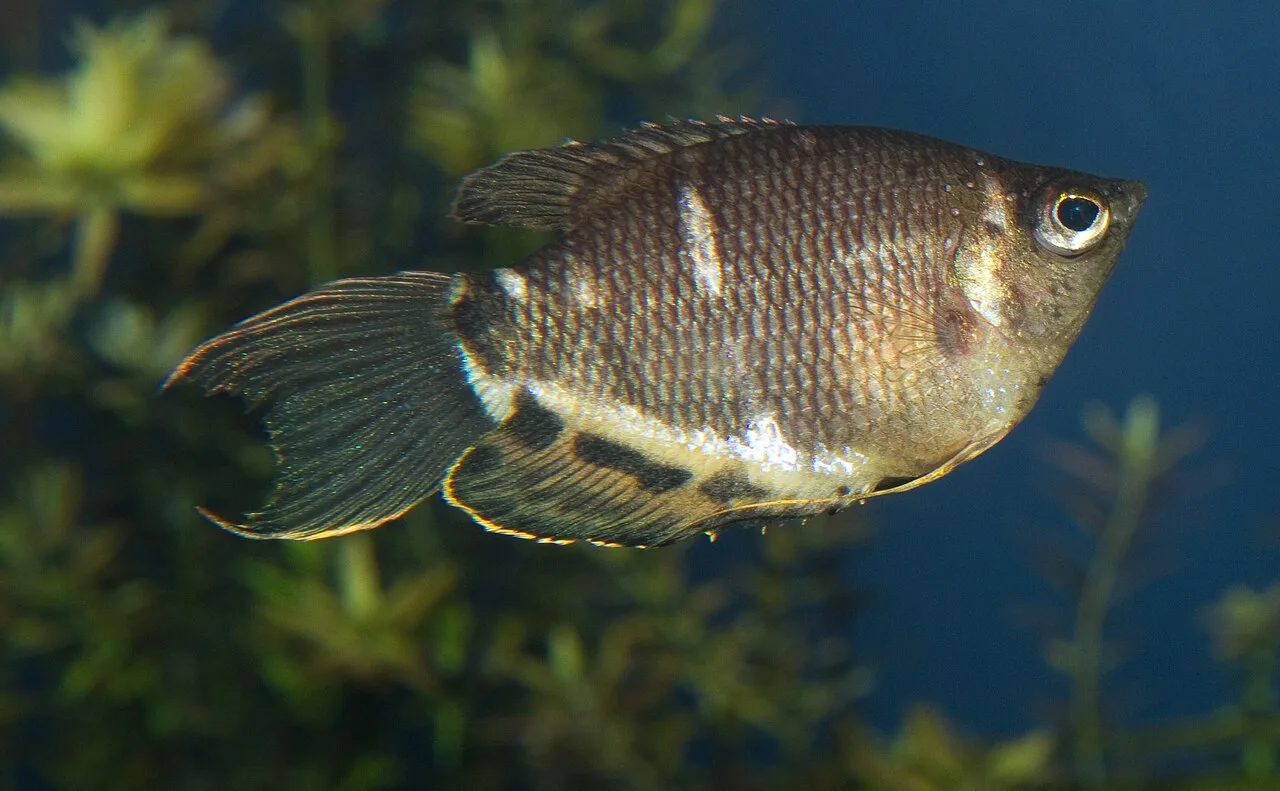
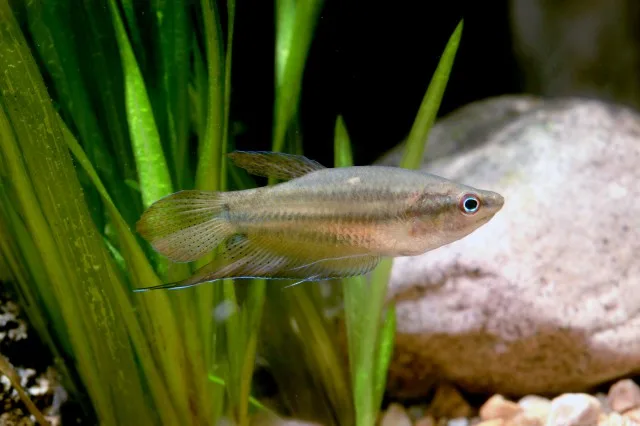
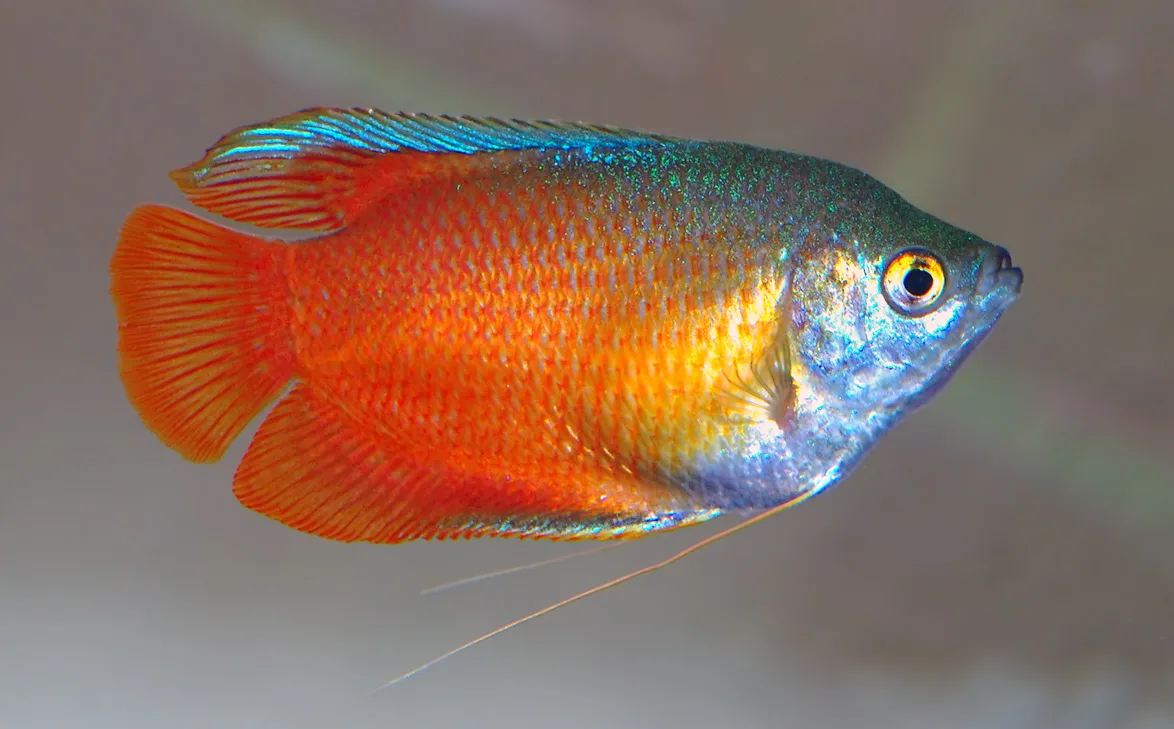
Similar water needs
Species with a similar temperature, a similar pH and a comparable adult size. Whether their behaviour fits as well is what the compatibility check is for.