
Silvertip tetra
Hasemania nana
20 views
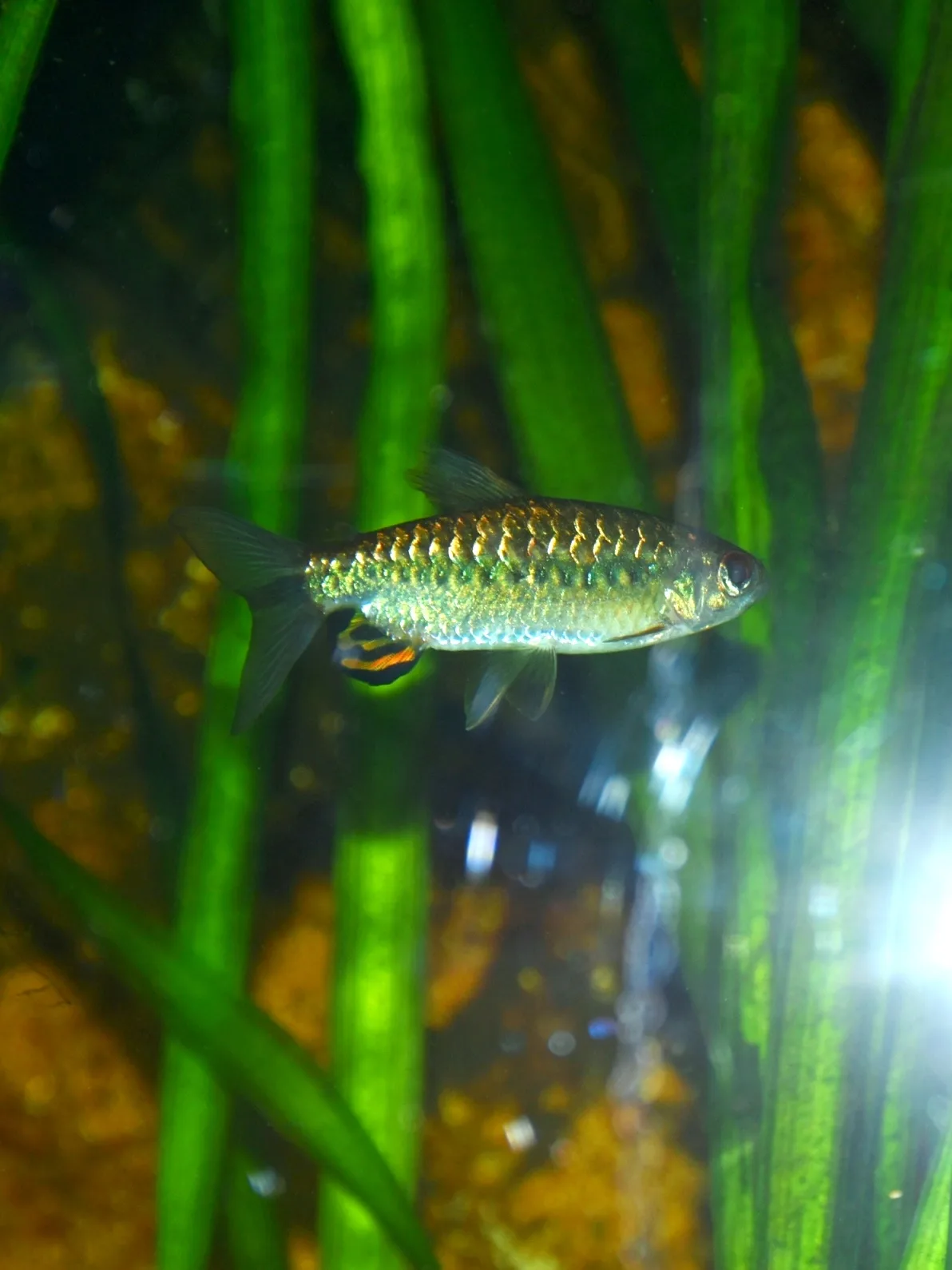
A peaceful schooling tetra to about 5 cm. Males show the copper sheen the species is named for.
- Temperature
- 22 – 28 °C
- pH
- 6 – 8 pH
- General hardness
- 3 – 15 °dH
- Maximum size
- 5 cm
- Minimum group size
- 8
- Minimum tank size
- 30 – 40 L
2 min read · 323 words
Fresh water
Quick facts
Place in the aquarium
Highlighted are the water layer and the spots where the species usually stays in the tank.
- Middle water Usually stays in the middle of the tank, between bottom and surface.
- Open swimming space Needs an open area without plants or decor to swim at length. Tank length matters more than height.
Shrimp in the tank
Shrimplets at risk
- Not shrimp safe
- Dwarf shrimp at risk
- Shrimplets at risk
- Shrimp safe
- Adult dwarf shrimp
- Safe
- Shrimplets
- Get eaten
- Safe from shrimp size
- about 1.5 cm
The silvertip tetra is compatible with adult dwarf shrimp. It grows to 5 cm and is an undemanding omnivore. Shrimp from about 1.5 cm do not fit its mouth. Young shrimp, however, are eaten, as these tetras even eat their own eggs. During the spawning season males show territorial behaviour, but it is directed at their own kind. In a shared tank moss cushions, dense plants and leaf litter ensure that some of the young shrimp survive and the population stays stable.
Home & range
Hatched countries are where the species occurs. It lives in particular waters there, not across the whole country. The points name known waters for orientation, not collection sites.
- Country of origin
- Water for orientation
Native
Overview
Males shine copper. A black band crosses the rear body and is strongest at the tail. The tips of the dorsal, anal and caudal fins are white. Females look deeper-bodied and more silver.
Names and introduction to the hobby
The silvertip tetra is called Kupfersalmler, copper tetra, in German. Older names are Tetragonopterus nanus, Hemigrammus nanus and Hasemania marginata. It belongs to the family Acestrorhamphidae, the American characins. It first reached Europe in 1937. The tail fin is forked. The body is translucent gold with a black stripe along the rear half, males more strongly and females more palely coloured. In 2013 the mitochondrial genome was fully sequenced, at 16,581 base pairs.
Origin & habitat
This describes the origin, not how to furnish the aquarium.
Home waters are the São Francisco in southeastern Brazil and headwaters of the Purus. The species lives in clear whitewater or blackwater.
The species is reliably known from streams in the São Francisco basin in Brazil. Headwaters of the Rio Purus are also named. Because the fish live in spring-fed streams, they need enough open swimming space besides sheltering plants.
Care
Length is up to about 5 cm, and the species is called a peaceful schooling fish.
It is kept at 22 to 28 °C and in slightly acidic water in the range pH 6.0 to 8.0. The species is common in the trade and regarded as relatively easy to keep, but can be affected by parasites and infections. In Austria the animal keeping regulation requires at least five fish.
Diet
The silvertip tetra is an omnivore without special demands, but welcomes varied food.
Behavior
The species likes to live in a school of its own kind but can become territorial. During the spawning season males often show marked territorial behaviour and turn clearly reddish.
Reproduction
A peaceful school. No minimum number is given.
Before spawning males are brightly coloured and females visibly swollen. The female scatters the eggs among plants and the male fertilises them. The parents eat their eggs. The larvae hatch after about one and a half days.
Gallery
More species in this group



Similar water needs
Species with a similar temperature, a similar pH and a comparable adult size. Whether their behaviour fits as well is what the compatibility check is for.





