
Goldeneye cichlid
Nannacara anomala
27 views
A peaceful dwarf cichlid from Guyana, to 9 cm.
- Temperature
- 24 – 26 °C
- pH
- 6.5 – 7.5 pH
- General hardness
- 2 – 12 °dH
- Maximum size
- 9 cm
- Minimum tank size
- 50 L
3 min read · 493 words
Fresh water
Quick facts
Place in the aquarium
Highlighted are the water layer and the spots where the species usually stays in the tank.
- Near the bottom Mostly stays just above the bottom. Food has to reach the substrate.
- Dense plants Looks for dense planting as cover, retreat or grazing ground.
- Rocks and caves Needs caves, crevices or rockwork as hiding place, territory or spawning site.
Shrimp in the tank
Dwarf shrimp at risk
- Not shrimp safe
- Dwarf shrimp at risk
- Shrimplets at risk
- Shrimp safe
- Adult dwarf shrimp
- At risk
- Shrimplets
- Get eaten
- Safe from shrimp size
- about 4 cm
The goldeneye cichlid endangers even adult dwarf shrimp. Males reach about 9 cm and with too few hiding places even eat small fish such as half-grown guppies. In the wild the species takes crustaceans, insects and other small animals. Young shrimp and Neocaridina or Caridina are eaten. Larger shrimp such as Amano shrimp from about 4 cm are usually safe, although during breeding the female defends her territory fiercely.
Dwarf shrimp are kept separately. Amano shrimp need plenty of plants and roots for shelter.
Home & range
Hatched countries are where the species occurs. It lives in particular waters there, not across the whole country. The points name known waters for orientation, not collection sites.
- Country of origin
- Water for orientation
Native
Overview
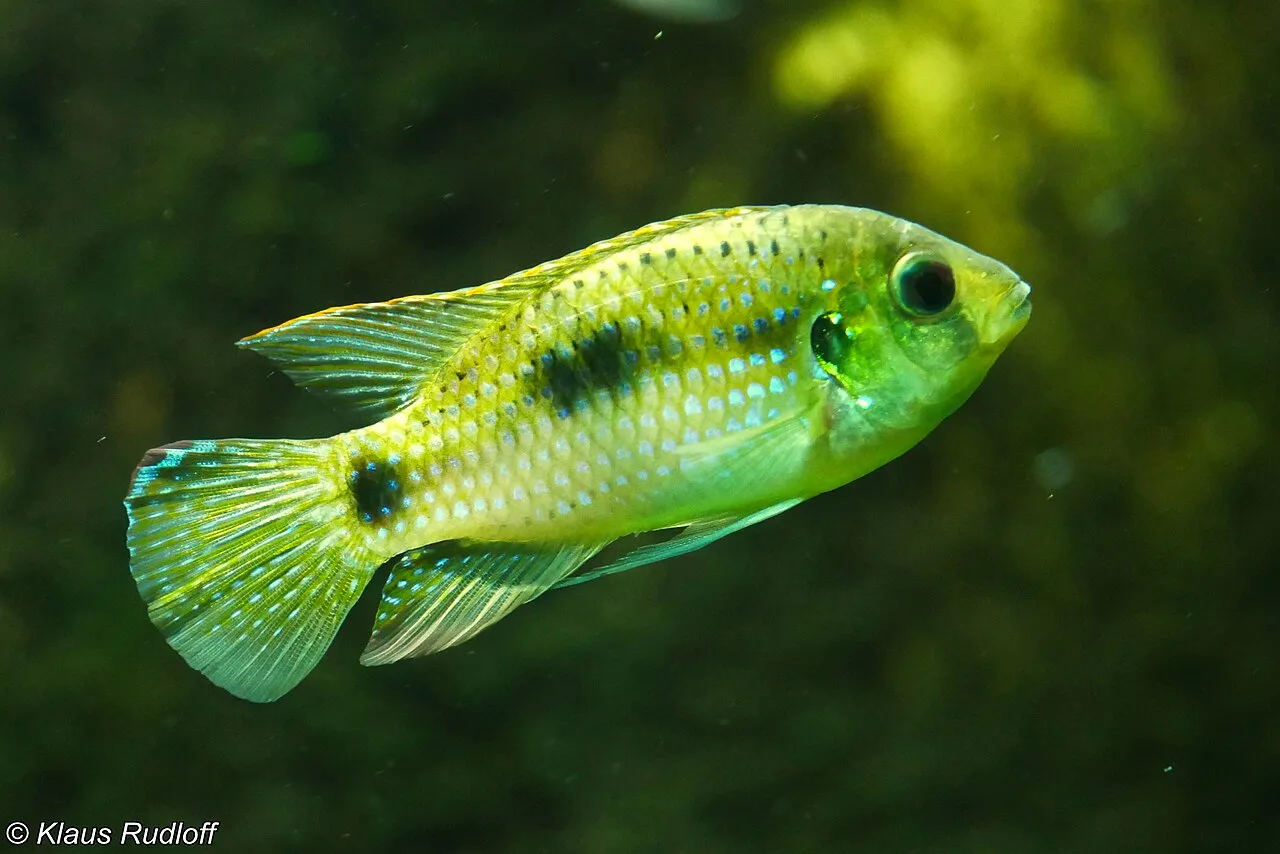
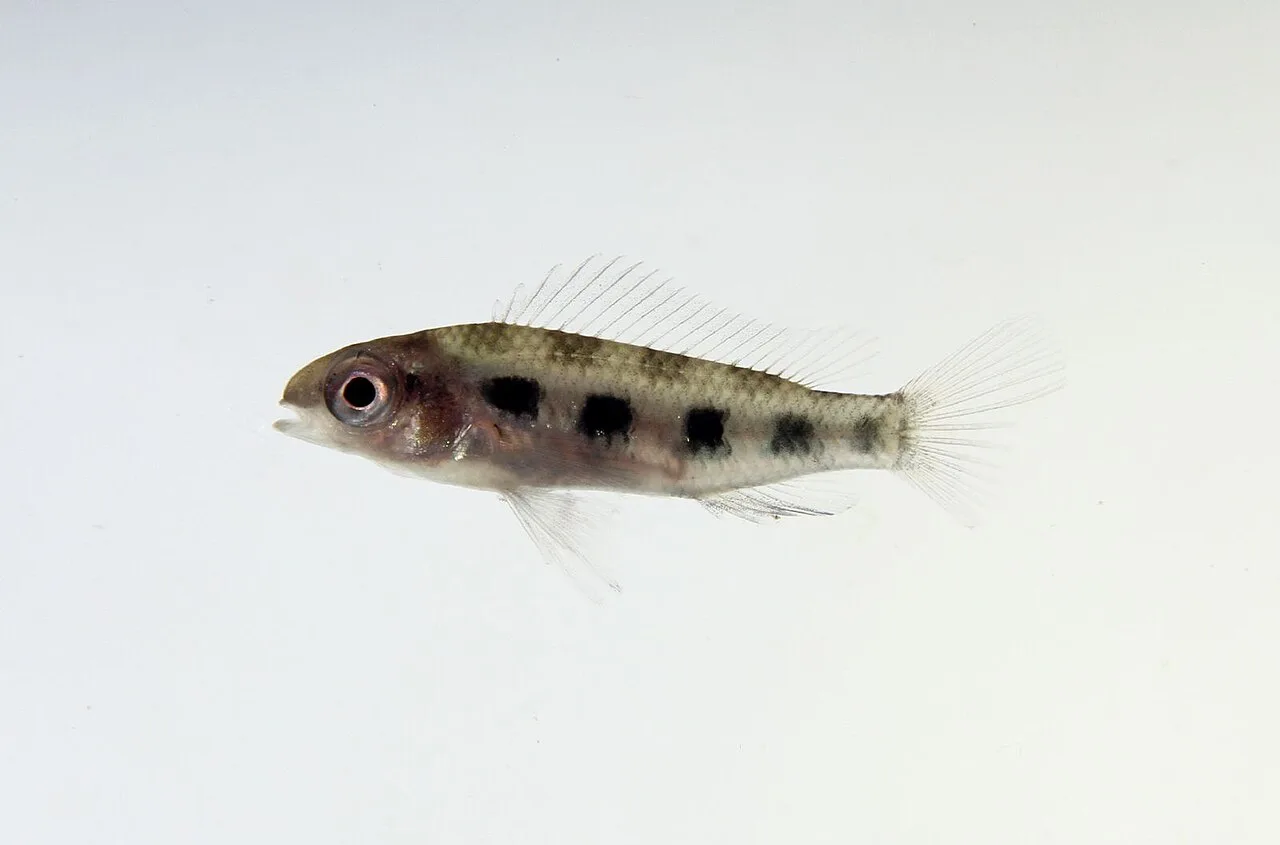
Two black longitudinal stripes, white to pale yellow between them. Females often light to dark brown.
Features and sexes
The middle longitudinal stripe is darker than the stripe near the dorsal fin. Dominant males shimmer greenish blue; in them the stripes are only weak, and a broad brown stripe runs along the back. Males reach about 9 cm, females only 5 to 6 cm. Even without knowing the age, males can be recognised by the high, rounded forehead. In acidic water males turn greenish. In breeding females the belly becomes bright yellow, and during courtship and brood care they show a checkerboard pattern. Juveniles look almost identical; young males carry female colouring and differ only by an extension at the end of the dorsal fin.
Charles Tate Regan described the species in 1905. In English it is called the goldeneye cichlid.
Origin & habitat
This describes the origin, not how to furnish the aquarium.
Guyana. The country stays coarse.
The species lives in fresh waters from the Aruka in Guyana to the Maroni in Suriname. The fish often live on flooded savannas near the coast. The IUCN lists the species as least concern.
Care
Dark tanks from 80 cm long for a pair, more room for one male with several females. About 25 percent water change each week, because males react to organic load with infections and protruding eyes.
Tankmates and food
Calm South American fish that stay near the surface are suitable. With too few hiding places large males eat small tankmates, even half-grown male guppies. The fish stay mostly near the bottom. With regular water changes they live more than three years in the aquarium. In Austria keeping them in a harem is required. Dry and frozen food is accepted, and the diet should be varied. Black and red mosquito larvae, tubifex, cyclops and daphnia are readily eaten. In the wild the fish eat crustaceans, insects and other small animals.
Behavior
Fights between males follow a fixed sequence: lateral display with spread fins, tail beating and squirting water, frontal display with biting, mouth wrestling, tight circling with bites at the back, and finally the loser retreating with folded fins and a colour change. With a large size difference the contest ends early. When a predator is present the fish mainly use the weaker displays.
Reproduction
Peaceful outside the spawning period. When spawning, the female defends about 30 by 30 cm of bottom, even against larger fish.
Brood care by the female
The species is a cave spawner. The female spawns in caves and defends the area around the clutch even against much larger fish. In large tanks the male guards the outer territory; in small ones the female often attacks him seriously, and he should then be removed early. The larvae hatch after about 36 to 48 hours and are moved several times to prepared hiding places. After about a week they swim freely and are fed freshly hatched brine shrimp nauplii; dust food usually lowers rearing success. After about six weeks they take small frozen or live food. Females mature at three to four months.
Gallery
More species in this group

Similar water needs
Species with a similar temperature, a similar pH and a comparable adult size. Whether their behaviour fits as well is what the compatibility check is for.





