Senegal bichir
Polypterus senegalus
19 views
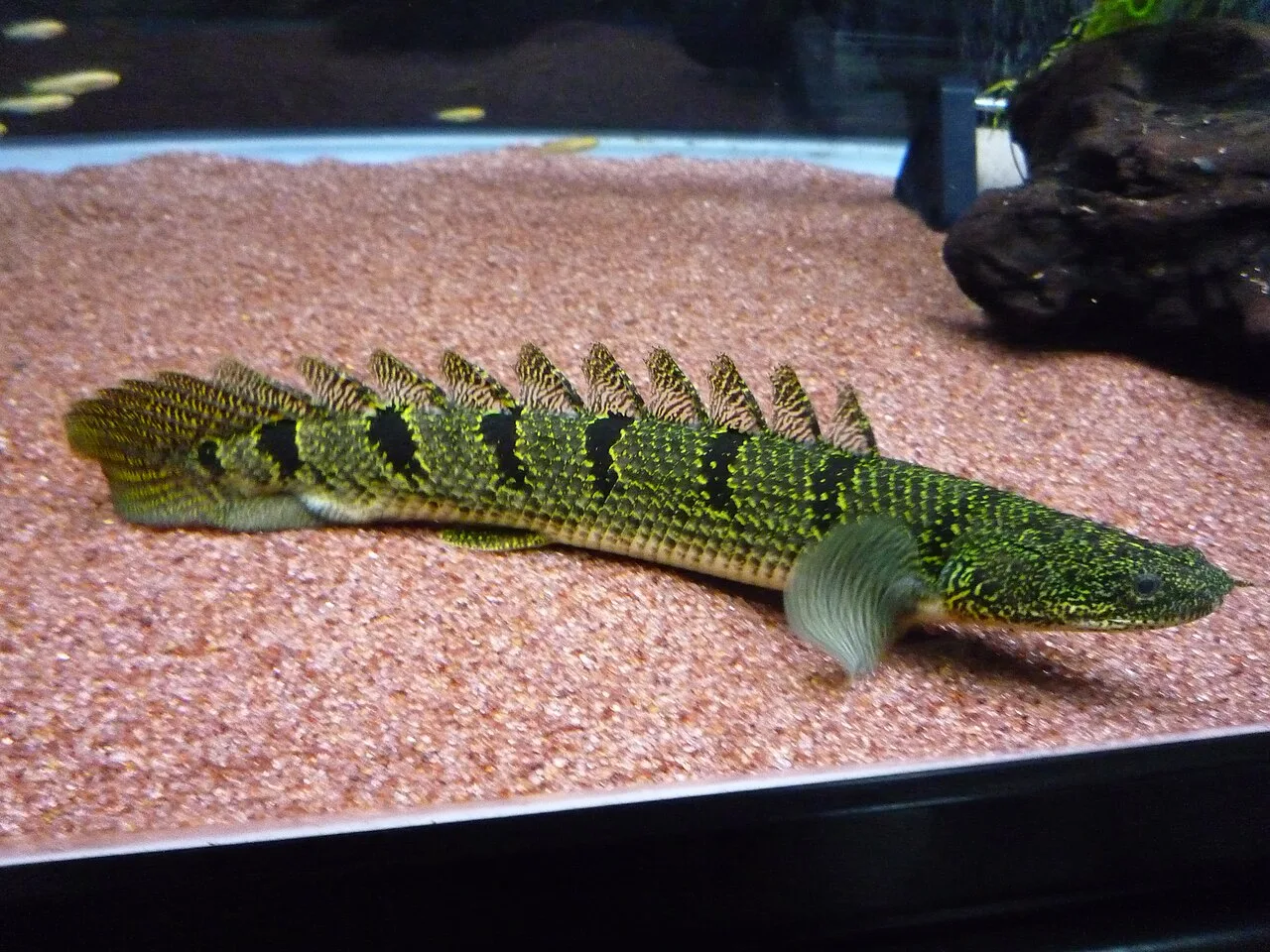
A bichir, about 50 cm. Like its relatives it also breathes air.
- Temperature
- 25 – 28 °C
- pH
- 6 – 8 pH
- General hardness
- 5 – 20 °dH
- Maximum size
- 50 cm
- Minimum tank size
- 100 L
3 min read · 453 words
Fresh water
Quick facts
Further published values
- Lifespan
- 10 – 15 a
Place in the aquarium
Highlighted are the water layer and the spots where the species usually stays in the tank.
- Near the bottom Mostly stays just above the bottom. Food has to reach the substrate.
- Rocks and caves Needs caves, crevices or rockwork as hiding place, territory or spawning site.
Shrimp in the tank
Not shrimp safe
- Not shrimp safe
- Dwarf shrimp at risk
- Shrimplets at risk
- Shrimp safe
- Adult dwarf shrimp
- At risk
- Shrimplets
- Get eaten
- Safe from shrimp size
- No size is safe
The Senegal bichir eats shrimp. It grows to about 35 to 50 cm, hunts as an ambush predator on the bottom and eats small vertebrates, insects and crustaceans. Anything that fits in its mouth is eaten in time. Because it finds prey mainly by smell and searches the bottom by day and night, even hidden shrimp are not safe.
Larger species such as Amano or fan shrimp count as prey too. Shrimp do not belong in a tank with bichirs.
Home & range
Hatched countries are where the species occurs. It lives in particular waters there, not across the whole country. The points name known waters for orientation, not collection sites.
- Country of origin
- Water for orientation
Native
Overview
About 50 cm. A white mark on the upper jaw, a black tear stripe, grey back, white belly.
Names and features
Georges Cuvier described the species in 1829. Besides the scientific name, common names such as grey bichir, Senegal bichir, Cuvier's bichir and dinosaur eel are in use. The last refers to its ancient look. The fish is neither an eel nor a reptile.
Looking closely, the grey back carries fine black speckles. Very young fish have three longitudinal stripes along the whole body, which disappear at about 5 cm length. Young bichirs have external gills that regress with age.
The scales are rhomboid and multi-layered. The dorsal fin is divided into 8 to 11 finlets and reaches almost to the caudal fin. The large, paddle-like pectoral fins are the main means of locomotion. A pair of simple lungs replaces the swim bladder. Males usually stay smaller than females and have a thicker anal fin. Eyesight is weak, and prey is found mainly by smell.
Origin & habitat
This describes the origin, not how to furnish the aquarium.
West Africa and the Nile region: White Nile, Lake Albert, Lake Rudolf, Omo, Lake Chad, Chari and the large rivers of Senegal. Senegal and Chad are unambiguous as names and stay coarse.
The range also includes the Gambia, Volta, Niger, Benue and the upper Congo basin. The species lives in lakes, along river margins, in swamps and floodplains and occurs in at least 26 African countries.
Care
The surface must stay reachable, because the gills of bichirs are not enough on their own.
Keeping
The species is considered peaceful, lively and easy to keep. It is traded regularly and in large numbers. Live imports come from the Nile region and from breeding farms in Southeast Asia. Even so, any fish that fits in the mouth will be eaten. Tankmates should be at least half the size of the bichir. Fins of other fish are bitten when the chance arises. In the aquarium the species reaches 10 to 15 years.
Diet
In the wild the species eats small vertebrates, insects and crustaceans. Prey is sucked in from the bottom. The fish lies in wait and stalks slowly; short quick bursts are possible.
Behavior
The species is active by day, exploring, feeding and searching for food. Individuals sometimes follow each other. At night it rests just above the bottom.
Reproduction
Dusk and night activity is typical of the genus. The short text does not state it separately for this species.
The species spawns in the rainy season. The male chases and nudges the female. Over a few days the female releases 100 to 300 eggs. The male catches them in a cup formed by its anal and caudal fins, fertilises them and scatters them in the vegetation. The larvae hatch after 3 to 4 days. The IUCN lists the species as least concern.
Gallery
More species in this group
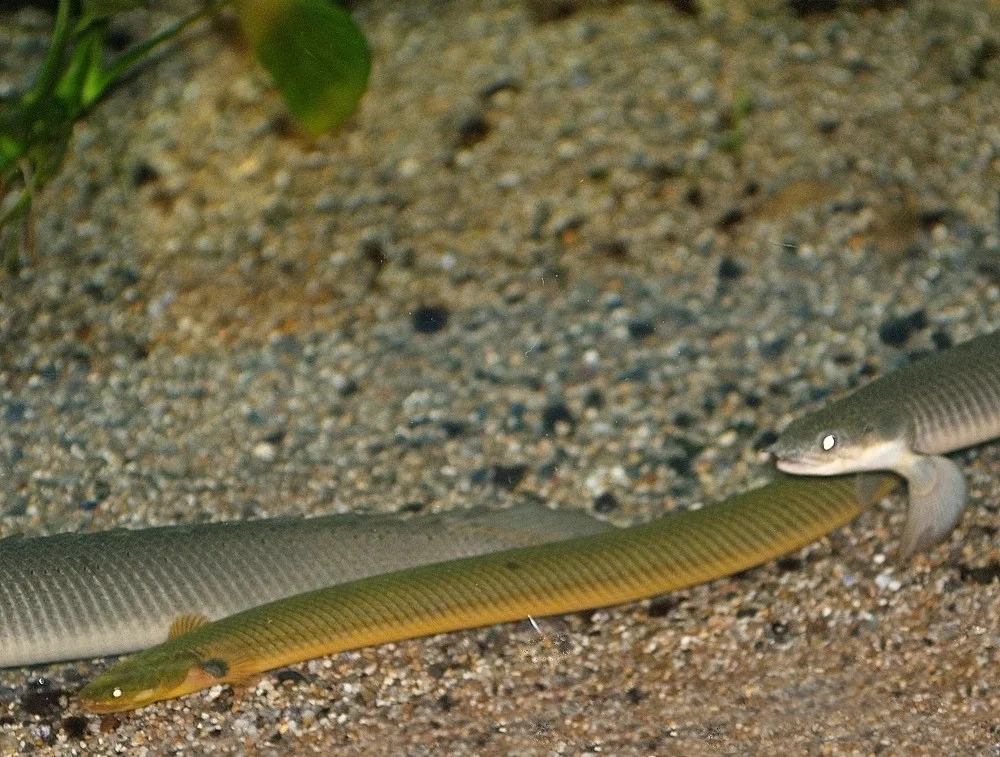
Similar water needs
Species with a similar temperature, a similar pH and a comparable adult size. Whether their behaviour fits as well is what the compatibility check is for.