Barred bichir
Polypterus delhezi
1 view
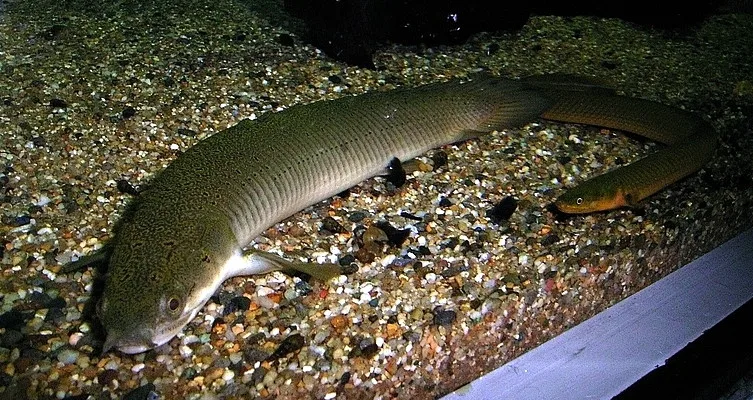
A bichir from the Congo basin with dark bars and a long row of dorsal finlets. It breathes air and eats anything that fits in its mouth.
- Temperature
- 24 – 28 °C
- pH
- 6 – 7.5 pH
- General hardness
- 5 – 15 °dH
- Maximum size
- 35 cm
- Minimum tank size
- 400 L
1 min read · 158 words
Quick facts
Place in the aquarium
Highlighted are the water layer and the spots where the species usually stays in the tank.
- Near the bottom Mostly stays just above the bottom. Food has to reach the substrate.
- Rocks and caves Needs caves, crevices or rockwork as hiding place, territory or spawning site.
Shrimp in the tank
Not shrimp safe
- Not shrimp safe
- Dwarf shrimp at risk
- Shrimplets at risk
- Shrimp safe
- Adult dwarf shrimp
- At risk
- Shrimplets
- Get eaten
- Safe from shrimp size
- No size is safe
Shrimp are not safe with the barred bichir. It reaches about 35 cm, searches the bottom at night and eats anything that fits in its mouth. Shrimp of any size are eaten.
Since it orients itself by smell, it finds hidden animals as well. Shrimp belong in a tank of their own.
Home & range
Hatched countries are where the species occurs. It lives in particular waters there, not across the whole country. The points name known waters for orientation, not collection sites.
- Country of origin
- Water for orientation
Native
Overview
Polypterus delhezi reaches about 35 cm. The body is long, olive brown with dark bars. The dorsal fin is divided into many small sails. The pectoral fins are strong, and the fish prop themselves up on the bottom with them. They also breathe air at the surface.
It is not Polypterus senegalus, which stays smaller and wears no bars. Both need a tight cover because they escape through the smallest gaps.
Origin & habitat
This describes the origin, not how to furnish the aquarium.
Slow waters in the Congo basin. The origin stays coarse. Warm water with plants along the bank matches that.
Care
Bottom
24 to 28 °C, pH 6 to 7.5. One or more fish from about 400 litres and 150 cm. A large floor area, caves, wood, a tight cover, access to the surface.
Company
Fish that do not fit in its mouth. Small fish are eaten at night.
Diet
Meaty food. Mysis, krill, shrimp, mosquito larvae, substantial granules.
Behavior
Calm and nocturnal. Mostly peaceful toward other species, as long as they do not fit in its mouth.
Gallery
More species in this group
Similar water needs
Species with a similar temperature, a similar pH and a comparable adult size. Whether their behaviour fits as well is what the compatibility check is for.