Black ghost knifefish
Apteronotus albifrons
21 views
A New World knifefish, about 50 cm. Not a bonytongue. No state is named.
- Temperature
- 24 – 28 °C
- pH
- 6 – 7.5 pH
- General hardness
- 4 – 15 °dH
- Maximum size
- 50 cm
- Minimum tank size
- 200 L
3 min read · 402 words
Fresh water
Quick facts
Place in the aquarium
Highlighted are the water layer and the spots where the species usually stays in the tank.
- Middle water Usually stays in the middle of the tank, between bottom and surface.
- Near the bottom Mostly stays just above the bottom. Food has to reach the substrate.
- Rocks and caves Needs caves, crevices or rockwork as hiding place, territory or spawning site.
Shrimp in the tank
Not shrimp safe
- Not shrimp safe
- Dwarf shrimp at risk
- Shrimplets at risk
- Shrimp safe
- Adult dwarf shrimp
- At risk
- Shrimplets
- Get eaten
- Safe from shrimp size
- No size is safe
The black ghost knifefish eats shrimp. It grows 45 to 50 cm long, has a large mouth and hunts insect larvae, small crustaceans and smaller fish at night. It has explicitly been seen eating shrimp. It locates prey electrically, even in darkness and in hiding places.
No shrimp species is safe with a nocturnal predator of this size, not even Amano shrimp. Hiding places help little, because it does not need to see its prey. Shrimp do not belong in a tank with knifefish.
Home & range
Hatched countries are where the species occurs. It lives in particular waters there, not across the whole country. The points name known waters for orientation, not collection sites.
- Country of origin
- Water for orientation
Native
Overview
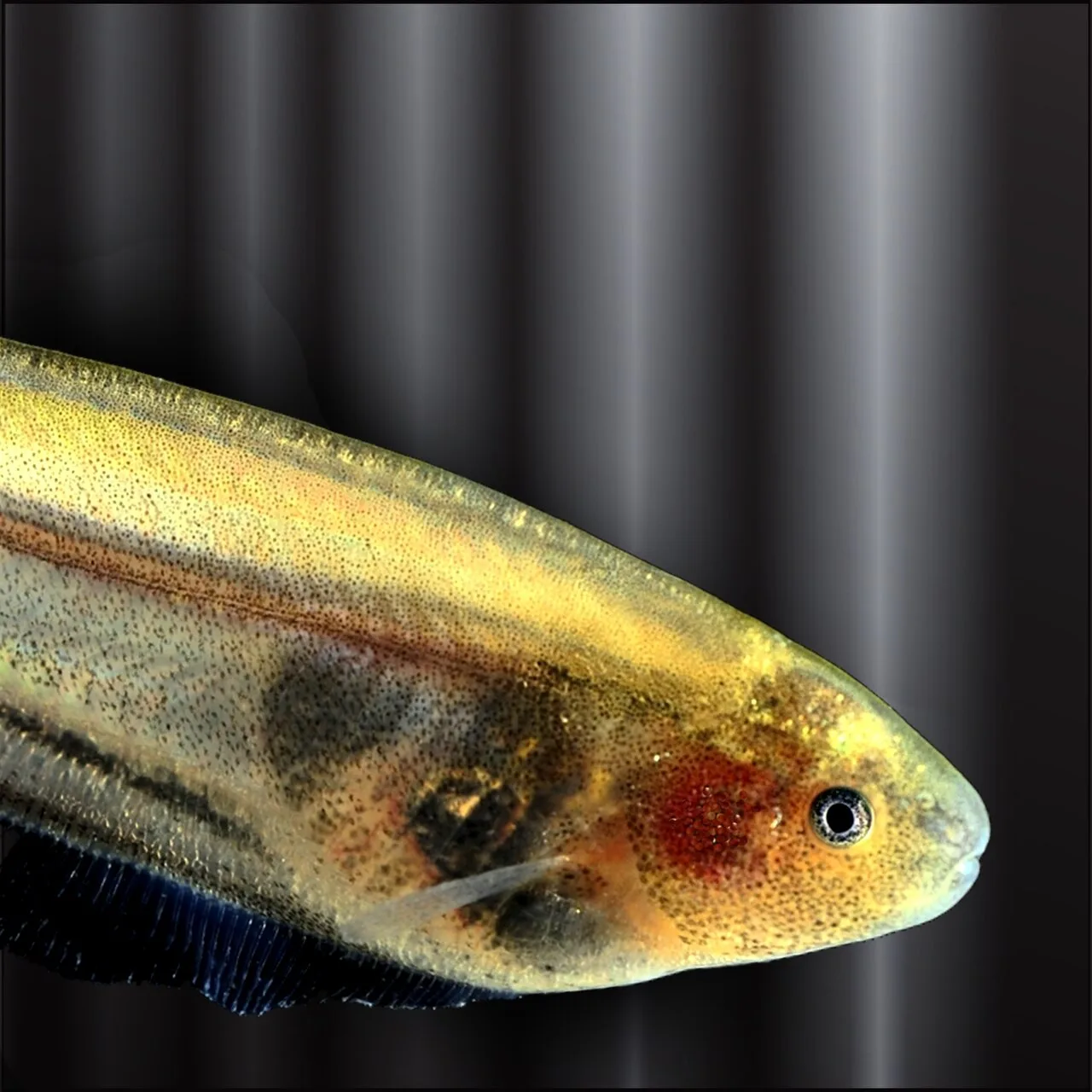
Long, strongly flattened, a small tail, no dorsal and no pelvic fins. Black-blue to dark brown, two white bands around the caudal peduncle and a narrow white line on the forehead. A weak electric organ of modified nerve cells.
Systematics and body
Carl Linnaeus described the species in 1766 as Gymnotus albifrons. It belongs to the ghost knifefishes (Apteronotidae), the most species-rich family of the New World knifefishes. Its sister group is Parapteronotus. Adults reach 45 to 50 cm.
The anal fin runs along almost the whole body and is the main propulsion organ. With its waves the fish can swim forwards, backwards, sideways and even upside down, and reverse direction in less than a second. The body stays rigid. The pectoral fins are faintly dark grey. The weak electric organ reaches into the tail.
Origin & habitat
This describes the origin, not how to furnish the aquarium.
South America east of the Andes from the Orinoco to the Río de la Plata, and the Río Magdalena west of the Andes.
The species is the most widespread of its family, from Ecuador to Brazil, in rivers and small creeks of the Orinoco, the Guianas, the Amazon, the Ucayali and the Paraguay and Paraná. The fish live on the bottom and in open water.
Care
Only flowing water with a strong current and sand.
Diet
Mainly insect larvae. Nocturnal.
The species is a nocturnal predator. Besides insect larvae it eats small crustaceans and smaller fish. It locates prey electrically even in darkness and turbid water and seizes it with a short, quick lunge.
Behavior
Electric signals
The fish produces continuous wave-type electric discharges. It uses them to sense its surroundings and to communicate with its own kind. Females discharge at a higher frequency than males, especially in fish from the Orinoco. Slowly rising frequencies are read as a submissive signal in subordinate fish. When the frequencies of two fish overlap, they shift away from each other.
Reproduction
Forwards and backwards on the anal fin.
The species spawns in batches. Each spawning places 1 to 105 sticky eggs one at a time in small holes and gaps, at night between 11 pm and 2 am. Juveniles can mature at about one year. Gonad maturation can be triggered by lower conductivity and a rising water level. Several males drive each other off aggressively.
Threat
The IUCN has listed the species as least concern since 2020. Many fish for the ornamental trade are wild-caught, however, and a large share does not appear in any official export record.
Gallery
More species in this group
Similar water needs
Species with a similar temperature, a similar pH and a comparable adult size. Whether their behaviour fits as well is what the compatibility check is for.