Silver arowana
Osteoglossum bicirrhosum
16 views
A bonytongue, to 90 cm. Not a community fish for a usual tank.
- Temperature
- 23 – 28 °C
- pH
- 6 – 7 pH
- General hardness
- 3 – 4 °dH
- Maximum size
- 90 cm
- Minimum tank size
- 2000 L
3 min read · 442 words
Fresh water
Quick facts
Further published values
- Lifespan
- 20 a
Place in the aquarium
Highlighted are the water layer and the spots where the species usually stays in the tank.
- Water surface Stays just below the surface. The top needs a calm current and a cover.
- Upper water Usually stays in the top third of the tank.
- Open swimming space Needs an open area without plants or decor to swim at length. Tank length matters more than height.
Shrimp in the tank
Not shrimp safe
- Not shrimp safe
- Dwarf shrimp at risk
- Shrimplets at risk
- Shrimp safe
- Adult dwarf shrimp
- At risk
- Shrimplets
- Get eaten
- Safe from shrimp size
- No size is safe
The silver arowana eats shrimp. It grows up to 90 cm, has a very large, upturned mouth and eats snails, crustaceans such as crabs, insects, spiders and smaller fish, as well as small frogs and lizards. Crustaceans are explicitly on its menu.
Even large shrimp species are prey for a predator of this size. Because it lies in wait near the surface, a bottom dweller may be overlooked for a while, but it is not safe there. Shrimp do not belong in an arowana tank, not even as bottom stock. Anyone who wants to keep shrimp sets up a separate, smaller tank for them.
Home & range
Hatched countries are where the species occurs. It lives in particular waters there, not across the whole country. The points name known waters for orientation, not collection sites.
- Country of origin
- Water for orientation
Native
Overview
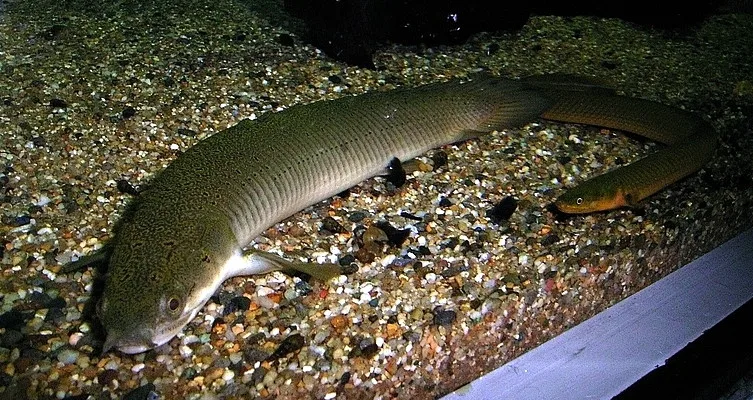
Band-shaped, large scales, a very large superior mouth, two barbels on the lower jaw. Adults silver, young greenish yellow. Dorsal and anal fins reach the tail.
Names and features
Georges Cuvier described the species in 1829. It is also called arowana, aruanã or arahuana and belongs to the bonytongues (Osteoglossidae). The genus name means bone-tongued, the species name two barbels. Aquarists also call arowanas dragon fish. Because of its leaps out of the water the species is also called water monkey.
The ribbon-like body is strongly compressed and covered with large scales. The two barbels at the tip of the lower jaw are bluish or greenish. The dorsal and anal fins are almost fused with the small caudal fin. The usual maximum length is 0.9 m, and single fish are said to reach 1.2 m. Adult silver and black arowanas look very similar and are separated by counts of body features.
Origin & habitat
This describes the origin, not how to furnish the aquarium.
Amazon, Araguaia, the Rupununi in southern Guyana and the Oyapock on the border of French Guiana and Brazil. Guyana, French Guiana and Brazil stay coarse. The Amazon basin is not extended onto unnamed states.
The species lives in the Amazon, Essequibo and Oyapock basins, in black and white water and in flooded forests. It is absent from the Rio Negro basin except for the Rio Branco, where silver and black arowanas occur together. The fish stays near the surface and waits there for prey.
Care
Jumps of up to two metres belong to the hunt.
Keeping
The arowana is one of the most popular ornamental fish from South America. It is seen as an accessible substitute for the Asian arowana, which is listed in CITES Appendix I. It is mostly kept by experienced aquarists, because as a predator it needs a very large tank.
Diet
Insects, small frogs and lizards, also from overhanging branches.
The species also eats snails, crustaceans such as crabs, beetles, spiders and smaller fish. The mouth opens like a drawbridge and is suited to prey at the surface. Stomachs have also contained remains of birds, bats, mice and snakes.
Reproduction
A mouthbrooder. The eggs are over 1.5 cm and, after being laid in a sand pit, are taken up by the male. The young leave the mouth after 50 to 60 days and are already 10 cm long.
Protection
The species is not listed in any CITES appendix and is rated least concern by the IUCN. It is threatened by the ornamental trade, droughts, deforestation, siltation and drainage. In 2005 Brazil and Colombia disputed the shared stock, because juveniles are caught for the trade in Colombia and adults as food fish in Brazil. Brazil banned fishing from 1 September to 15 November, Colombia from 1 November to 15 March.
Gallery
More species in this group
Similar water needs
Species with a similar temperature, a similar pH and a comparable adult size. Whether their behaviour fits as well is what the compatibility check is for.