Peters elephantnose
Gnathonemus petersii
16 views
A weakly electric mormyrid. Average 25 cm is not a maximum.
- Temperature
- 26 – 28 °C
- pH
- 6.8 – 7.2 pH
- General hardness
- 10 – 20 °dH
- Maximum size
- 35 cm
- Minimum tank size
- 200 L
3 min read · 468 words
Fresh water
Quick facts
Further published values
- Lifespan
- 6 – 10 a
Place in the aquarium
Highlighted are the water layer and the spots where the species usually stays in the tank.
- Near the bottom Mostly stays just above the bottom. Food has to reach the substrate.
- Rocks and caves Needs caves, crevices or rockwork as hiding place, territory or spawning site.
- Substrate Sifts through the substrate or burrows into it. Fine, rounded sand without sharp edges suits it.
Shrimp in the tank
Dwarf shrimp at risk
- Not shrimp safe
- Dwarf shrimp at risk
- Shrimplets at risk
- Shrimp safe
- Adult dwarf shrimp
- At risk
- Shrimplets
- Get eaten
- Safe from shrimp size
- about 5 cm
The elephantnose fish endangers dwarf shrimp. It grows to about 23 to 25 cm and at night searches the bottom for worms, insect larvae and other invertebrates with its electric sense and sensitive snout organ. Hiding places hardly protect small shrimp from this sense. Young shrimp and Neocaridina or Caridina are eaten. Larger shrimp such as adult Amano shrimp from about 5 cm are usually safe.
Dwarf shrimp are kept in a separate tank. The elephantnose fish needs a large, calm tank with soft sand anyway.
Home & range
Hatched countries are where the species occurs. It lives in particular waters there, not across the whole country. The points name known waters for orientation, not collection sites.
- Country of origin
- Water for orientation
Native
- Nigeria
- Range: Old Calabar in Nigeria as the type locality and the lower Niger basin.
Overview
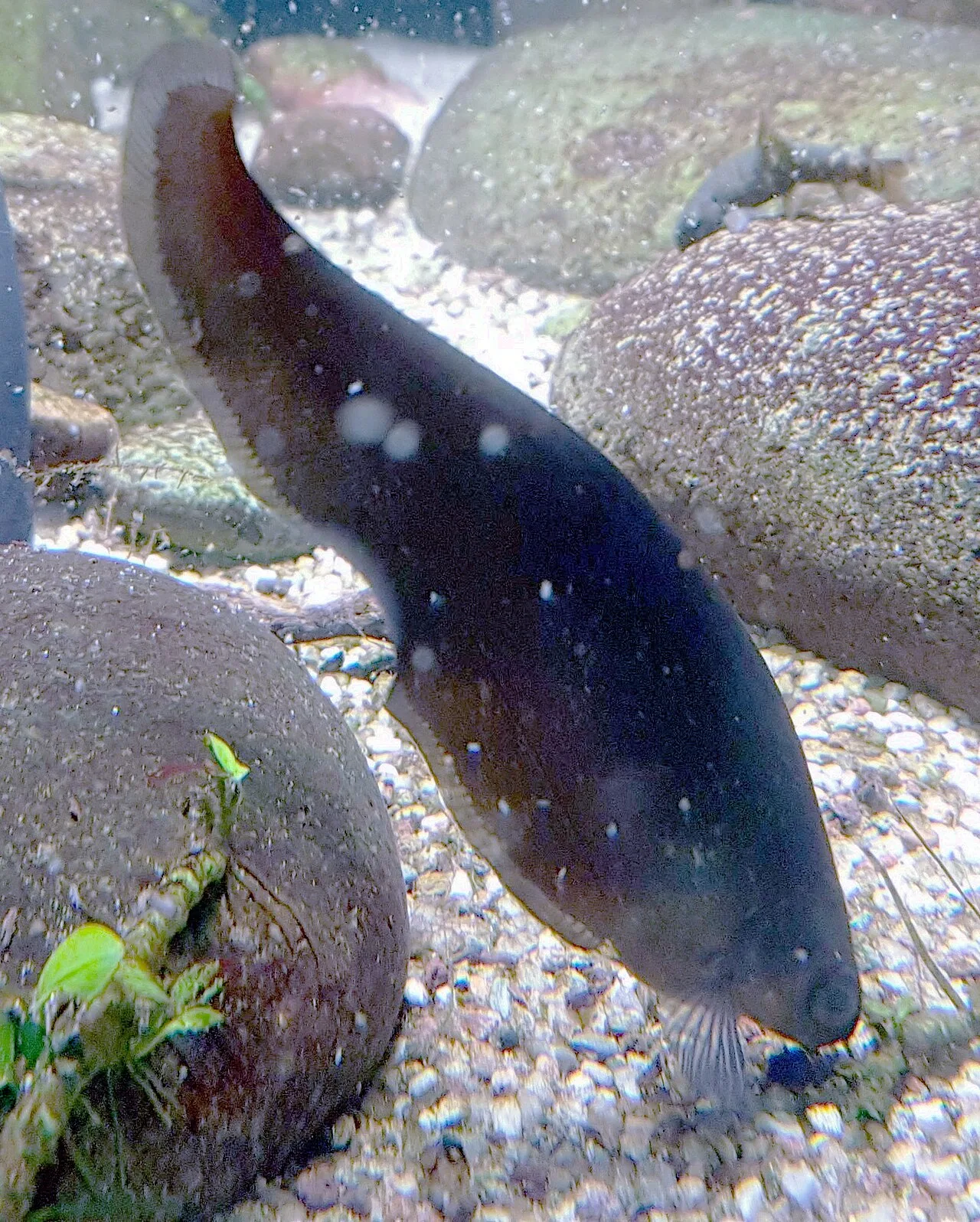
Dark brown, a pale bar between the dorsal and anal fins. A fleshy extension of the lower jaw. The anal fin of males is concave, that of females straight. 60 to 69 scales in the lateral line.
Features
The scales become smaller towards the head and slightly larger towards the tail. The dorsal fin has 25 to 31 and the anal fin 32 to 36 soft rays, and the anal fin base is a little longer than the dorsal base. The body is laterally compressed and dark brown to black, and the tail is forked. The head extension is not a nose but a sensitive extension of the mouth, the Schnauzenorgan. It is densely covered with electroreceptors and is used for defence, communication, navigation and finding worms and insects.
Electric sense
The organ in the caudal peduncle sends out short, weak pulses and creates a three-dimensional field. Receptors on the head, belly and back register distortions caused by conductive or insulating objects. There are also organs for passive electroreception and for electrical communication. The cerebellum is unusually large. The species has the highest brain oxygen use relative to body mass of all known vertebrates. The elephantnose fish is an important laboratory animal in sensory research.
Taxonomy
Albert Günther described the species in 1862 as Mormyrus petersii from a single specimen from Old Calabar in Nigeria. The name probably honours the naturalist Wilhelm Peters. Gnathonemus brevicaudatus and Gnathonemus histrio are regarded as synonyms.
Origin & habitat
This describes the origin, not how to furnish the aquarium.
Africa only, without a named country.
The species lives in flowing waters of West and Central Africa, in particular the lower Niger basin, the Ogun and the upper Chari. The species prefers muddy, slow-flowing rivers and pools with cover such as submerged branches. In its home range all mormyrids are important food fish and are regularly caught.
Care
The electric organ in the caudal peduncle is used for sensing, feeding and communication.
Keeping
The elephantnose fish is timid and prefers a heavily planted tank with subdued light, a pipe or hollow log as a hiding place and soft sand to sift. It needs more than 200 litres, 26 to 28 °C, pH 6.8 to 7.2 and medium-hard water. It is usually peaceful but can become aggressive towards other species. Below about 400 litres it is strongly territorial towards its own kind, so only one fish is recommended.
Diet
Food is found with the electric field and the trunk.
The species is nocturnal and mainly searches for insect larvae on the bottom. In the aquarium it takes small worms, mostly bloodworms, and other invertebrates, plus frozen or flake food.
Reproduction
Nothing reliable is known about the reproduction of this species. Breedings concern other mormyrids.
In captivity the species lives about 6 to 10 years. Aquarium fish are almost exclusively wild-caught. First captive breedings were achieved by Frank Kirschbaum by simulating a rainy season: rising water level, falling conductivity and falling pH.
Gallery
More species in this group
Similar water needs
Species with a similar temperature, a similar pH and a comparable adult size. Whether their behaviour fits as well is what the compatibility check is for.