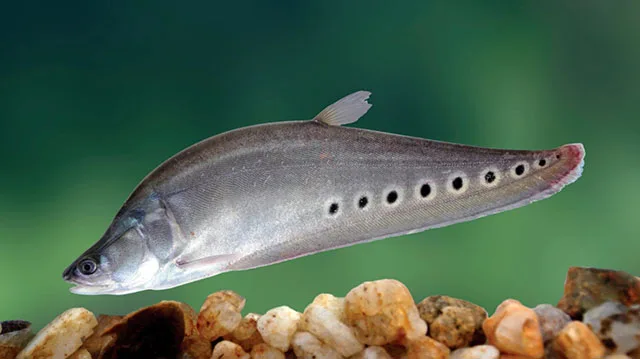
African knifefish
Xenomystus nigri
18 views
An Old World knifefish, to 30 cm. It also breathes through the swim bladder.
- Temperature
- 22 – 28 °C
- pH
- 6 – 8 pH
- General hardness
- 5 – 15 °dH
- Maximum size
- 30 cm
- Minimum tank size
- 300 L
3 min read · 450 words
Fresh water
Quick facts
Place in the aquarium
Highlighted are the water layer and the spots where the species usually stays in the tank.
- Near the bottom Mostly stays just above the bottom. Food has to reach the substrate.
- Rocks and caves Needs caves, crevices or rockwork as hiding place, territory or spawning site.
Shrimp in the tank
Not shrimp safe
- Not shrimp safe
- Dwarf shrimp at risk
- Shrimplets at risk
- Shrimp safe
- Adult dwarf shrimp
- At risk
- Shrimplets
- Get eaten
- Safe from shrimp size
- No size is safe
The African brown knifefish is no partner for shrimp. It grows to 30 cm, has a large mouth and hunts worms, crustaceans, insects and snails on the bottom at night. With its sensitive lateral line it finds prey even in complete darkness, so hiding places help shrimp very little. Amano and fan shrimp fit its prey range as well, dwarf shrimp and their young all the more.
Keeping both requires separate tanks. The knifefish belongs in a large, calm tank with robust tankmates that are not too small.
Home & range
Hatched countries are where the species occurs. It lives in particular waters there, not across the whole country. The points name known waters for orientation, not collection sites.
- Country of origin
- Water for orientation
Native
Overview
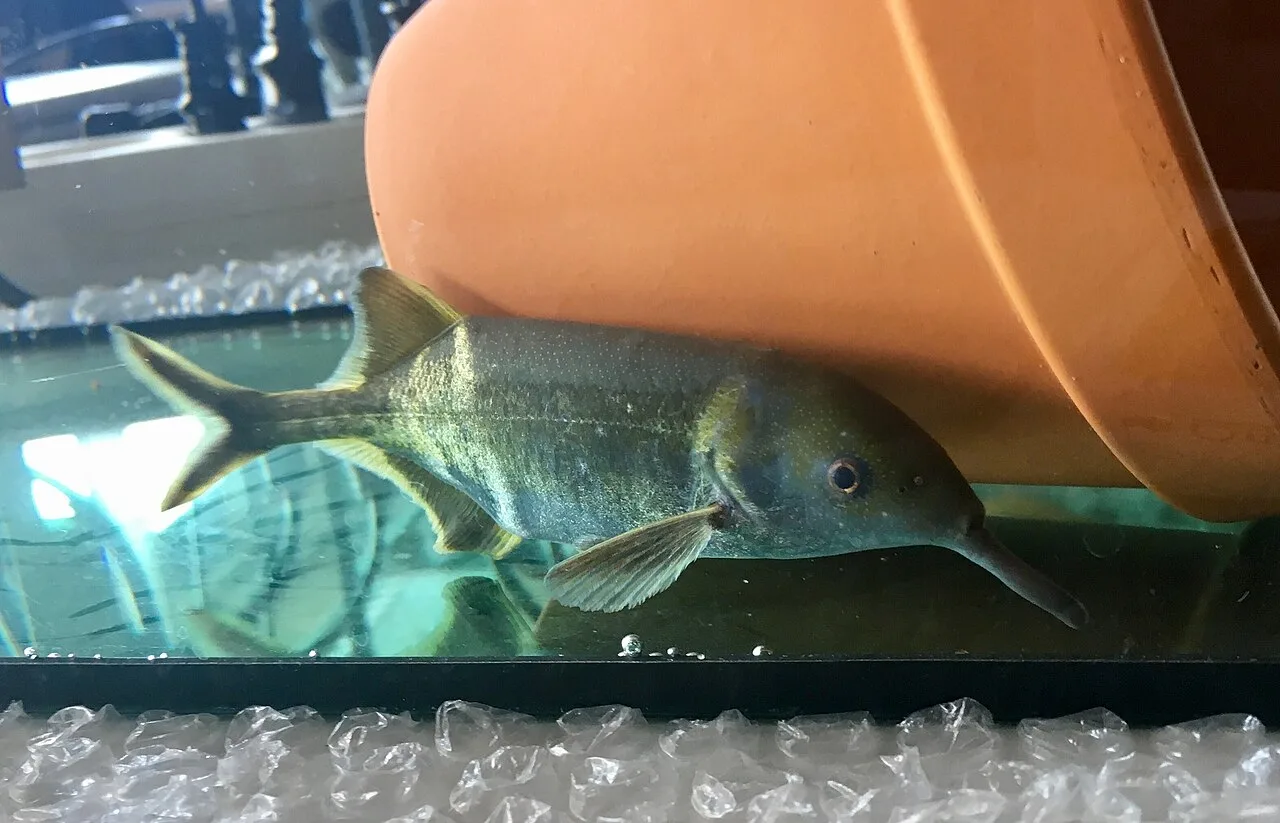
Grey-brown, deep-bodied, no dorsal fin. The anal fin is joined to the tail. 108 to 130 anal rays.
Body shape
The African brown knifefish is the only species of the genus Xenomystus within the Old World knifefishes (Notopteridae). The body is strongly compressed and elongated and resembles a knife blade. The anal and caudal fins are fused into one continuous fin that begins just behind the gill opening and runs to the pointed end of the body. By rippling this fin the fish can swim forwards and backwards without bending its body. The pelvic fins are greatly reduced, while the long pectoral fins provide fine steering. There is no dorsal fin, which separates it at a glance from the larger Asian relatives such as the clown knifefish.
The scales are very small, so the skin looks smooth. The lateral line stands out clearly and is, next to the large eyes, the most important sense organ. The large mouth carries a pair of short barbels. Males and females are hard to tell apart. A female ready to spawn is most easily recognised by a fuller body.
Origin & habitat
This describes the origin, not how to furnish the aquarium.
Upper Nile south of the Sudd, the Central African Republic, the northern Congo basin, Gabon and West Africa to Liberia. Mapped are the states named as such: the Central African Republic, Gabon and Liberia.
The range includes the Chad, Nile, Congo, Ogowe and Niger basins, plus coastal river basins in Sierra Leone, Liberia, Togo, Benin and Cameroon. It lives in quiet streams and lakes with vegetation. The species is nocturnal and spends the day in caves or dense plant cover.
Care
Notes from the hobby
The African brown knifefish has been offered occasionally as an aquarium fish for a long time. Because it is nocturnal, it retreats from bright light. Hiding places and subdued lighting match its way of life. Larger specimens may eat smaller tankmates, since the mouth is large for the body size.
Diet
Invertebrates from the bottom and from plants, located with electroreceptors.
The species feeds on worms, crustaceans, insects and snails. While searching it often swims head down close to the bottom. Barbels, eyes and the electroreceptors of the lateral line help it find prey even in complete darkness.
Behavior
Young fish in a school, adults solitary. Barking sounds by forcing air from the swim bladder.
From time to time the knifefish rises to the surface to gulp air, which it uses through the swim bladder. Young fish can be kept in small groups, but with age they become rather aggressive towards their own kind. The eyes are large and give good night vision. The forebrain is enlarged for processing sensory input.
Reproduction
150 to 200 eggs of 2 to 3 mm.
The eggs are about 2 mm in diameter.
Gallery
More species in this group
Similar water needs
Species with a similar temperature, a similar pH and a comparable adult size. Whether their behaviour fits as well is what the compatibility check is for.