Butterfly splitfin
Ameca splendens
21 views
A splitfin from western Mexico. Extinct in the wild. Males to 8 cm, females to 12 cm.
- Temperature
- 20 – 25 °C
- pH
- 7 pH
- General hardness
- 5 – 10 °dH
- Maximum size
- 12 cm
- Minimum tank size
- 100 L
4 min read · 646 words
Fresh water
Quick facts
Further published values
- Lifespan
- 6 a
Place in the aquarium
Highlighted are the water layer and the spots where the species usually stays in the tank.
- Upper water Usually stays in the top third of the tank.
- Middle water Usually stays in the middle of the tank, between bottom and surface.
- Open swimming space Needs an open area without plants or decor to swim at length. Tank length matters more than height.
Shrimp in the tank
Dwarf shrimp at risk
- Not shrimp safe
- Dwarf shrimp at risk
- Shrimplets at risk
- Shrimp safe
- Adult dwarf shrimp
- At risk
- Shrimplets
- Get eaten
- Safe from shrimp size
- about 4 cm
The butterfly splitfin is risky for dwarf shrimp. Females grow to 12 cm, and besides algae the species also eats insect larvae and small crustaceans. It is also robust and likes to nip fins. Young shrimp are certainly eaten, and adult Neocaridina or Caridina often as well. Larger shrimp such as Amano shrimp from about 4 cm are usually safe.
Dwarf shrimp are better kept separately. Amano shrimp suit well, because they also eat algae and cope with the lively splitfins. Plenty of plants and stones give them shelter.
Home & range
Hatched countries are where the species occurs. It lives in particular waters there, not across the whole country. The points name known waters for orientation, not collection sites.
- Country of origin
- Water for orientation
Native
- Rio Teuchitlan
- Only the Rio Teuchitlan and the Rio Ameca. The wild population is extinct.
Overview
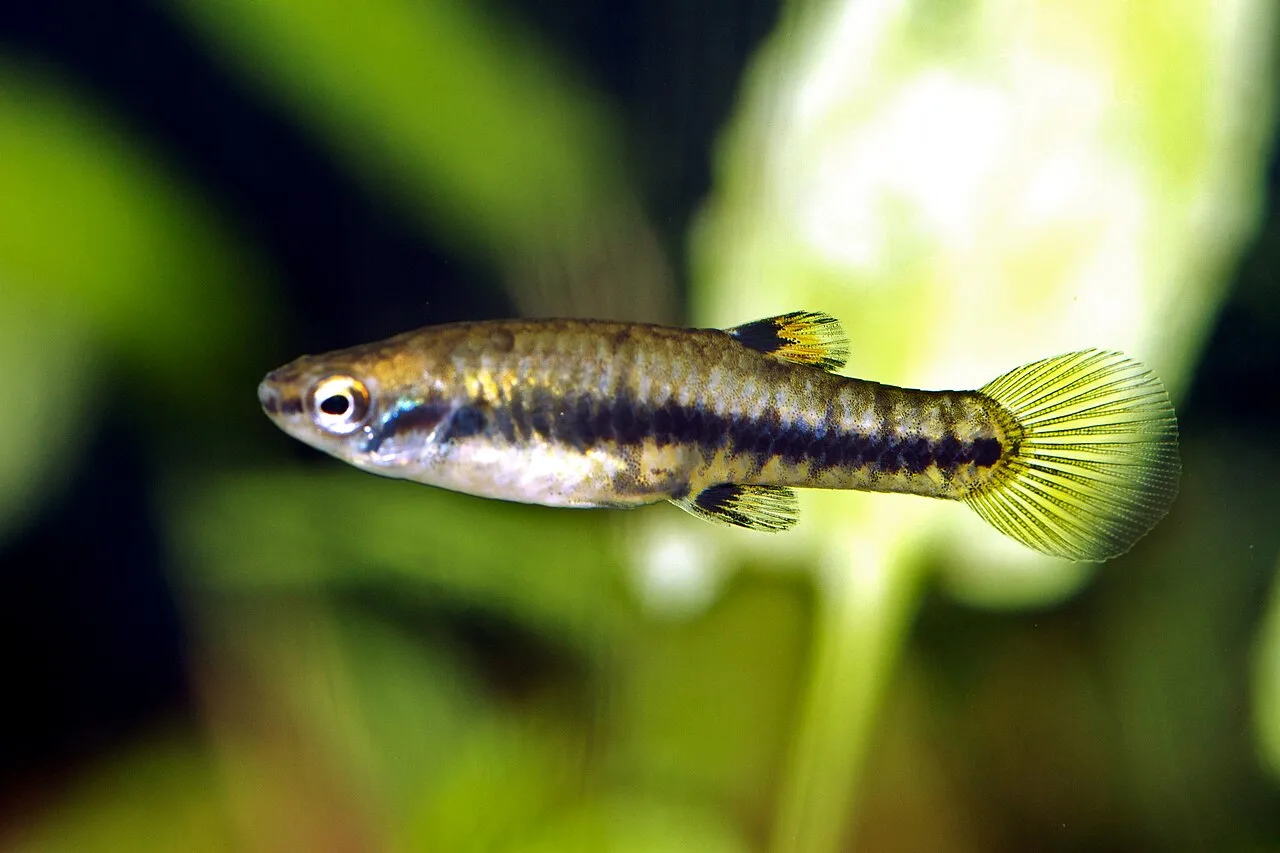
Males with an andropodium and often a black band in the tail, females larger and spotted. Flanks metallic blue, greenish or yellow depending on the light. Up to six years in the aquarium.
Colour in detail
Between the pointed head and the long caudal peduncle the body looks cylindrical. The transparent dorsal fin starts well behind the middle of the body. In females it is short and triangular, in adult males enlarged like a flag. Females have silvery pelvic, anal and tail fins with black spots and are spotted dark grey to black below the lateral line. Males show a dark band from the eye to the base of the tail, overlaid with glittering scales. In dominant males the anal and tail fins are edged white to bright yellow. Excited males colour their fins more strongly. Young fish are entirely silvery for roughly their first two weeks.
Taxonomy
Arthur A. Alcorn first recorded the species in the Rio Teuchitlán on 13 February 1949. Robert Rush Miller and John Michael Fitzsimons described it in 1971 in the new monotypic genus Ameca. Its closest relative is Xenotoca variata, which looks very similar, especially in the black and yellow tail of the males.
Origin & habitat
This describes the origin, not how to furnish the aquarium.
The only site known for a long time was the Balneario Teuchitlan, the spring of the Rio Teuchitlan, ten kilometres east of Ameca, later also the Rio Ameca. Mexico stays coarse and is not filled as a country shape. The readings at the spring, including about 28 °C as a yearly mean, 32 °C in April and later 25 °C, pH 7, KH 4 and GH 3, are the site, not a care optimum.
The spring pool at the Balneario Teuchitlán covers about 170 m² and is 30 to 150 cm deep. The bottom is slightly rocky and mostly covered with fine gravel and sand, while the slow outflows are muddy. Hornwort and water hyacinth grew densely, and stones and walls were coated with diatoms. The former habitat over limestone was hard and alkaline with a pH around 8. There are also finds in a few other streams and springs of the Ameca system, up to 100 km away at Cuyacapán. Assessments range from critically endangered to extinct in the wild.
Care
Not a standard shop fish, but offered regularly. Conservation breeding runs on captive-bred fish.
Keeping
The species thrives in clean, well-aerated water at about 20 to 25 °C, neutral to slightly alkaline pH and a hardness of 5 to 10 dGH, mainly from calcium. It does not tolerate water that is too soft or too acidic. The butterfly splitfin is known as a fin nipper and bullies small, delicate species such as guppies or small tetras. With sturdier tankmates, even hardy Apistogramma, it does well. Many zoos and public aquariums keep colonies of the species.
Diet
In the wild the fish fed mainly on plant matter and grazed diatom lawns. They also took insect larvae and small crustaceans.
Behavior
Livebearing.
In groups a loose hierarchy forms, especially in confined tanks. Males chase each other, and the top-ranking ones show the finest colours. Subordinate males usually retreat towards the surface and shake their heads as a calming signal.
Reproduction
The wild population is extinct. The fish in the trade are captive-bred.
Live birth with feeding cords
The male's andropodium is not a copulatory organ in the strict sense, but helps transfer sperm when the genital openings are pressed together. The embryos hatch inside the mother, remain in ovarian cavities and are nourished through feeding cords, the trophotaeniae. The young are born after 50 to 60 days. The trophotaeniae stay visible for hours to a few days. There is no sperm storage, and a brood has up to 30 young. Females mature at about six months and can give birth every six to ten weeks. Newborns are up to 20 mm long. During courtship the male presents himself to the female with the head tilted down by up to 45 degrees and shakes the front of his body.
Gallery
More species in this group

Similar water needs
Species with a similar temperature, a similar pH and a comparable adult size. Whether their behaviour fits as well is what the compatibility check is for.