Peppered cory
Hoplisoma paleatum
21 views
A cory from the Paraná, Uruguay and Río de la Plata. Corydoras paleatus is the synonym.
- Temperature
- 18 – 26 °C
- pH
- 5.5 – 7.2 pH
- General hardness
- 1 – 15 °dH
- Maximum size
- 7 cm
- Minimum group size
- 5
- Minimum tank size
- 120 L
4 min read · 533 words
Fresh water
Quick facts
Further published values
- Lifespan
- 10 – 13 a
Place in the aquarium
Highlighted are the water layer and the spots where the species usually stays in the tank.
- Near the bottom Mostly stays just above the bottom. Food has to reach the substrate.
- Substrate Sifts through the substrate or burrows into it. Fine, rounded sand without sharp edges suits it.
Shrimp in the tank
Shrimp safe
- Not shrimp safe
- Dwarf shrimp at risk
- Shrimplets at risk
- Shrimp safe
- Adult dwarf shrimp
- Safe
- Shrimplets
- Mostly safe
- Safe from shrimp size
- Any size
The peppered catfish is very peaceful and can be kept with shrimp without problems. It grows to about 7 cm and searches the bottom for algae, detritus, small animals and plant parts. It ignores adult shrimp. It cannot be ruled out completely that a newly hatched shrimp is taken in while it forages, but that remains the exception. Moss cushions and plant islands away from the sandy areas offer the young extra protection, so corys and dwarf shrimp thrive well in the same tank.
Home & range
Hatched countries are where the species occurs. It lives in particular waters there, not across the whole country. The points name known waters for orientation, not collection sites.
- Country of origin
- Water for orientation
Native
Overview
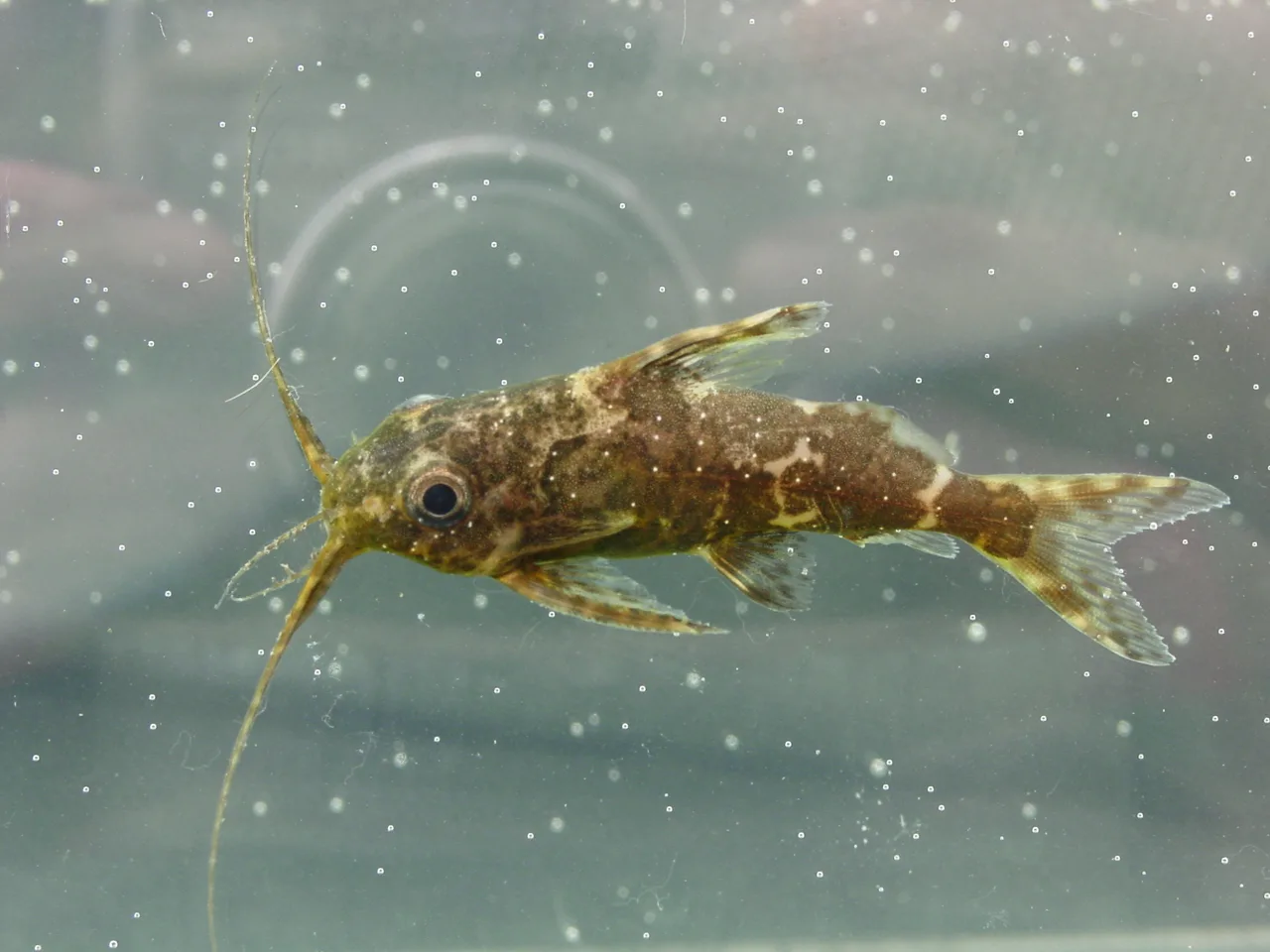
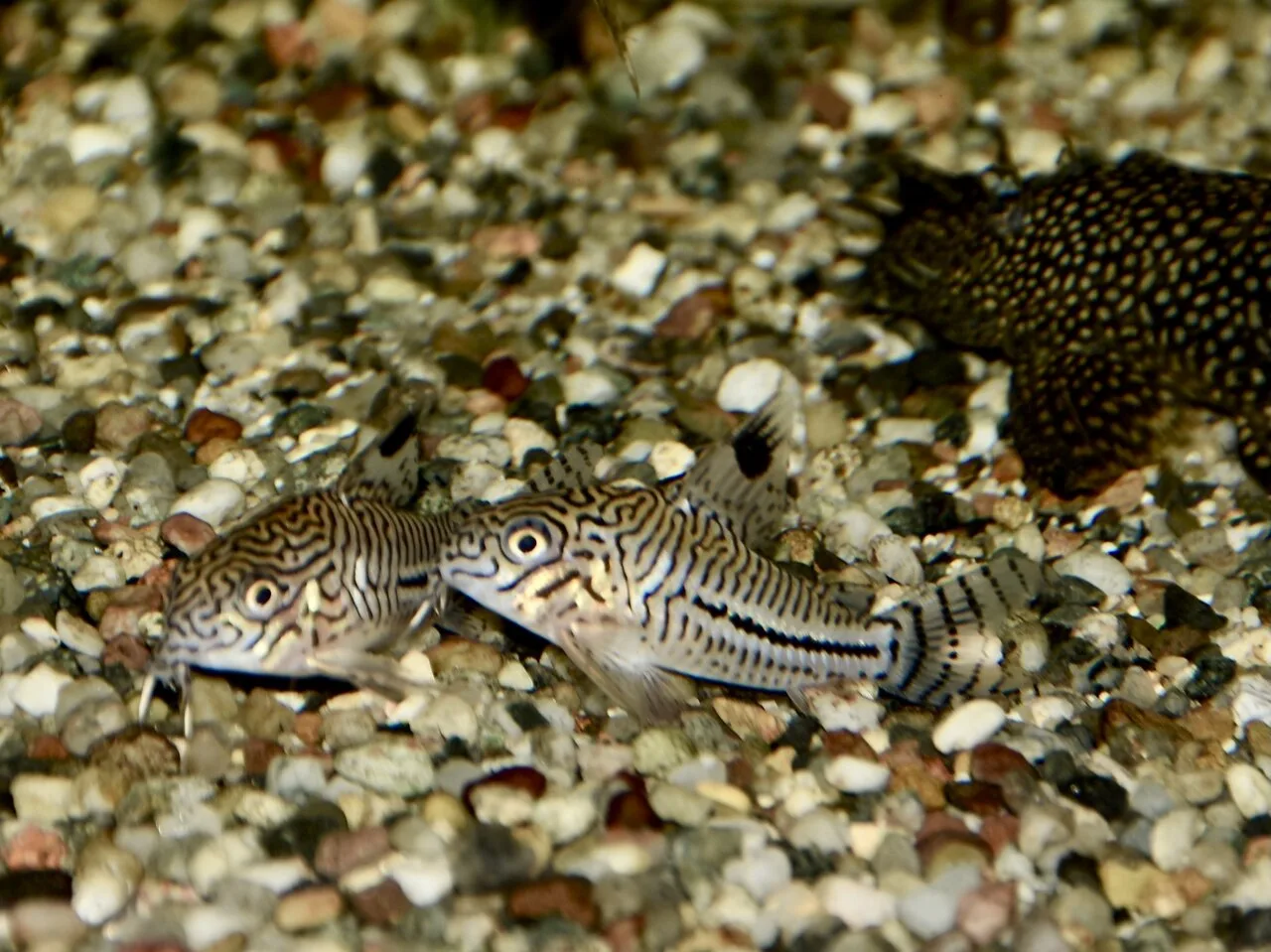
About 7 cm, 10 to 13 years. Yellowish orange with iridescent green and three large black spots. The tail has bars.
Features and name
The former species name paleatus comes from the Latin palea for chaff, in the sense of speckled. In English the species is called peppered catfish, mottled corydoras or blue leopard corydoras. The pectoral fins are transparent or black. The dorsal spine is serrated at the rear of its outer part with five to nine teeth, smooth in some fish. The pectoral spines are serrated along their whole length. The adipose fin is roughly triangular, as is the anal fin. The fin formula is dorsal I/7–8 and anal I/6.
Males are smaller and slimmer than females and, relative to body length, have longer dorsal and pectoral fins. Standard length is 5.9 to 7 cm.
Classification
Leonard Jenyns described the species in 1842 as Callichthys paleatum. Charles Darwin had discovered it in the 1830s near Buenos Aires during the voyage of the Beagle. For a long time it was placed in Corydoras. Because that genus was not a natural group, in June 2024 it moved together with more than 80 other short-snouted corys into the genus Hoplisoma, which William Swainson had established as early as 1838.
Origin & habitat
This describes the origin, not how to furnish the aquarium.
Lower Paraná, Uruguay and Río de la Plata in Argentina and Uruguay, plus rivers in Rio Grande do Sul. The three countries stay coarse.
The species lives in the lower Paraná basin in Paraguay, Argentina and Brazil and in coastal rivers in Brazil and Uruguay.
Care
Groups from five, tanks from 60 cm long. Peaceful, also with smaller fish and shrimp.
The fish feel at home in a well-structured tank with many hiding places and fine sand or gravel. They prefer dim light to strong lighting. Like all corys they also breathe through the gut and take air at the surface from time to time. The species is regarded as relatively hardy.
Diet
On and near the bottom: algae, detritus, small animals, plant parts.
Its food includes worms, crustaceans, insects and plant matter.
Behavior
Lively, it roams the tank.
Moving together
The fish roam the bottom in groups and dig through the upper layers for food. Active phases alternate with shared rest phases, in which the fish lie motionless on the bottom or on surfaces for a while. By rubbing the pectoral fin in a groove on the shoulder girdle they produce sounds. Males use them in courtship, and both sexes and juveniles when distressed.
Reproduction
Easy to breed, triggered by an imitated rainy season. More males than females.
Breeding
During reproduction males are not aggressive towards each other and claim neither spawning sites nor females. As in many corys, the T-position is part of courtship. Spawning is triggered by large, sudden partial water changes with temperature swings. One female to two males is enough, and with fewer males far fewer eggs are fertilised. The female attaches about 150 transparent white eggs one after another to large leaves, stones or the glass. Unfertilised eggs easily develop fungus, which spreads to fertilised ones. The eggs are soon separated from the parents and hatch after three to five days. Two to three days later, once the yolk sac is used up, the tiny larvae are given brine shrimp nauplii.
Gallery
More species in this group

Similar water needs
Species with a similar temperature, a similar pH and a comparable adult size. Whether their behaviour fits as well is what the compatibility check is for.