
Steel-blue killifish
Fundulopanchax gardneri
20 views
A killifish from Nigeria and southwestern Cameroon, to 6.5 cm. Four recognised subspecies stay one species.
- Temperature
- 22 – 25 °C
- pH
- 6 – 7.5 pH
- General hardness
- 4 – 12 °dH
- Maximum size
- 6.5 cm
- Minimum tank size
- 40 L
3 min read · 369 words
Fresh water
Quick facts
Place in the aquarium
Highlighted are the water layer and the spots where the species usually stays in the tank.
- Middle water Usually stays in the middle of the tank, between bottom and surface.
- Near the bottom Mostly stays just above the bottom. Food has to reach the substrate.
- Dense plants Looks for dense planting as cover, retreat or grazing ground.
Shrimp in the tank
Dwarf shrimp at risk
- Not shrimp safe
- Dwarf shrimp at risk
- Shrimplets at risk
- Shrimp safe
- Adult dwarf shrimp
- At risk
- Shrimplets
- Get eaten
- Safe from shrimp size
- about 4 cm
Gardner's killifish endangers dwarf shrimp. It grows to 6.5 cm, eats any live or frozen food and prefers insect larvae. Males are territorial and fairly aggressive. Young shrimp are eaten, and smaller Neocaridina or Caridina often as well. Larger shrimp such as Amano shrimp from about 4 cm are usually safe.
Since the species is often kept in a species tank anyway, dwarf shrimp are better kept in a tank of their own. Dense plants and moss reduce losses if both live together.
Home & range
Hatched countries are where the species occurs. It lives in particular waters there, not across the whole country. The points name known waters for orientation, not collection sites.
- Country of origin
- Water for orientation
Native
Overview
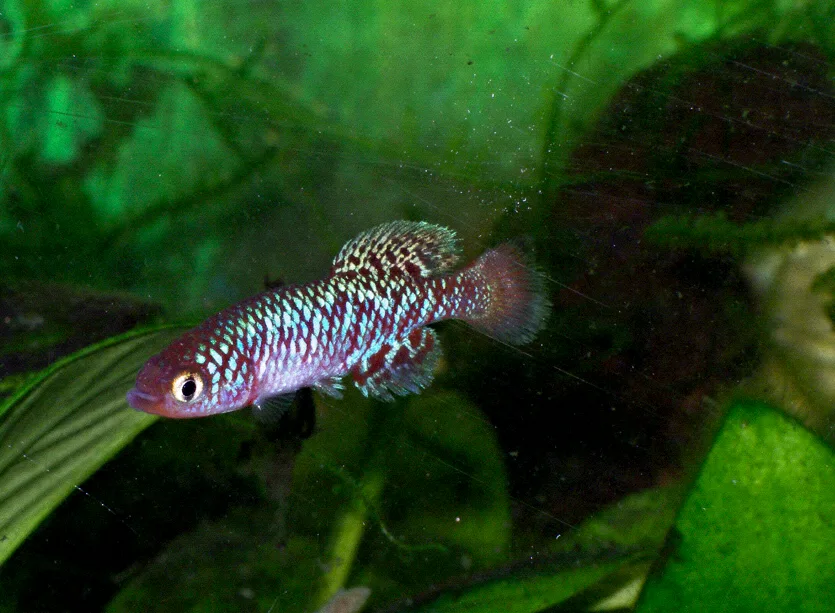
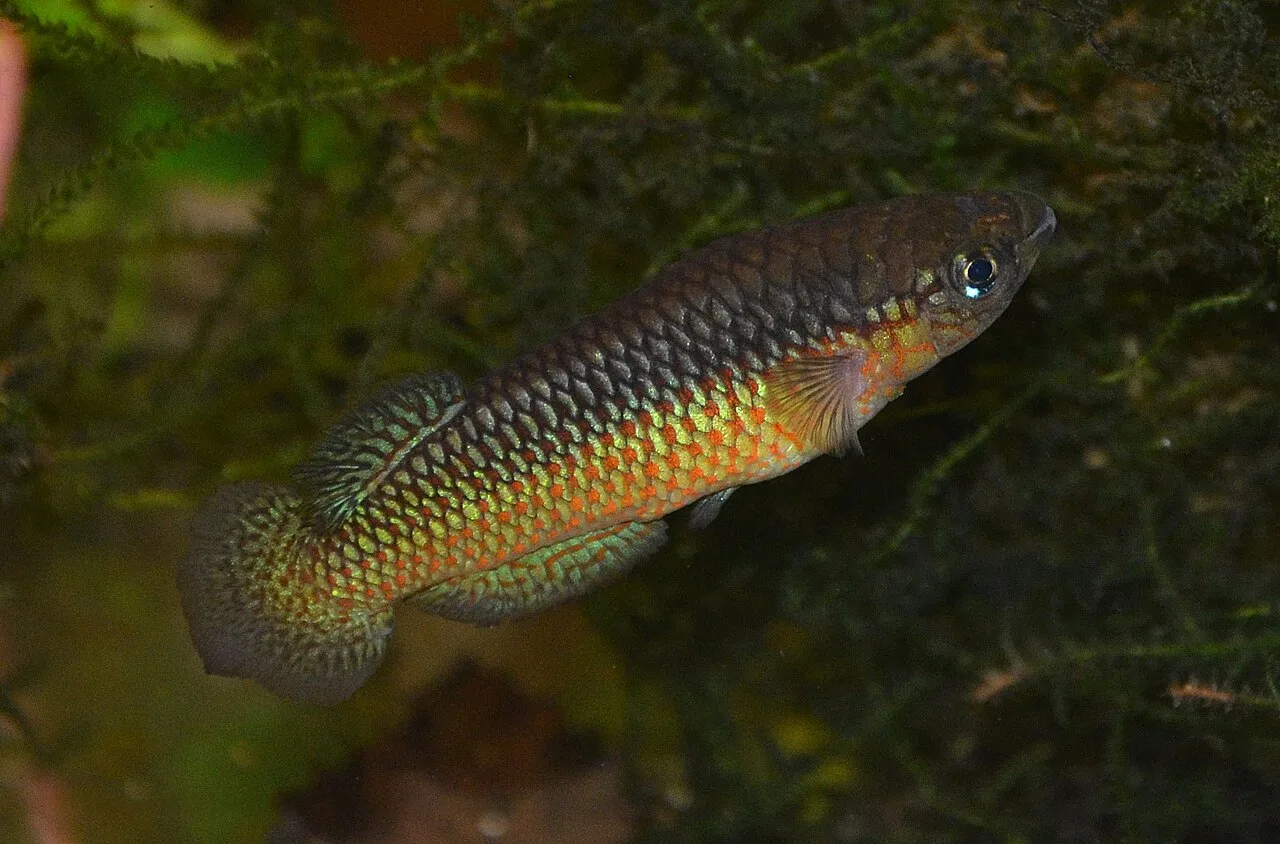
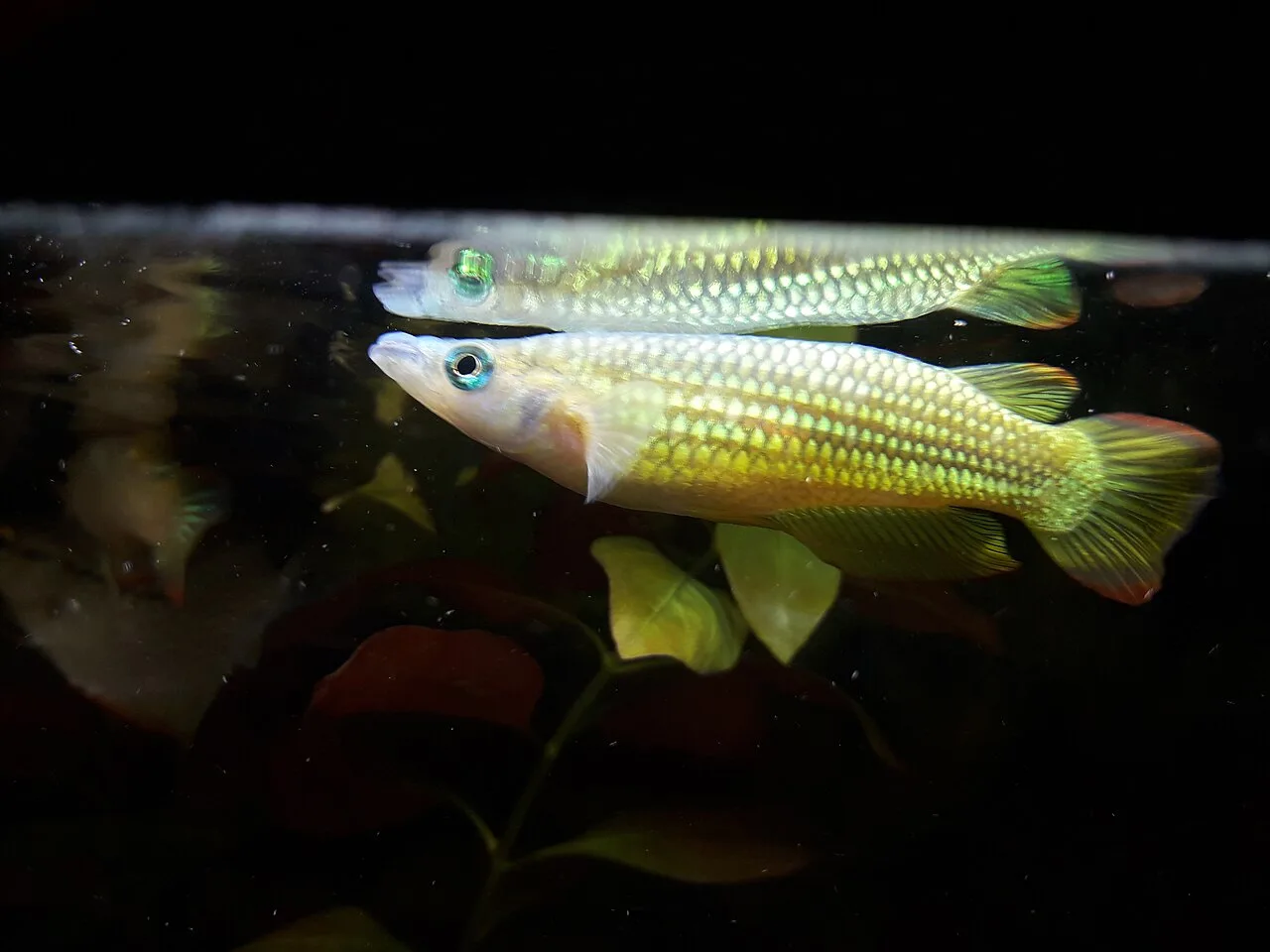
Males metallic green to blue with carmine spots, females light brown and plainer. The pattern varies by population. Formerly placed in Aphyosemion.
Pattern and forms
The red dots of the males can form longitudinal rows on the front of the body. Forms with a red stripe have a yellow, rarely orange fin margin, while forms with only red dots usually have bluish or white-edged fins. Females are light brown with small brown dots on the flanks and at the fin bases. A middle longitudinal row has 29 to 34 scales. Males are larger, more colourful and have larger fins with yellow-tinted margins.
Name and taxonomy
George Albert Boulenger described the species in 1911 as Fundulus gardneri. The name honours the officer R. D. Gardner, who handed over the type specimens. The type locality is Okwoga in the headwaters of the Cross River. The subspecies gardneri, lacustris, mamfensis and nigerianus are recognised. The genus Fundulopanchax now includes several former subgenera of Aphyosemion. The species was first imported to Germany in 1913.
Origin & habitat
This describes the origin, not how to furnish the aquarium.
Rainforest and savanna waters. The nominate form in tributaries of the Cross River in southeastern Nigeria. Nigeria and Cameroon stay coarse. Soft, slightly acidic water, without a number. Semiannual: the eggs survive a drying of the water.
The species lives in tributary streams and marshes of the Benue and Cross River basins in Nigeria and Cameroon, in savanna as well as forest areas. The waters are unpredictable, so the species follows a switch or semi-annual strategy: the eggs survive drying out but also develop when permanently submerged. The species is regarded as especially resistant to low oxygen. The IUCN rates it as near threatened.
Care
Keeping
The blue lyretail is considered easy to keep and breed. Species tanks are generally recommended. Males may harass slower species and, without females, may try to mate with unrelated tankmates. The males are territorial.
Behavior
The males in particular fight each other hard. They drive the females strongly.
Reproduction
Eggs on fine-leaved plants or a wool mop. Without a dry phase, hatch in two to three weeks.
The eggs are laid on the bottom and, when submerged, hatch after about 14 to 21 days depending on temperature. In the aquarium they can be collected from a spawning mop.
Gallery
More species in this group
Similar water needs
Species with a similar temperature, a similar pH and a comparable adult size. Whether their behaviour fits as well is what the compatibility check is for.

