Flagfish
Jordanella floridae
22 views
A toothcarp from Florida. Females to 6 cm, males to 4.5 cm.
- Temperature
- 19 – 25 °C
- pH
- 6.5 – 8 pH
- General hardness
- 8 – 20 °dH
- Maximum size
- 6 cm
- Minimum tank size
- 60 L
3 min read · 405 words
Fresh water
Quick facts
Place in the aquarium
Highlighted are the water layer and the spots where the species usually stays in the tank.
- Middle water Usually stays in the middle of the tank, between bottom and surface.
- Near the bottom Mostly stays just above the bottom. Food has to reach the substrate.
- Dense plants Looks for dense planting as cover, retreat or grazing ground.
Shrimp in the tank
Shrimplets at risk
- Not shrimp safe
- Dwarf shrimp at risk
- Shrimplets at risk
- Shrimp safe
- Adult dwarf shrimp
- Safe
- Shrimplets
- Get eaten
- Safe from shrimp size
- about 2 cm
Adult dwarf shrimp are usually safe from the flagfish. Males stay at 4.5 cm and females reach 6 cm. The species mainly eats algae and plants, plus worms, small crustaceans and insects. Shrimp from about 2 cm are usually safe, while young are eaten. Territorial males may also chase shrimp away.
Because it eats hair algae, it complements shrimp well. Moss and dense plants give the young shelter. Neocaridina suit the moderately hard water well.
Home & range
Hatched countries are where the species occurs. It lives in particular waters there, not across the whole country. The points name known waters for orientation, not collection sites.
- Country of origin
- Water for orientation
Native
- Florida
- Only Florida.
Overview
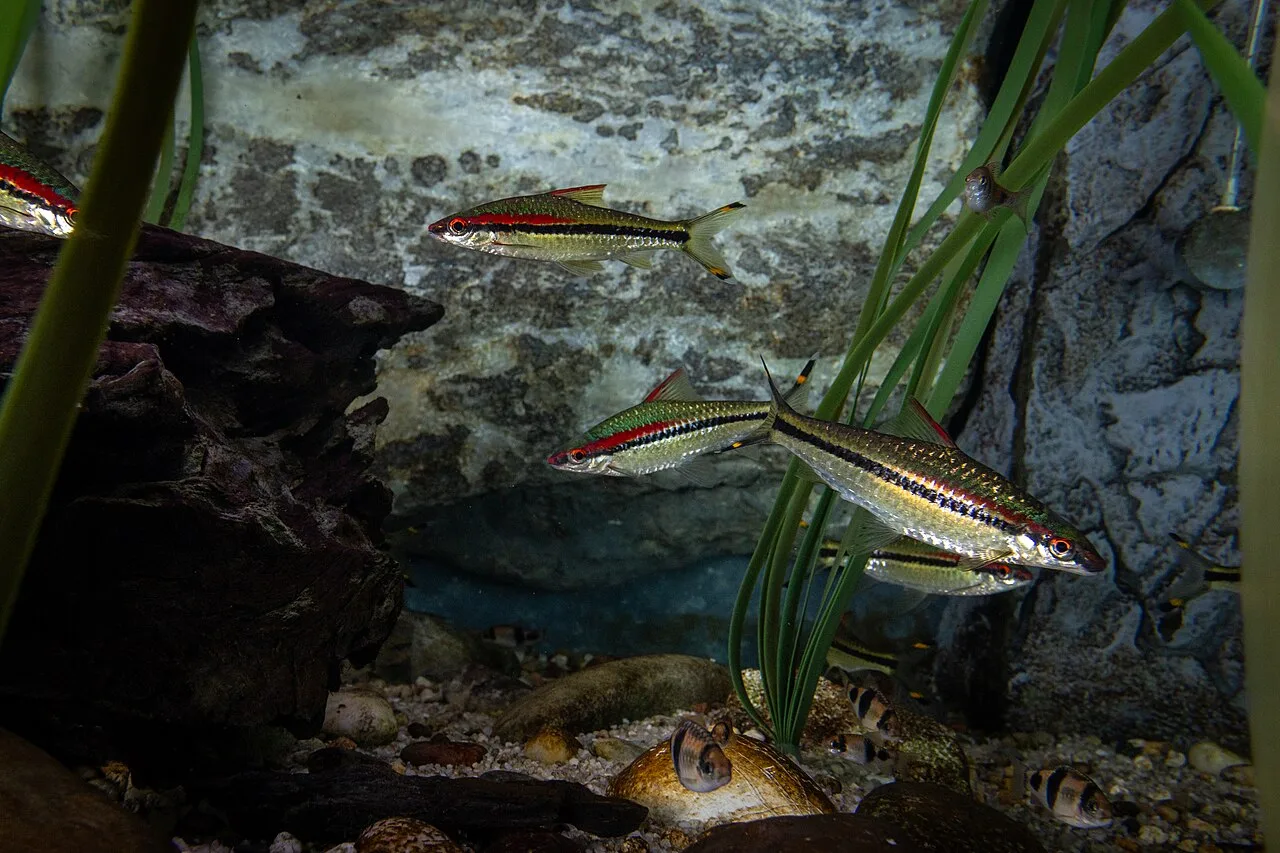
Stocky and deep-bodied, the body depth one third of the length. Brownish to greenish, belly almost whitish, scales with bluish to pale yellow dots. Males with 9 to 10 red longitudinal lines. A dark spot on the flanks.
Body shape and pattern
The flagfish is laterally compressed and has a very deep caudal peduncle. Dorsal, anal and tail fins are rounded. The dorsal fin starts midway between the eye and the base of the tail and is longer than the anal fin. The mouth is superior with small three-pointed teeth, and the scales are large. The blunt snout recalls a bulldog. Dominant males carry a dark rectangle on the shoulder and red and greenish stripes, which resembles the flag of the USA and explains the English name. Females have a clear spot on the flank and a pale, white-edged spot at the rear of the dorsal fin. Non-dominant males, females and juveniles are olive-grey.
Name and taxonomy
George Brown Goode and Tarleton Hoffman Bean described the species in 1879, with Lake Monroe in Florida as the type locality. The genus honours the zoologist David Starr Jordan, and the specific name refers to the range. A close relative is the Yucatan flagfish Garmanella pulchra.
Origin & habitat
This describes the origin, not how to furnish the aquarium.
Pools, ditches and slow streams in Florida. The United States stay coarse and are not filled as a country shape.
The species lives near the bottom in plant-rich still and slow-flowing waters, occasionally also in brackish water. It is endemic to the Florida peninsula south of the St. Johns River and Ochlockonee River basins. Shallow, densely vegetated backwaters, marshes, canals and ditches are named.
Diet
The flagfish mainly eats algae and plants, plus worms, small crustaceans and insects. Zooplankton is eaten as well. Notably, the species eats hair algae in notable amounts and is therefore used against such algae in aquariums.
Behavior
Males are territorial. During courtship the male is very active. The female nips the male to make him follow. Then the two face each other, the female swims backwards, and the male does a backflip.
Reproduction
Keeping as an aquarium fish is named, without a protocol.
The female lays 200 to 300 eggs in a pit, and the male guards and fans them. His care usually ends after just one day. Depending on temperature the young hatch after 5 to 10 days. Other reports speak of only about 20 eggs over a few days. The male may also eat his own eggs or young.
More species in this group
Similar water needs
Species with a similar temperature, a similar pH and a comparable adult size. Whether their behaviour fits as well is what the compatibility check is for.