Japanese ricefish
Oryzias latipes
16 views
A ricefish, to 4 cm. Oryzias sakaizumii has been a separate species since 2012 and is not a second profile.
- Temperature
- 15 – 28 °C
- pH
- 7 – 8 pH
- General hardness
- 9 – 19 °dH
- Maximum size
- 4 cm
- Minimum tank size
- 40 L
4 min read · 544 words
Fresh water
Quick facts
Further published values
- Lifespan
- 2 – 4 a
Place in the aquarium
Highlighted are the water layer and the spots where the species usually stays in the tank.
- Water surface Stays just below the surface. The top needs a calm current and a cover.
- Upper water Usually stays in the top third of the tank.
Shrimp in the tank
Shrimplets at risk
- Not shrimp safe
- Dwarf shrimp at risk
- Shrimplets at risk
- Shrimp safe
- Adult dwarf shrimp
- Safe
- Shrimplets
- Get eaten
- Safe from shrimp size
- about 1.5 cm
Adult dwarf shrimp are safe from the medaka. It grows to only about 3.6 to 4 cm, has a small mouth and eats mosquito larvae and small plankton. It cannot handle shrimp from about 1.5 cm. Newly hatched young shrimp, however, are part of its prey. Because medaka are also kept in mini ponds and tubs, hardy Neocaridina that tolerate similar temperatures suit them well. Dense plants, moss and the roots of floating plants give the young cover.
Home & range
Hatched countries are where the species occurs. It lives in particular waters there, not across the whole country. The points name known waters for orientation, not collection sites.
- Country of origin
- Water for orientation
Native
- Korea
- Range: Korea without separating north and south.
Overview
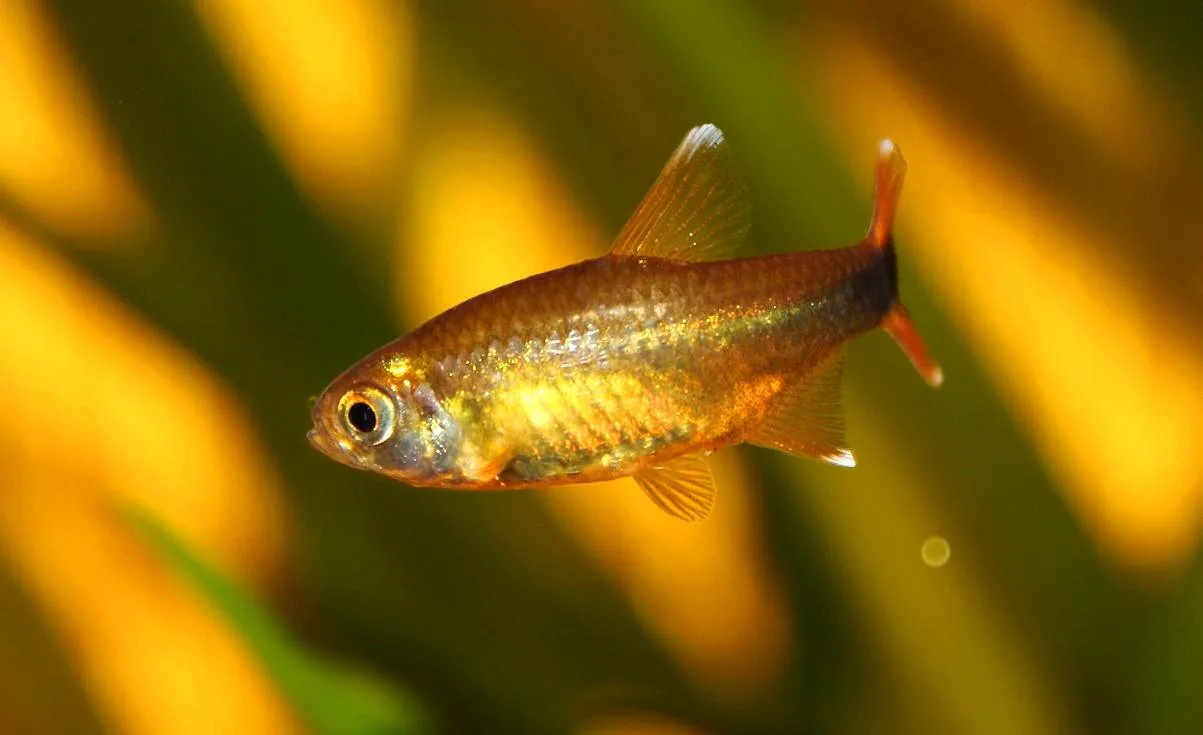
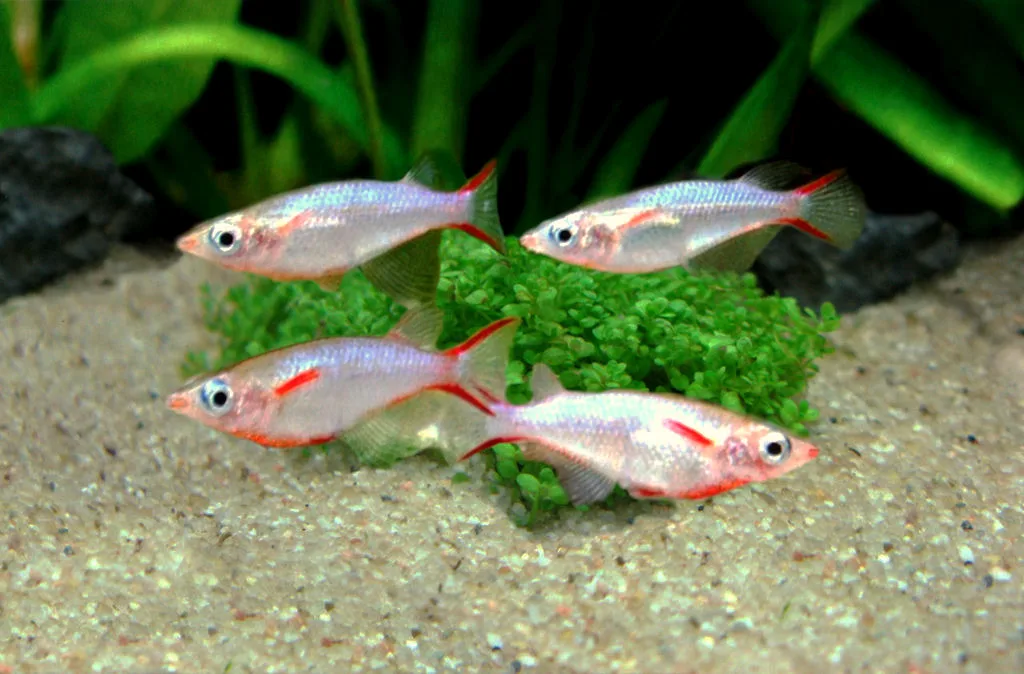
Laterally flattened, translucent, 28 to 32 scales along the body. Compared with sakaizumii a larger tail and usually lower-set eyes. Breeds have other traits than wild fish and are not counted as species here.
Names and features
The medaka is also called Japanese rice fish and belongs to the ricefish family Adrianichthyidae. Temminck and Schlegel described it in 1846 as Poecilia latipes. Oryzias comes from the Greek oryza for rice and refers to the habitat, latipes from the Latin latus for broad and pes for foot.
The head takes up about a quarter of standard length. The mouth is terminal, and the jaws are about equal or the lower jaw is slightly longer. The medium-sized eyes do not project above the top of the head. Scattered dark pigment cells in the translucent body form more or less distinct rows from the back of the head to the dorsal fin and along the flank from head to tail. Size figures start at about 3.6 cm.
Model organism
The medaka is an important model organism, above all in toxicology and increasingly also for bone diseases such as osteoporosis. It has a short generation time, is very prolific, cold-hardy and easy to ship. Inbred lines are easier to establish than in zebrafish or mice, and there were already ten by 1979. In 1994 it was the first vertebrate recorded mating in orbit: healthy fry hatched aboard the Space Shuttle Columbia. In 2012 it went to space again, into an aquarium on the International Space Station.
Origin & habitat
This describes the origin, not how to furnish the aquarium.
Japan, Korea, China and Vietnam. The four countries stay coarse. Records in the Nam Theun, Mekong, Irrawaddy, Salween, Red River and Nanpangjiang add no further states. Ponds, swamps, rice fields, slow streams, lowlands and also brackish water and tide pools in Japan and Korea. The preferred temperature of 18 to 24 °C describes the habitat, not an aquarium optimum.
The medaka tolerates a wide range of salinity and therefore also lives in brackish water. It survives water temperatures from 0 to 42 °C but prefers 15 to 28 °C. Wild populations are threatened by land consolidation and pesticides and also by released aquarium strains. Where these are released, hybrids keep increasing, so pure wild forms may disappear. The Japan Medaka Association tries to counter this with education.
Care
Released breeds threaten the wild form by hybridisation.
Keeping
Medaka are easy to keep in the aquarium and, when the weather allows, in mini ponds and outdoor tubs. pH 7.0 to 8.0 and 9 to 19 °dH are preferred, and brackish water is also possible. The pH should not drop much below 7. In Japan the medaka has been kept for centuries. Today 456 commercial strains are documented there, partly developed with Oryzias sakaizumii. It is also used in school teaching.
Diet
Omnivore.
Because the medaka eats mosquito larvae and small plankton, it is regarded as useful to humans.
Reproduction
Southern medaka is the Japanese name used to separate it from sakaizumii.
At constantly warm temperatures medaka mature after two to three months, so several generations a year are possible. Females carry the eggs as a cluster below the vent for a while and then wipe them off in dense growth, on roots of floating plants or on a spawning mop. Each spawning produces 10 to 20 eggs, daily under laboratory conditions. In nature reproduction is seasonal. The eggs are hardy and easy to ship.
Gallery
More species in this group
Similar water needs
Species with a similar temperature, a similar pH and a comparable adult size. Whether their behaviour fits as well is what the compatibility check is for.