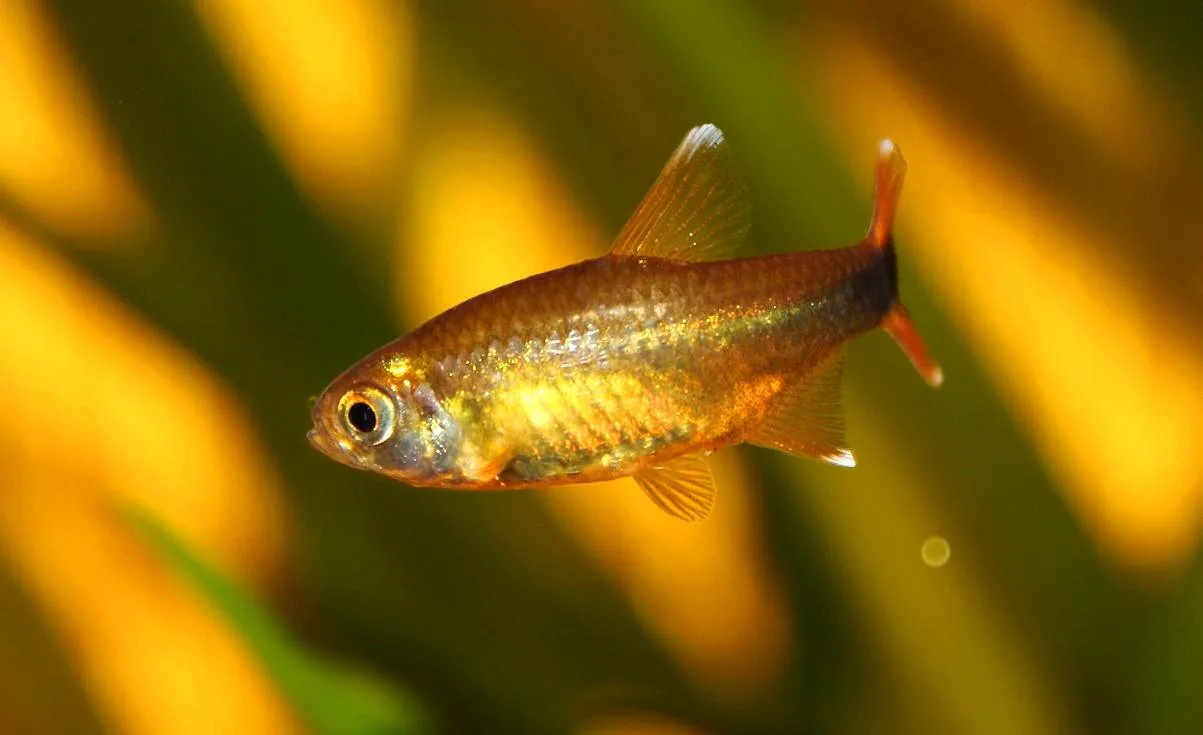
Daisy ricefish
Oryzias woworae
14 views
A small ricefish from Sulawesi, the males with a blue and red sheen. It swims as a group near the surface.
- Temperature
- 23 – 27 °C
- pH
- 6.5 – 7.5 pH
- General hardness
- 5 – 15 °dH
- Maximum size
- 3 cm
- Minimum group size
- 8
- Minimum tank size
- 40 L
2 min read · 304 words
Quick facts
Place in the aquarium
Highlighted are the water layer and the spots where the species usually stays in the tank.
- Upper water Usually stays in the top third of the tank.
- Dense plants Looks for dense planting as cover, retreat or grazing ground.
Shrimp in the tank
Shrimplets at risk
- Not shrimp safe
- Dwarf shrimp at risk
- Shrimplets at risk
- Shrimp safe
- Adult dwarf shrimp
- Safe
- Shrimplets
- Get eaten
- Safe from shrimp size
- about 1 cm
The neon rice fish is harmless to adult shrimp. It stays at about 3 cm, lives in a school and is an omnivore with a small mouth. It cannot eat shrimp from about 1 cm. Newly hatched shrimp, however, are eaten when they get into open water.
The fish stay mainly in the upper water. Moss and fine plants on the bottom give the young shrimp enough cover for Neocaridina or Caridina to breed alongside a school.
Home & range
Overview
Oryzias woworae stays at about 3 cm. The males show a blue body sheen and red fin edges, the females plainer olive. The eyes are large. The species is not the medaka Oryzias latipes, which stays paler and tolerates cooler water. Both are listed as ricefish and have different temperatures.
The colour comes in the group and against a dark bottom. A single male in a bright tank looks grey. That is the place, not a pale strain.
Origin & habitat
This describes the origin, not how to furnish the aquarium.
Streams and small waters on Sulawesi, clear, with plants and light. The island stays the coarse origin. The natural area is small. Aquarium fish should be captive-bred. The species jumps.
Care
Size
23 to 27 °C, pH 6.5 to 7.5. A school from eight, tanks from about 40 litres, densely planted at the edges, open above, with a firm cover. Not a permanent stay below 22 °C and not an unheated pond fish like some medaka. Floating plants give cover without closing the whole surface.
Company
Other very small, quiet fish, or the species alone. Shrimp fit. Large tetras, barbs and every cichlid do not. The ricefish lose every feeding to faster mouths and are also eaten.
Diet
Fine food at the surface and in the upper midwater. Brine-shrimp nauplii, cyclops, dust-fine flakes. Several small feeds. Bottom tablets miss the species.
Behavior
A loose group near the surface. The males show each other the red fins. Too few fish stand singly and lose the colour. Within the species they stay peaceful. A cover is not caution. It is the keeping, because they go through narrow gaps.
Reproduction
The eggs hang as a small cluster on the belly of the female and are stripped off onto fine plants. The parents do not guard them. In moss a few young survive. Deliberate breeding means moving the plants with the eggs and feeding the larvae dust food.
More species in this group
Similar water needs
Species with a similar temperature, a similar pH and a comparable adult size. Whether their behaviour fits as well is what the compatibility check is for.