Zebrafish
Danio rerio
22 views
Striped schooling fish from the Ganges basin. It tolerates cooler water than many tropical fish and is a laboratory animal.
- Temperature
- 18 – 25 °C
- pH
- 6.5 – 8 pH
- General hardness
- 5 – 19 °dH
- Maximum size
- 5 cm
- Minimum group size
- 8
- Minimum tank size
- 80 L
3 min read · 460 words
Fresh water
Quick facts
Further published values
- Lifespan
- 2 – 3 a
Place in the aquarium
Highlighted are the water layer and the spots where the species usually stays in the tank.
- Upper water Usually stays in the top third of the tank.
- Open swimming space Needs an open area without plants or decor to swim at length. Tank length matters more than height.
Shrimp in the tank
Shrimplets at risk
- Not shrimp safe
- Dwarf shrimp at risk
- Shrimplets at risk
- Shrimp safe
- Adult dwarf shrimp
- Safe
- Shrimplets
- Get eaten
- Safe from shrimp size
- about 1.5 cm
Adult dwarf shrimp are safe with the zebra danio. It grows up to 5 cm, has a slightly upturned mouth and is an omnivore that mixes well with other tank inhabitants. Shrimp from about 1.5 cm are too large for it. Juvenile shrimp are eaten, however, when they get into open water.
The school swims mainly in the upper and middle water. Dense plants and moss on the bottom let enough young shrimp survive. The rather cool temperatures of the species suit Neocaridina well.
Home & range
Hatched countries are where the species occurs. It lives in particular waters there, not across the whole country. The points name known waters for orientation, not collection sites.
- Country of origin
- Water for orientation
Native
Overview
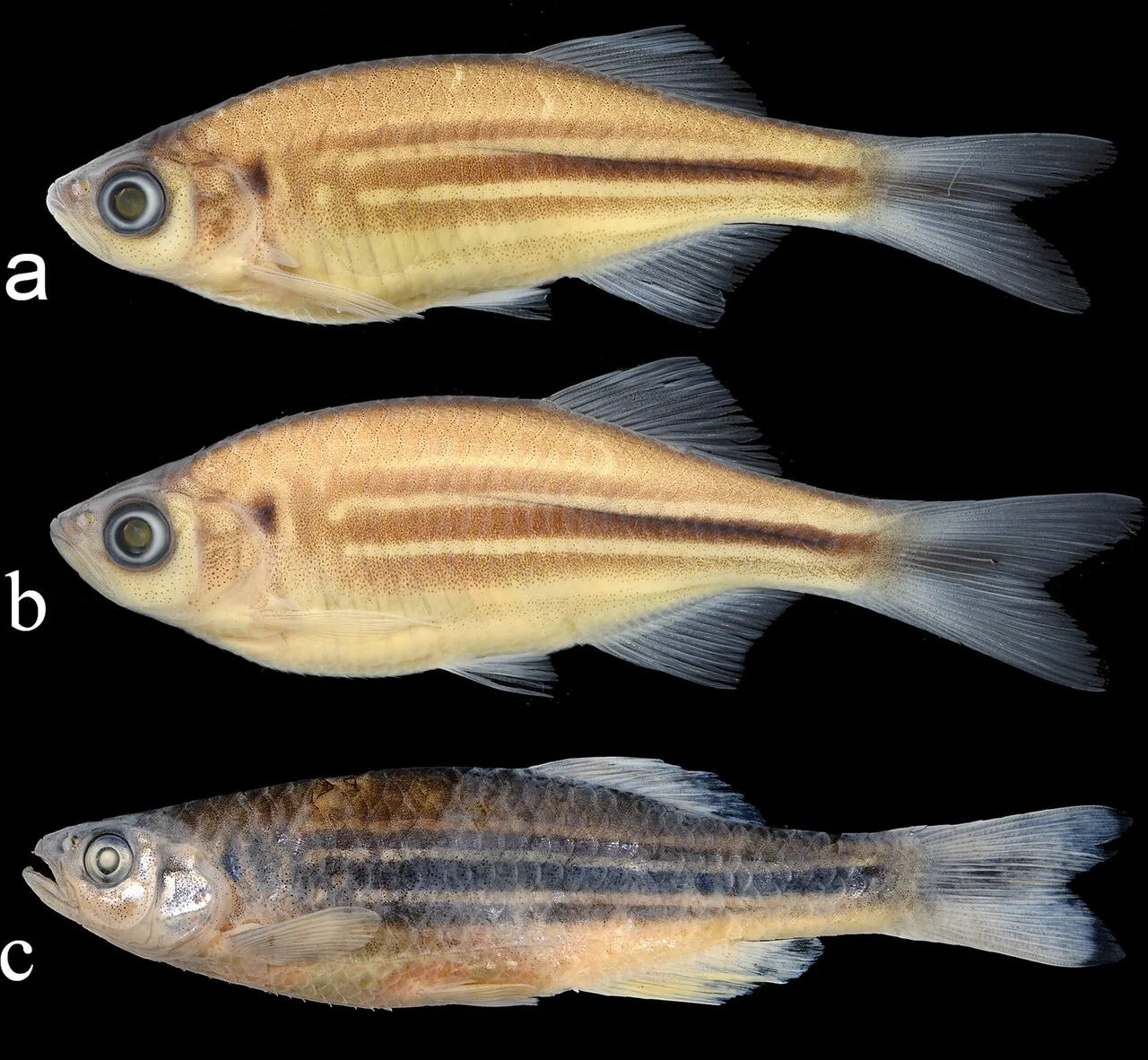
The species reaches 5 cm. Olive-brown back, yellow-white belly, blue-iridescent black stripes from the gill cover into the tail. Two pairs of barbels. Females are deeper, a little larger and paler. The leopard danio is a mutant in which the stripes break into spots, not a separate species. A visible lateral line is absent. Cover the tank, because the fish jump.
Further features
Francis Buchanan-Hamilton described the species in 1822. An older name is Brachydanio rerio, and in the lab the fish is called zebrafish. The body is slender and only slightly compressed. The flanks are yellowish silver. Anal fin and gill cover carry grey-blue and pale yellow stripes or spots, and the pectoral and pelvic fins are colourless. The mouth is slightly upturned. The upper pair of barbels reaches the front edge of the eye, the longer lower pair the middle of the gill cover. Fin formula: dorsal 2/7, anal 2/13. The middle longitudinal row has 26 to 28 scales, and there are 31 to 32 vertebrae.
Leopard danio
The spotted pattern goes back to a mutation in the gene for connexin 41.8, a gap-junction protein. The leopard danio was described by Meinken in 1963 as Danio frankei but is not accepted as a separate species. It was first found in an aquarium in Prague. Whether a natural population exists is disputed.
Origin & habitat
This describes the origin, not how to furnish the aquarium.
It lives in the Ganges drainage in Pakistan, northern India, southern Nepal and Bangladesh, in slow or still water and rice fields. Those four countries are a coarse origin and are not filled. Records in the United States are traced to fish farms and are not mapped.
Care
Keeping is possible from about 18–20 °C. The keeping range is 18–25 °C. Outside 25–31 °C the fish do not breed, or breed less. The warmer window is reproduction, not general keeping. Groups of at least eight are.
Diet
Omnivore. Flakes and small frozen food are the practical feeding.
Behavior
A peaceful school that can be kept with other tankmates. A single fish does not suit it; the species belongs in a group.
Reproduction
Egg scatterer without brood care. In good conditions a female lays up to 300 eggs a week. The embryos develop outside the body and are transparent. The fish mature at twelve to sixteen weeks. That explains the use as a laboratory animal. It is not an instruction to turn a community tank into a breeding setup.
Model organism
In genetics and developmental biology the zebrafish is an important model organism, because it is diploid, has a short generation time and suits many mutagenesis and screening methods. In experiments hearts regenerate after losing up to 20 percent of their muscle tissue, and amputated fins regrow through activated osteoblasts. Since 2003 genetically modified fluorescent zebrafish have been sold in the USA as GloFish. Sale and breeding are banned in the EU.
Gallery
More species in this group
Similar water needs
Species with a similar temperature, a similar pH and a comparable adult size. Whether their behaviour fits as well is what the compatibility check is for.