Celestial pearl danio
Danio margaritatus
20 views
A small danio with pearly spots. Standard length is 2.1 cm. The preferred temperature is 20 to 24 °C.
- Temperature
- 20 – 24 °C
- pH
- 6.5 – 7.5 pH
- General hardness
- 5 – 10 °dH
- Maximum size
- 2 cm
- Minimum group size
- 6
- Minimum tank size
- 20 – 30 L
4 min read · 512 words
Fresh water
Quick facts
Further published values
- Lifespan
- 2.5 a
Place in the aquarium
Highlighted are the water layer and the spots where the species usually stays in the tank.
- Middle water Usually stays in the middle of the tank, between bottom and surface.
- Near the bottom Mostly stays just above the bottom. Food has to reach the substrate.
- Dense plants Looks for dense planting as cover, retreat or grazing ground.
Shrimp in the tank
Shrimplets at risk
- Not shrimp safe
- Dwarf shrimp at risk
- Shrimplets at risk
- Shrimp safe
- Adult dwarf shrimp
- Safe
- Shrimplets
- Get eaten
- Safe from shrimp size
- about 1 cm
Adult dwarf shrimp are safe from the celestial pearl danio. It grows to only 2 to 2.5 cm and has a very small mouth. Shrimp from about 1 cm are too large for it.
Newly hatched baby shrimp can still be eaten, because it takes tiny food animals. Dense plants and moss, which the species likes anyway, give the young good cover. Celestial pearl danios are therefore among the best companions for dwarf shrimp in small tanks. The more fine structure lies on the bottom, the more young grow up, and food given in the evening distracts the fish as well.
Home & range
Hatched countries are where the species occurs. It lives in particular waters there, not across the whole country. The points name known waters for orientation, not collection sites.
- Country of origin
- Water for orientation
Native
- Myanmar
- The origin text names a small area east of Inle Lake.
Overview
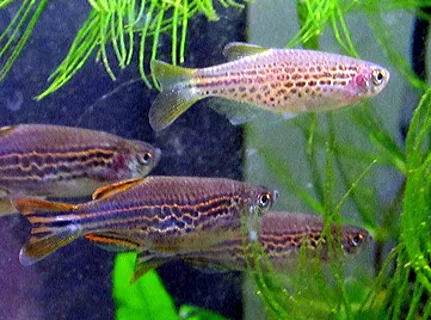
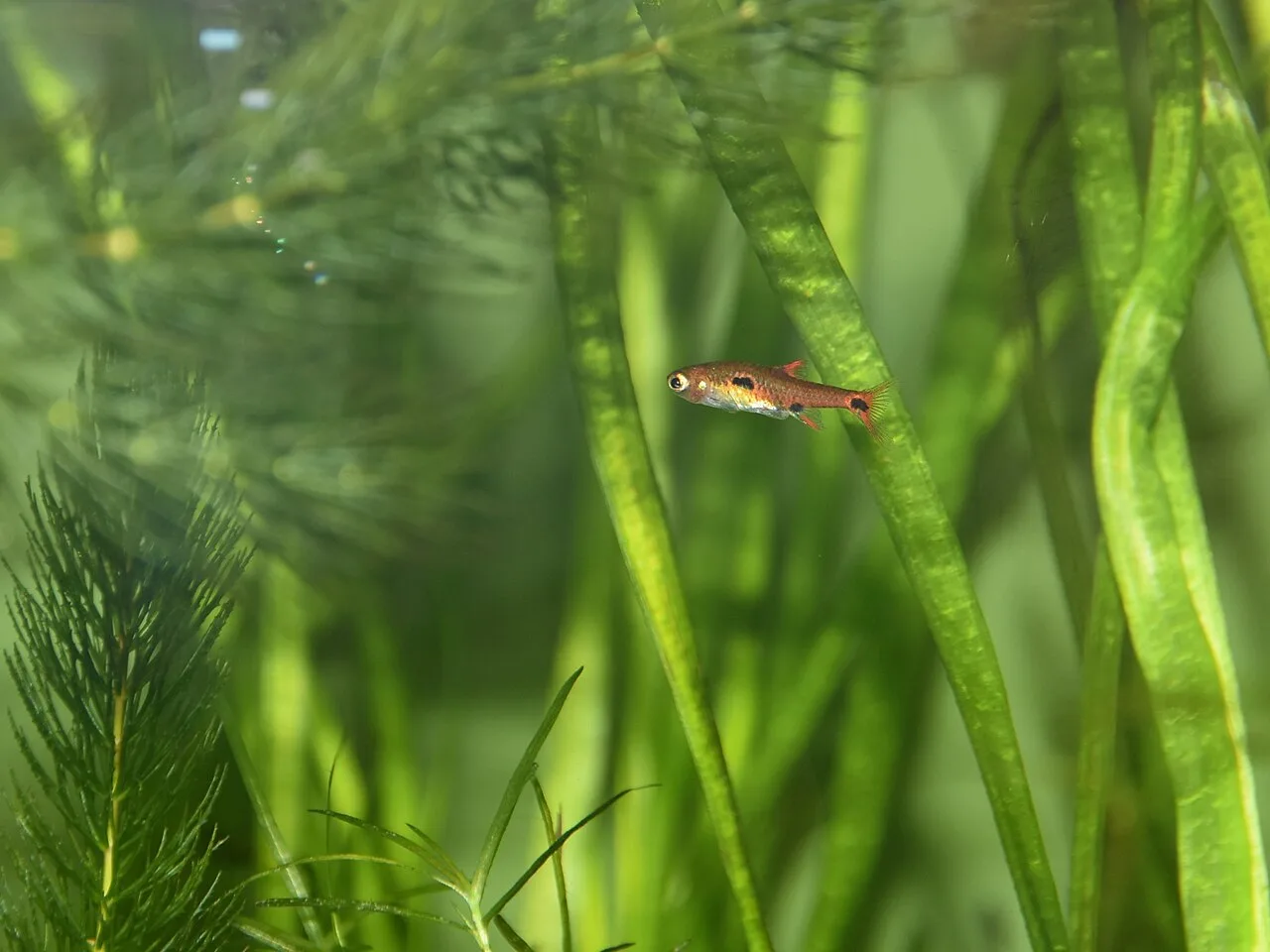
The body is deep and compressed, the head round, the mouth very small. The base colour is deep blue to greenish blue with oval spots in white, cream, pink or gold. In males the colour reaches farther forward. Females keep a paler front. The belly can be pink or reddish.
Sexes
Males have a stronger blue ground colour, a fully patterned anal fin with a red stripe between two black ones, and a red belly in courtship. Females are a paler blue-green, and their anal fin is almost transparent. In mature females a black anal spot separates the belly from the reddish fin base. The red gills show through the transparent gill covers. Juveniles are striped, and only later do the stripes break up into pearly dots.
Discovery
The species was discovered in 2006 and described by Tyson R. Roberts in 2007 as Celestichthys margaritatus, but placed in Danio in 2008. Its closest relatives are Danio erythromicron and Danio choprae. Shortly after it appeared in the trade, it was said to be very rare, and Myanmar banned exports in February 2007. Further populations are now known, and the species is bred worldwide.
Origin & habitat
This describes the origin, not how to furnish the aquarium.
At the time of description the species was known only from a small area east of Inle Lake, above 1000 m. The species prefers relatively cool, slightly basic water.
At first only a small area near Hopong east of Inle Lake at over 1000 m was known, in the Salween basin with the Nam Lang and Nam Pawn rivers. Later, populations in northern Thailand and in other rivers of Myanmar were added. The fish live in small, shallow ponds densely grown with Elodea-like plants and fed by seepage or springs. In January 22 to 24 °C was measured, and the water is slightly alkaline.
Care
Preferred temperature 20 to 24 °C in slightly basic water. Standard length is 2.1 cm.
Small and quiet
The celestial pearl danio stays at about 2 to 2.5 cm and does not belong in a tank with large, hectic fish. 22 to 26 °C, rather cooler than many tetras, pH 6.5 to 7.5, a school from eight, tanks from about 40 litres if it is densely planted and quiet. The pearl pattern shows on a dark bottom. On pale gravel it disappears.
The species is not a beginner fish for an unstable nano tank. It is a fish for a mature, finely furnished tank with fine food.
Diet
The mouth is very small.
Dust-fine food. Brine-shrimp nauplii, cyclops, crushed flakes. A normal food for guppies is too coarse. The fish then go hungry beside a full feeding ring.
Behavior
The species is not a true schooling fish and tends to stay in one place. Males display to each other with spread fins and defend a dense patch of plants. For small tanks a group of six fish, half males and half females, is suggested.
Reproduction
There is no fixed spawning season. Each spawning hides about 30 eggs as a loose batch in plants. At 24 to 25 °C the larvae hatch after three to four days and stay hidden for about three days. Metamorphosis takes eight to ten weeks, and the colour appears from week twelve.
Gallery
More species in this group
Similar water needs
Species with a similar temperature, a similar pH and a comparable adult size. Whether their behaviour fits as well is what the compatibility check is for.