
Blackline rasbora
Rasbora borapetensis
18 views
A slender schooling fish with a dark longitudinal band and a red tail. Peaceful, and suited to a planted tank.
- Temperature
- 22 – 27 °C
- pH
- 6.5 – 7.5 pH
- General hardness
- 5 – 12 °dH
- Maximum size
- 6 cm
- Minimum group size
- 8
- Minimum tank size
- 80 L
3 min read · 478 words
Fresh water
Quick facts
Place in the aquarium
Highlighted are the water layer and the spots where the species usually stays in the tank.
- Upper water Usually stays in the top third of the tank.
- Middle water Usually stays in the middle of the tank, between bottom and surface.
- Open swimming space Needs an open area without plants or decor to swim at length. Tank length matters more than height.
Shrimp in the tank
Shrimplets at risk
- Not shrimp safe
- Dwarf shrimp at risk
- Shrimplets at risk
- Shrimp safe
- Adult dwarf shrimp
- Safe
- Shrimplets
- Get eaten
- Safe from shrimp size
- about 2 cm
Adult dwarf shrimp are usually safe with the blackline rasbora. It grows to about 5 to 6.4 cm, swims in a tight school in the middle and upper water and eats mainly insects from the surface, plus zooplankton, crustaceans and worms. It rarely takes shrimp from about 2 cm.
Baby shrimp in open water are eaten. Because it seldom searches the bottom, enough young get through among moss and dense plants. For deliberate breeding a separate tank is the safer choice.
Home & range
Hatched countries are where the species occurs. It lives in particular waters there, not across the whole country. The points name known waters for orientation, not collection sites.
- Country of origin
- Water for orientation
Native
Overview
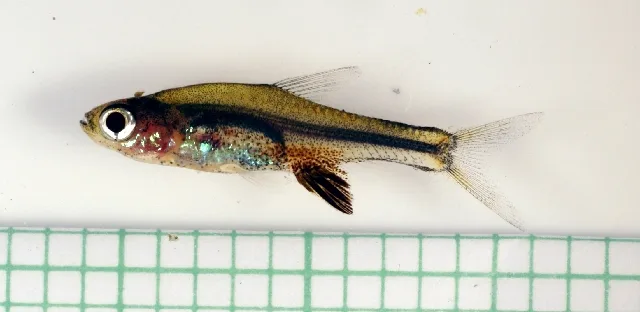
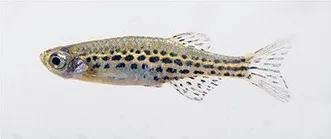
Rasbora borapetensis reaches about 6 cm. A dark band runs from the gill cover to the tail base, often with a pale line above it. The tail fin is red. Males are slimmer, females deeper. In a school the band reads as a row.
It is not the scissortail rasbora and not the harlequin rasbora. The wedge is missing. The signal is the band and the red flag at the rear.
Features
The blackline rasbora, also called the red-tailed rasbora, grows to about 5 to 6.4 cm. The body is elongated and compressed, olive to greenish yellow. A dark brown to black stripe runs from the gill cover to the tail base, with a green-gold line above it. Black lines edge the middle of the back and the base of the anal fin. The tail is bright red and, unlike in Rasbora einthovenii, has no black pigment, and some populations also have a red dorsal fin. The lateral line reaches only to just before the anal fin. The sexes look alike, with females somewhat larger and fuller. Rasbora rubrodorsalis is very similar.
Smith described the species in 1934. It reached Germany in 1954. The IUCN lists it as least concern.
Origin & habitat
This describes the origin, not how to furnish the aquarium.
Slow and still waters in Thailand, often with plants. The origin stays coarse. A planted tank with an open run matches that.
The species lives in Thailand in the Mekong, Chao Phraya and Mae Klong basins and on the northern Malay Peninsula to Kuala Terengganu. It inhabits ponds, ditches, canals and reservoir margins up to 2 m deep, flowing and still, and keeps to midwater up to the surface. pH 6.5 to 7, 5 to 12 °dH and 22 to 26 °C are preferred.
Care
School
22 to 27 °C, pH 6.5 to 7.5. A group from eight, tanks from about 80 litres and 70 cm. Plants at the edge, an open middle, a cover.
Company
Other peaceful schooling fish, corydoras, small cichlids. Large, hectic barbs and Malawi mouthbrooders, no.
Slow water and a densely planted tank are recommended. The blackline rasbora is a true schooling fish that swims in a tight school in the middle and upper water. It is hardy and peaceful and goes with loaches, tetras, livebearers, plecos and rainbowfish.
Diet
Prepared food. Flakes, granules, cyclops, brine shrimp. Several small feeds.
In the wild it eats mainly insects from the surface, plus zooplankton, crustaceans and worms.
Behavior
A peaceful school in the upper and middle water. Too few fish turn pale. The species jumps when it is startled.
The dorsal fin has two unbranched and seven branched rays, the anal fin three and five. The lateral line holds 29 to 30 scales, and the mouth is terminal. Other English names are red-tailed, bora bora or brilliant rasbora. The fish live in groups in flowing and still water near the surface or in midwater.
Reproduction
Egg scatterer without brood care. The eggs fall into fine plants and are eaten if the parents stay in the same tank.
Gallery
More species in this group

Similar water needs
Species with a similar temperature, a similar pH and a comparable adult size. Whether their behaviour fits as well is what the compatibility check is for.




