
Glowlight danio
Danio choprae
25 views
A small schooling fish from Myanmar with an orange band. It is not the glowlight tetra.
- Temperature
- 22 – 26 °C
- pH
- 6.5 – 7.5 pH
- General hardness
- 5 – 12 °dH
- Maximum size
- 3 cm
- Minimum group size
- 8
- Minimum tank size
- 60 L
5 min read · 735 words
Fresh water
Quick facts
Further published values
- Lifespan
- 3 – 6 a
Place in the aquarium
Highlighted are the water layer and the spots where the species usually stays in the tank.
- Upper water Usually stays in the top third of the tank.
- Open swimming space Needs an open area without plants or decor to swim at length. Tank length matters more than height.
Shrimp in the tank
Shrimplets at risk
- Not shrimp safe
- Dwarf shrimp at risk
- Shrimplets at risk
- Shrimp safe
- Adult dwarf shrimp
- Safe
- Shrimplets
- Get eaten
- Safe from shrimp size
- about 1.5 cm
Adult dwarf shrimp are safe from the glowlight danio. It stays at about 3 cm and eats insects falling onto the water, insect larvae and other small animals that fit its small mouth. It cannot handle shrimp from about 1.5 cm. Newly hatched young, however, are part of its prey, and because the danios are lively all day they find many of them. To breed shrimp, provide dense moss cushions and fine-leaved plants near the bottom. The young stay there, while the danios mostly use the middle water layers.
Home & range
Hatched countries are where the species occurs. It lives in particular waters there, not across the whole country. The points name known waters for orientation, not collection sites.
- Country of origin
- Water for orientation
Native
- Myanmar
- Range: upper Myanmar with Myitkyina District and the Irrawaddy.
Overview
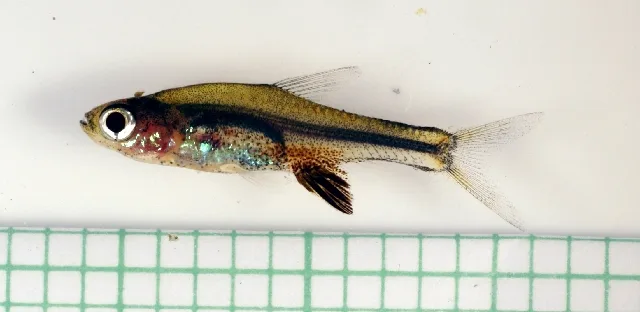
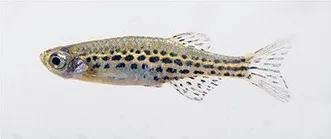
Danio choprae reaches about 3 cm. An orange to gold band runs over the body, with darker stripes above and below. Males stay slimmer and more colourful, females deeper. The species jumps. An open tank loses them on the first night.
It is not Hyphessobrycon erythrozonus. The glowlight tetra has a red band and a different body. Both are sold under similar names. The orange band and the barbel at the mouth separate the danio.
Names and confusion
In German the species is also called ruby danio or snakeskin danio. Older spellings are Danio choprai and Brachydanio choprai. S. L. Hora named it after the zoologist B. N. Chopra. Because the ending -ae normally honours women, many lists use the corrected form choprai.
The fish is most often confused with Devario maetangensis. That species looks browner, has much stronger vertical bars and grows larger at about 5 cm. The glowlight danio is stockier, brighter and stays at about 3 cm. Above the orange longitudinal band the flanks carry blue-black vertical bars, and the fins are edged with yellow.
A larger form with more bars and longer barbels comes from the Putao area in northern Myanmar. It is sometimes traded under the name „Danio putaoensis“, which was never validly described, and it may belong to Danio flagrans.
Origin & habitat
This describes the origin, not how to furnish the aquarium.
Streams and small waters in Myanmar, clear, with current and gravel. Myanmar stays the coarse origin. The habitat is moving water, not a still, very warm blackwater.
The fish stand as a group in open water and need a run, although they are small.
The documented localities are in upper Myanmar: in Myitkyina District near Namma and Kamaing and in the Irrawaddy. In the water the fish stay mostly in the middle layers.
Care
Size
22 to 26 °C, pH 6.5 to 7.5. A school from eight, better more, tanks from about 60 litres and 60 cm, with a firm cover. Some current, plants at the edge, an open middle. A permanent stay above 28 °C leaves them short of breath. An unheated room tank in summer is often already too warm.
Company
Other small, peaceful schooling fish. Large barbs and cichlids eat or stress them. Shrimp in a dense tank usually survive. The species is lively all day and not a fish for a still tank of dusk species.
Water values
The species is kept at pH 6.0 to 7.5, carbonate hardness of 2 to 8 °dKH and general hardness of 5 to 12 °dH at 22 to 26 °C. The species prefers 22 to 24 °C but tolerates somewhat warmer water well. Soft to medium-hard water, slightly acidic to slightly alkaline, suits keeping and breeding. Care is regarded as moderate. The fish usually live three years, six years and more with good care.
Diet
Fine prepared food. Flakes, small granules, cyclops and brine shrimp. The mouth is small. Food that is too coarse is ignored, and the fish thin out even though they are being fed. Several small feeds, because the leading fish otherwise take everything.
In the wild the danios eat insects that fall onto the water, aquatic insect larvae and other small animals. In the aquarium they take almost any food offered, including most dry foods.
Behavior
A close, fast school. Too few fish stand singly at the glass and lose the band. Within the species they are peaceful. Courtship is a circling, not a fight across the whole tank.
They use the whole water column, especially the middle and the top. Bottom fish bother them little.
Group rather than school
Danios are not schooling fish in the strict sense, like herring. They live in close social groups with a hierarchy in which individual fish act on their own. The top male is clearly more colourful than the other males. The species gets on well with other Danio species, except for its large relative known as the giant danio.
Reproduction
Egg scatterer without brood care. Fine plants or a spawning grate and removing the parents are the breeding path. In a community tank the eggs are eaten. The larvae are small and need dust-fine food.
How breeding works
The male chooses a spawning site among fine-leaved plants and leads the female there by showing her his flanks. A clutch holds about 50 eggs. The larvae hatch after three days and swim freely after another four days. By then at the latest the parents must be removed, or they eat the young. Well-fed fish spawn about every ten days. Breeding is regarded as moderate to hard.
Gallery
More species in this group

Similar water needs
Species with a similar temperature, a similar pH and a comparable adult size. Whether their behaviour fits as well is what the compatibility check is for.


