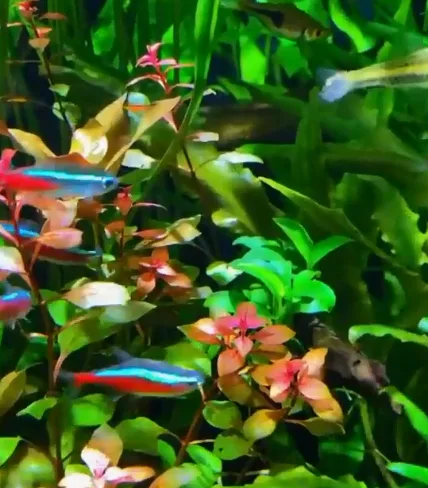
Cherry barb
Rohanella titteya
22 views
Endemic to Sri Lanka, 4 to 5 cm. Puntius titteya is the synonym. Red and yellow colours are variations.
- Temperature
- 20 – 27 °C
- pH
- 6.5 – 7 pH
- General hardness
- 5 – 19 °dH
- Maximum size
- 5 cm
- Minimum group size
- 6
- Minimum tank size
- 54 L
3 min read · 487 words
Fresh water
Quick facts
Further published values
- Lifespan
- 4 – 7 a
Place in the aquarium
Highlighted are the water layer and the spots where the species usually stays in the tank.
- Middle water Usually stays in the middle of the tank, between bottom and surface.
- Dense plants Looks for dense planting as cover, retreat or grazing ground.
Shrimp in the tank
Shrimplets at risk
- Not shrimp safe
- Dwarf shrimp at risk
- Shrimplets at risk
- Shrimp safe
- Adult dwarf shrimp
- Safe
- Shrimplets
- Get eaten
- Safe from shrimp size
- about 1.5 cm
Adult dwarf shrimp are safe from the cherry barb. It grows to at most 5 cm, has a small mouth and is very peaceful. It cannot swallow shrimp from about 1.5 cm. As an omnivore, however, it picks up freshly hatched young, so only a few survive in a community tank.
Dense planting, which the barbs like anyway, and moss give the young cover. Anyone who wants to raise many shrimp keeps some in a tank of their own.
Home & range
Hatched countries are where the species occurs. It lives in particular waters there, not across the whole country. The points name known waters for orientation, not collection sites.
- Country of origin
- Water for orientation
Native
Overview
The only species of the genus Rohanella, erected in 2023. Males more strongly coloured and larger-finned when courting, females mostly yellow, both with a dark band and one pair of barbels. The sister species Plesiopuntius bimaculatus stays outside.
Colour
The body is small, elongated and relatively compressed. Females are fawn above with a greenish sheen, silvery on the sides and belly, sometimes rosy on the back. A horizontal stripe runs from the snout through the eye to the base of the tail. Males are reddish and slimmer, deep red when breeding. Almost only the red form is found in the trade. The cherry barb is one of the oldest aquarium fish and first reached Germany in 1936.
Name and taxonomy
Paules Edward Pieris Deraniyagala described the species in 1929 as Puntius titteya, with Ambagaspitiya in Sri Lanka as the type locality. The genus Puntius turned out to be strongly polyphyletic. In 2023 Sudasinghe, Rüber and Meegaskumbura erected the genus Rohanella. It honours Rohan Pethiyagoda, who first recognised that some Sri Lankan barbs belong outside Puntius. The specific name is the Sinhala name of the fish.
Origin & habitat
This describes the origin, not how to furnish the aquarium.
Southern Sri Lanka, slow rainforest streams, including the Nilwala and the Kelani. Sri Lanka only, coarse. Threatened by habitat loss.
The species lives in slow-flowing rainforest streams and lowland rivers. It prefers heavily shaded, shallow and calm water over silty ground with leaf cover, with pH 6 to 8, a hardness of 5 to 19 dGH and 23 to 27 °C. Introduced populations exist in Mexico and Colombia. The IUCN rates the species as vulnerable, because of overcollection and habitat loss. It is bred in large numbers for the trade.
Care
Relatively undemanding. pH 6.5 to 7.0, medium-hard to hard, 20 to 27 °C, also unheated, from 54 litres, plants and cover, dark sand or fine gravel, floating plants. Groups from six. Not with long-finned fish, because the barbs eat fins.
Diet
Adults are omnivores: live, dry and frozen food. Breeding is encouraged with live food.
Behavior
Little territorial, peaceful, it roams.
The cherry barb lives in looser schools than other barbs, with a hierarchy. Groups of five or more and at least two females per male are recommended, because the male harasses the females to breed. Two thirds to three quarters of the tank should be planted, with open swimming space. Young males are peaceful, mature males become aggressive when breeding. Calm tankmates such as Rasbora suit.
Reproduction
Free spawner, up to 280 eggs in Java moss, usually early in the morning. Breeding names soft water and about 25 °C. That is breeding, not the keeping span. Larvae need paramecia or Artemia. About five years in captivity.
The male follows the female closely and chases rivals away. Other reports give 200 to 300 eggs on plants and substrate. The eggs hatch after one to two days, and the larvae swim freely two days later. After five weeks the young are about 1 cm long. Parents eat eggs and fry. The average lifespan is four years and the maximum about seven years.
More species in this group
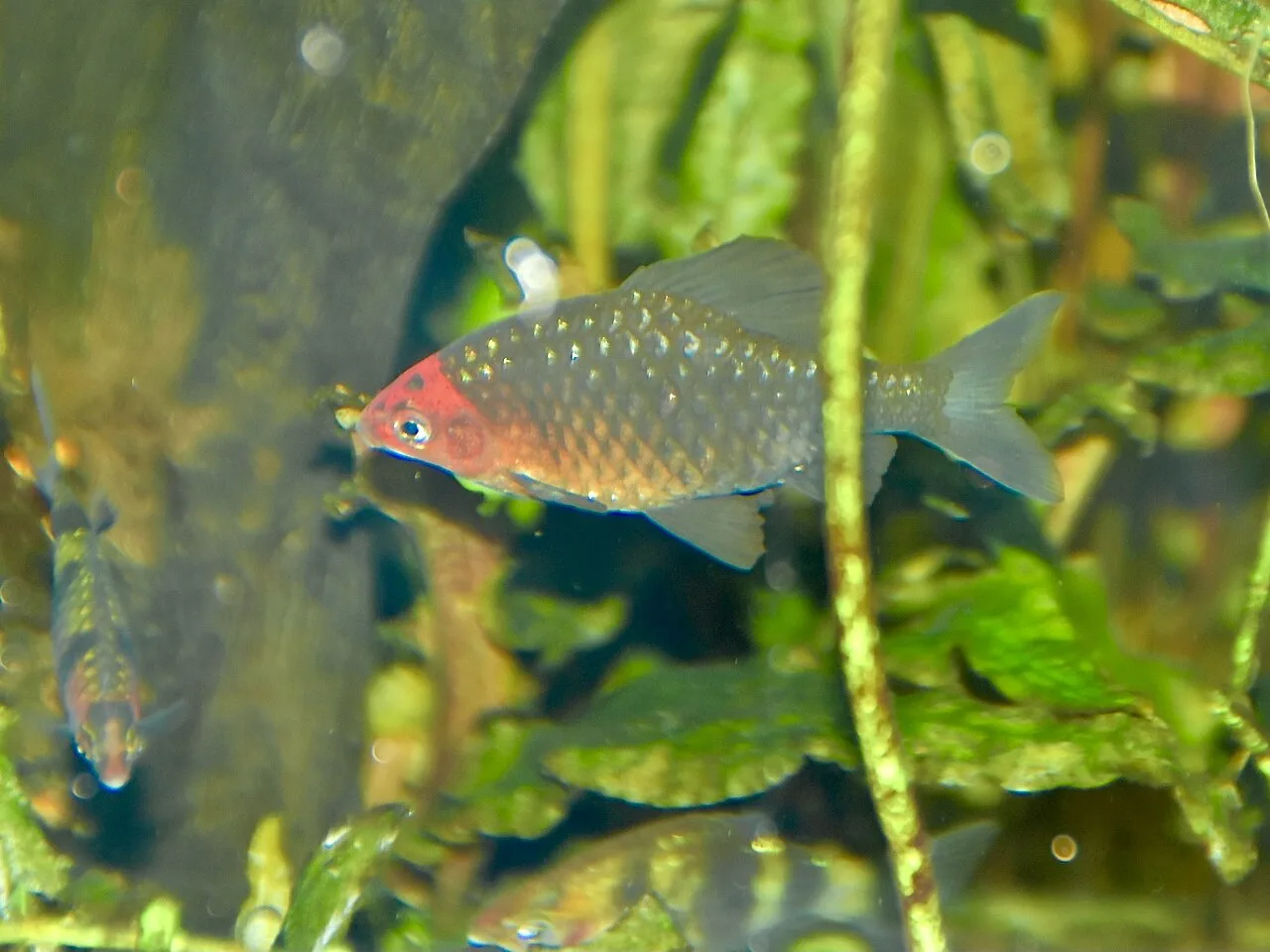
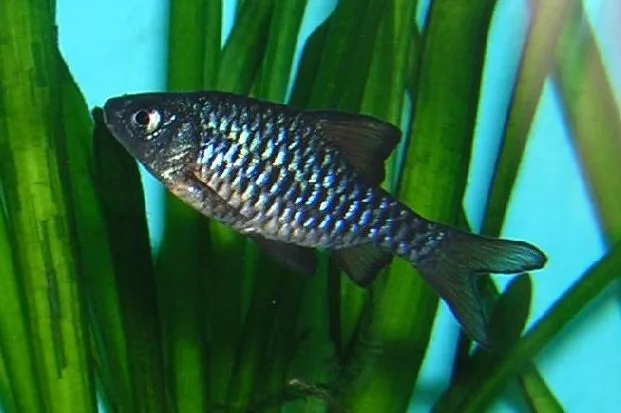
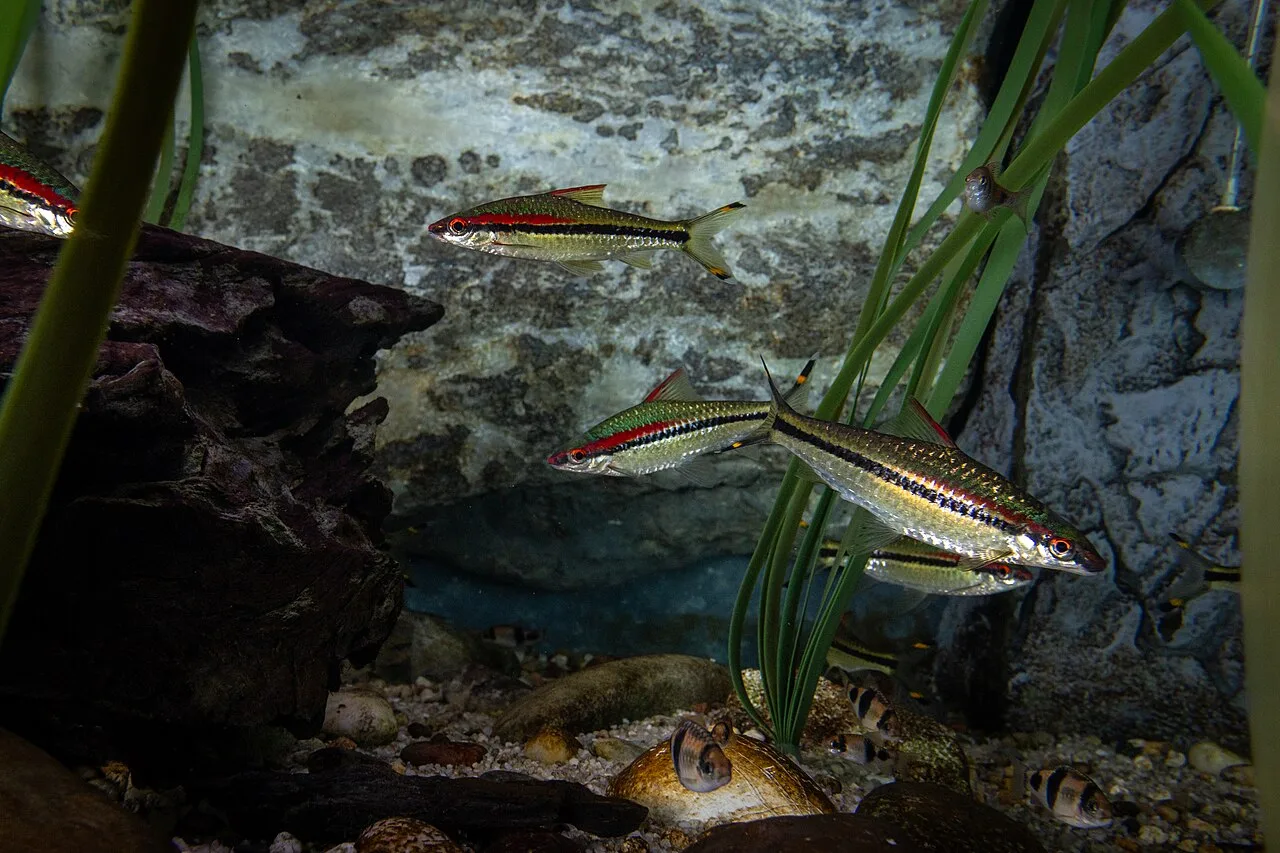
Similar water needs
Species with a similar temperature, a similar pH and a comparable adult size. Whether their behaviour fits as well is what the compatibility check is for.