
Black ruby barb
Pethia nigrofasciata
20 views
A barb from Sri Lanka whose males turn purple-black when courting. It stays peaceful in a school and turns pale without a group.
- Temperature
- 22 – 26 °C
- pH
- 6 – 7.5 pH
- General hardness
- 5 – 12 °dH
- Maximum size
- 6 cm
- Minimum group size
- 8
- Minimum tank size
- 100 L
4 min read · 605 words
Fresh water
Quick facts
Further published values
- Lifespan
- 4 a
Place in the aquarium
Highlighted are the water layer and the spots where the species usually stays in the tank.
- Middle water Usually stays in the middle of the tank, between bottom and surface.
- Dense plants Looks for dense planting as cover, retreat or grazing ground.
Shrimp in the tank
Shrimplets at risk
- Not shrimp safe
- Dwarf shrimp at risk
- Shrimplets at risk
- Shrimp safe
- Adult dwarf shrimp
- Safe
- Shrimplets
- Get eaten
- Safe from shrimp size
- about 2 cm
Adult dwarf shrimp usually get along with the black ruby barb. It grows to 5 to 7 cm, in nature eats mainly filamentous algae and detritus, and is regarded as very peaceful. Shrimp from about 2 cm are usually safe.
As an omnivore with a good appetite it does take baby shrimp that wander in the open. With dense planting, moss and a layer of mulm on the bottom, which the species likes anyway, enough young survive. For deliberate breeding a separate tank is safer.
Home & range
Hatched countries are where the species occurs. It lives in particular waters there, not across the whole country. The points name known waters for orientation, not collection sites.
- Country of origin
- Water for orientation
Native
Overview
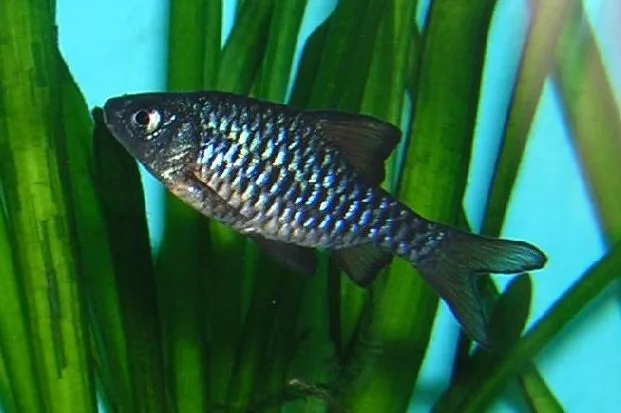
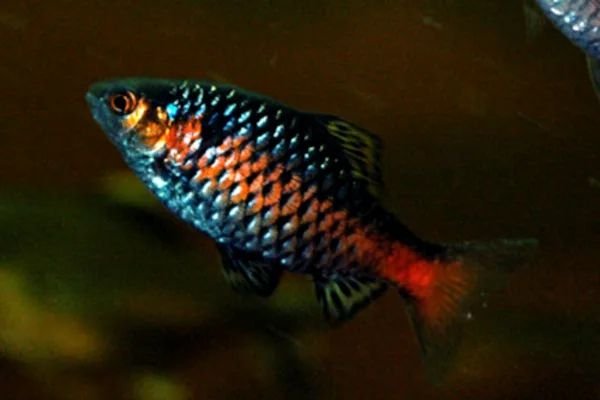
The black ruby barb reaches about 6 cm. Outside courtship the fish are silvery with dark bars. When courting the males colour the fore-body deep purple to black and the fins redden. Females stay lighter and deeper. This colour change is mood and rank, not another sex and not a disease.
In the shop the fish often look pale, because the tank is bright, bare and the group too small. In a planted aquarium with several males the colour comes.
Colour and sexes
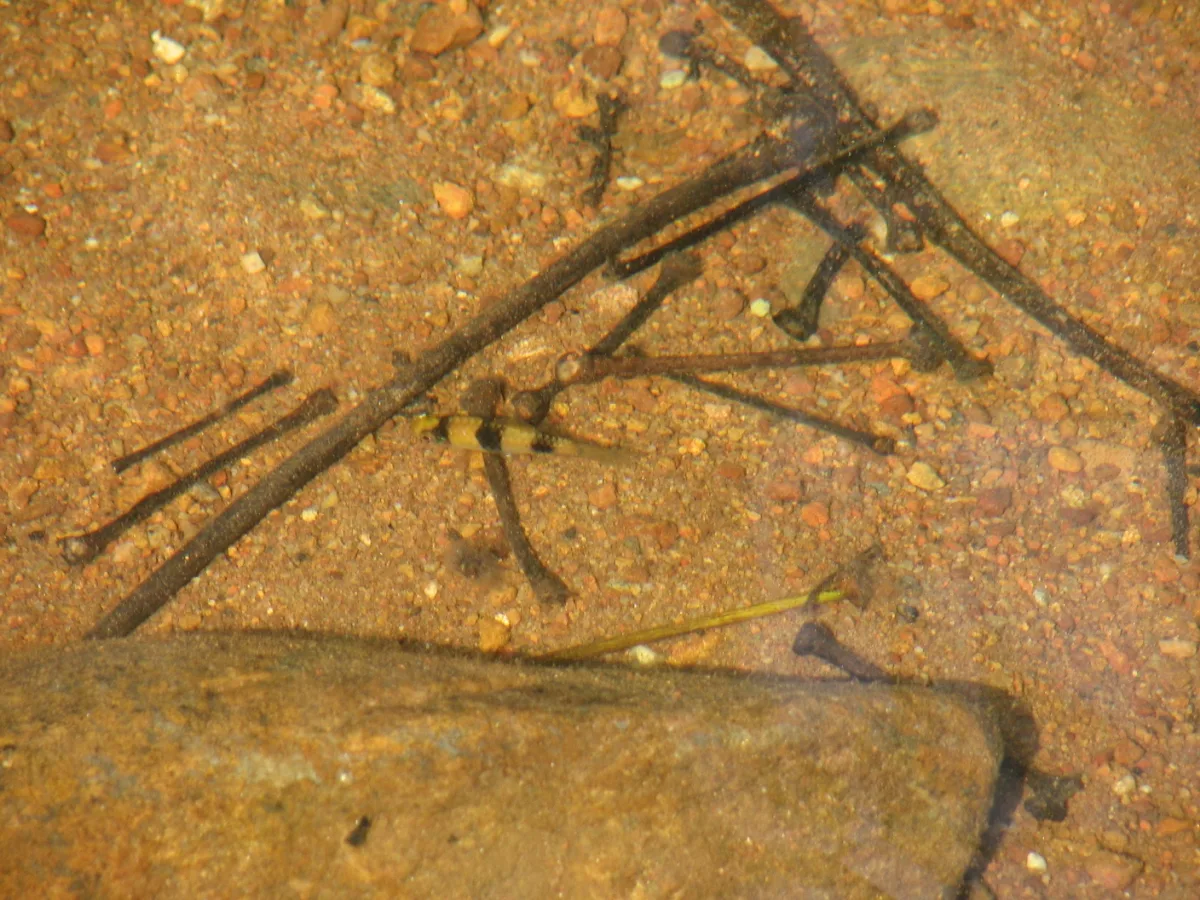
The black ruby barb grows to 5 to 6 cm and is deep-bodied, without barbels. Three to four blackish crossbands lie on the flanks. Both sexes have a purple-red head. Males carry deep black or purple-red fins, and in the spawning season the whole front body turns purple-red. Females are paler, and their dorsal and anal fins are coloured only near the body. Juveniles are slender, silver-grey and carry three black stripes like the females. It looks somewhat like the tiger barb. Under stress, such as moving tanks, it can turn almost black.
Albert Günther described it in 1868 as Barbus nigrofasciatus. It is the type species of the genus Pethia, set up in 2012. It reached Germany in 1935.
Origin & habitat
This describes the origin, not how to furnish the aquarium.
Forest streams and slow waters in Sri Lanka, shaded, with leaf litter and gravel. The island stays the coarse origin. Soft to medium-hard water matches that better than very hard tap water, even though captive-bred fish tolerate a good deal.
The species is endemic to southern Sri Lanka, from the Kelani basin to the Nilwala basin, in slow, cool, shaded forest streams over gravel or sand up to about 300 m. pH 6 to 6.5, 5 to 12 °dGH and 22 to 26 °C were measured. It was introduced into the Mahaweli. The IUCN lists it as vulnerable, with habitat destruction and collection for the aquarium trade as causes.
Care
School
22 to 26 °C, pH 6 to 7.5. A group from eight, with several males, tanks from about 100 litres and 80 cm. Plants at the edge, an open middle, a dark bottom, some current. Permanently very warm water they tolerate less well than many tetras.
Company
Other calm barbs, larger rasboras, corydoras. Long fins are a risk when the own group is too small. In the right number they hardly nip. Tiny Boraras are too small.
The species is kept at 22 to 26 °C in slightly acidic water up to at most 12 °dGH, in small schools from six fish, with dense planting on half to two thirds of the area, floating plants and not too bright light. A layer of mulm on the bottom is recommended. It is very peaceful and goes well with other barbs.
Diet
Omnivore with a plant share. Flakes, granules, blanched vegetables, frozen food. Several small feeds. Mosquito larvae alone make them fat and do not replace the green food they also take.
In the wild it eats mainly filamentous algae and detritus. In aquaria it is an omnivore with a good appetite.
Behavior
A school with courtship by the males. The purple is display, not permanent aggression, as long as there is room to get away. A single male stays silvery or becomes fidgety. The fish are active by day and need the run.
Reproduction
Egg scatterer without brood care. Softer water, fine plants and removing the parents are the breeding path. In a community tank the eggs are eaten. The young are small.
Before spawning, rival males hold a contest. Then the pairs swim in tight spirals around each other and spawn within seconds among plants in shallow water, more than 100 eggs. There is no brood care. After one to two days the larvae hatch and swim free 24 hours later.
Gallery
More species in this group
Similar water needs
Species with a similar temperature, a similar pH and a comparable adult size. Whether their behaviour fits as well is what the compatibility check is for.

