
Melon barb
Haludaria fasciata
31 views
A barb with dark bars that become stronger in the school and during courtship. It stays more manageable than many other barbs.
- Temperature
- 22 – 26 °C
- pH
- 6 – 7.5 pH
- General hardness
- 0 – 10 °dH
- Maximum size
- 6 cm
- Minimum group size
- 8
- Minimum tank size
- 80 L
3 min read · 451 words
Fresh water
Quick facts
Place in the aquarium
Highlighted are the water layer and the spots where the species usually stays in the tank.
- Middle water Usually stays in the middle of the tank, between bottom and surface.
- Dense plants Looks for dense planting as cover, retreat or grazing ground.
Shrimp in the tank
Shrimplets at risk
- Not shrimp safe
- Dwarf shrimp at risk
- Shrimplets at risk
- Shrimp safe
- Adult dwarf shrimp
- Safe
- Shrimplets
- Get eaten
- Safe from shrimp size
- about 2 cm
The melon barb is usually compatible with adult dwarf shrimp. Depending on the account it grows to 6 to 8 cm and is regarded as calmer than many other barbs. Shrimp from about 2 cm are usually safe. Young shrimp, however, are eaten, as the barbs scatter their eggs and do not care for young, nor for those of others. In a shared tank dense plants, moss and hiding places on the bottom make sure enough shrimp grow up. With larger fish, caution with very small shrimp species is advisable.
Home & range
Hatched countries are where the species occurs. It lives in particular waters there, not across the whole country. The points name known waters for orientation, not collection sites.
- Country of origin
- Water for orientation
Native
Overview
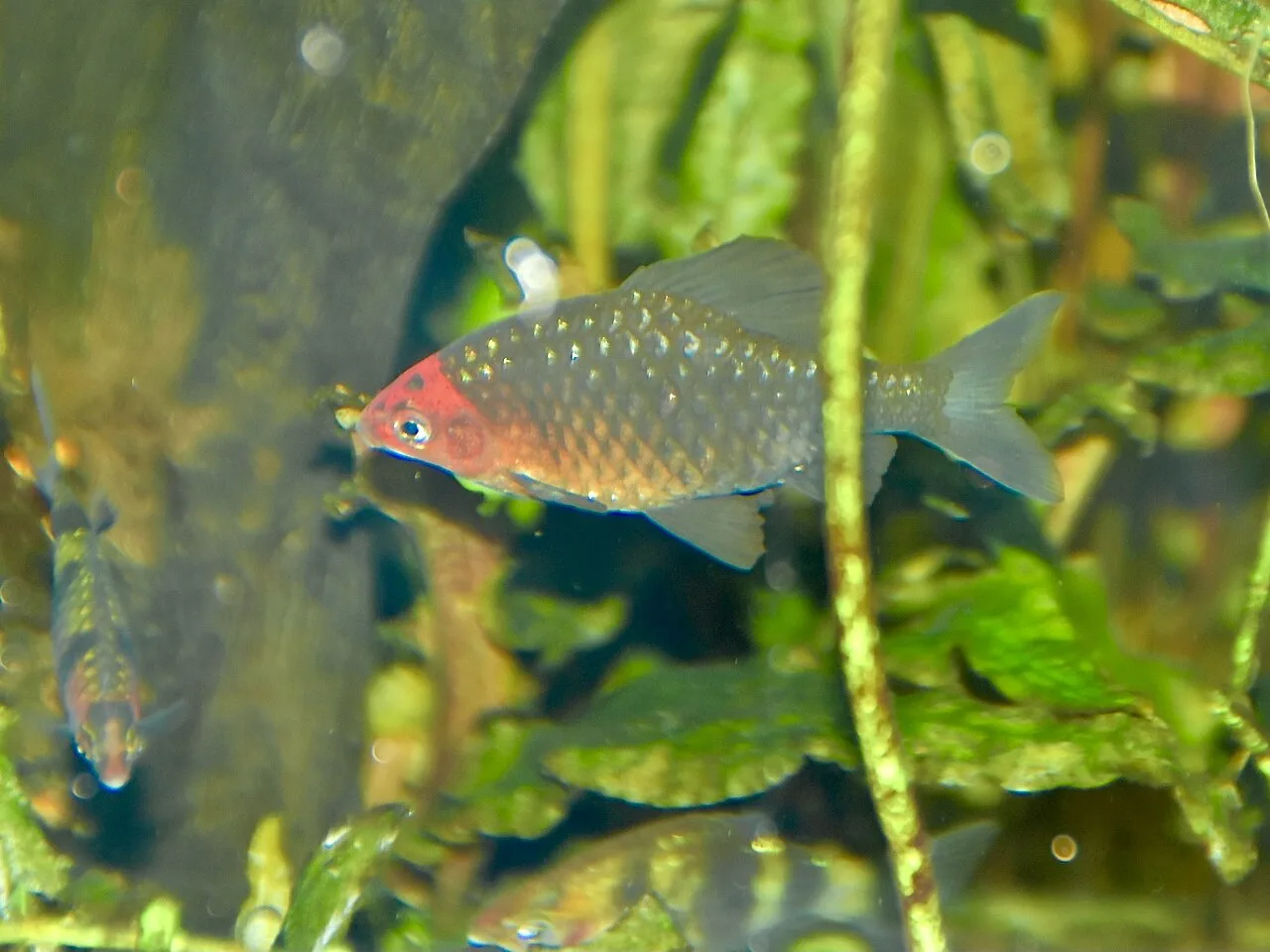
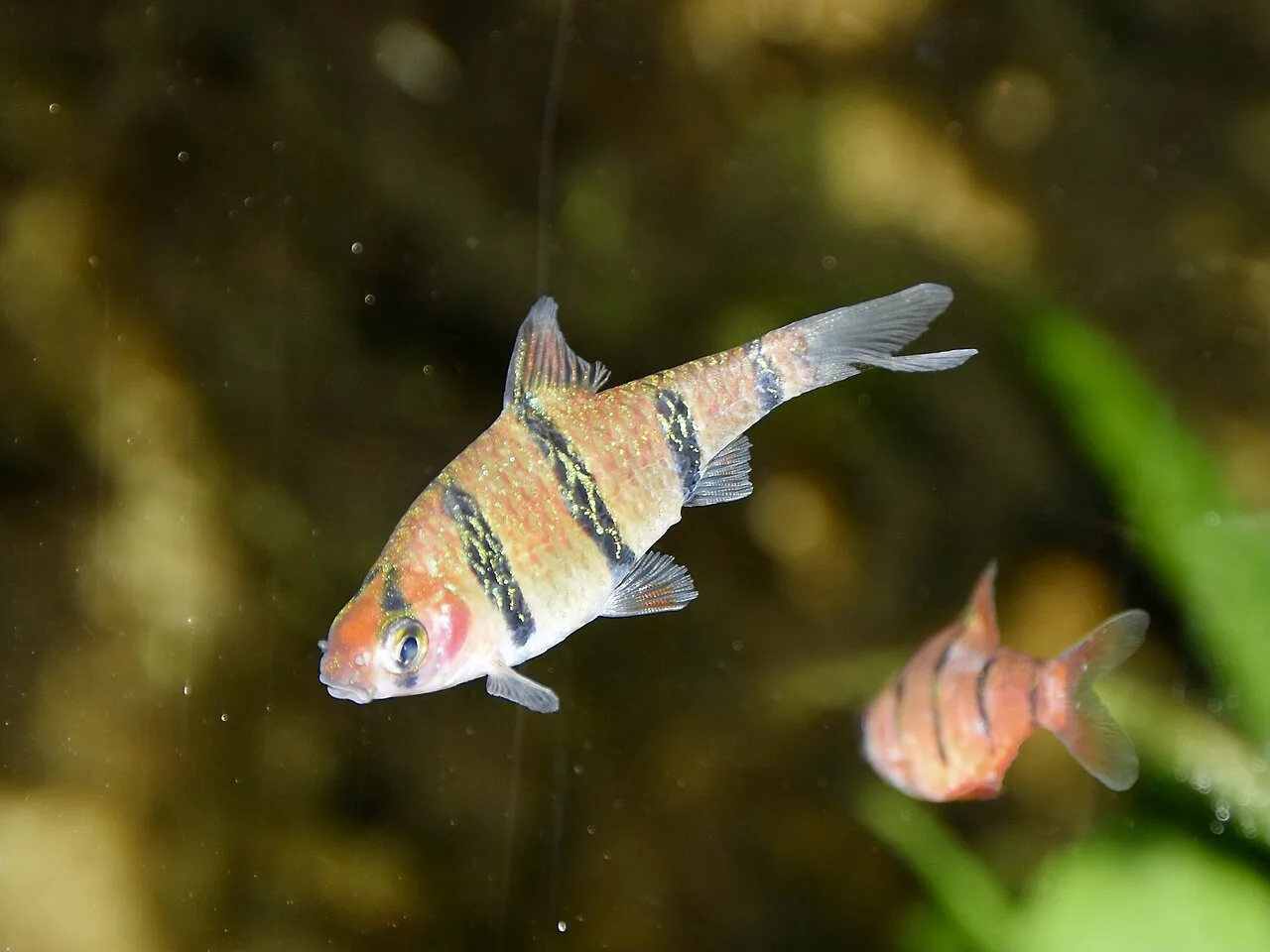
Haludaria fasciata reaches about 6 cm. The body is silvery to reddish, with several dark bars. When courting the males turn redder, the females stay deeper. Earlier trade names say Puntius fasciatus. It is the same species.
It is not the tiger barb. The bars are less sharp, the temperament quieter, the adult size smaller. A school remains the keeping.
Names and features
In German the species is also called Glühkohlenbarbe or Pandabarbe, ember barb or panda barb, and the Latin fasciatus means striped. Synonyms are Puntius fasciatus, Barbus fasciatus and Puntius melanampyx. The species is the type species of the genus Haludaria and belongs to the cyprinids. Length figures range from 6 to 8 cm.
The body is deep, and the fish carry two pairs of barbels. Colouring varies greatly: the base colour may be ochre and look green or yellow depending on the light, or pinkish or deep red. The back is darker, often greenish gold, and the belly whitish. Three to five broad, irregular black or dark brown vertical bars and one longitudinal band are more or less distinct depending on mood. Because the scales may have black edges, a net pattern sometimes appears on the flanks. Pectoral and pelvic fins are reddish, and the anal and dorsal fins red with a black edge. The fin formula is dorsal 3/8 and anal 2/7, with 19 to 20 scales along the lateral line.
Origin & habitat
This describes the origin, not how to furnish the aquarium.
Streams and slow waters in southern India. The origin stays coarse. Plants and an open run belong together.
The species lives in rivers in the states of Goa, Karnataka, Kerala and Tamil Nadu in the Western Ghats. The species lives mainly in flowing waters. There pH is 6.0 to 6.5, hardness around 5 °dGH and temperature 22 to 26 °C. These are habitat measurements.
Care
School
22 to 26 °C, pH 6 to 7.5. A group from eight, tanks from about 80 litres and 70 cm. Plants at the edge, some current, a cover.
Company
Peaceful tetras, rasboras, corydoras. The long fins of a fighting fish are the wrong neighbourhood, even though this barb is quieter than a tiger barb.
Diet
Prepared food. Flakes, granules, frozen food, a plant share. Several small feeds.
Behavior
A school with small courtship chases. Too few fish nip or stand pale. The colour comes in the school, not on a single fish.
Reproduction
Egg scatterer without brood care. The eggs are laid in plants and eaten if the parents stay.
The melon barb scatters its eggs over the substrate, and the parents do not guard them. Males in breeding condition flush red and develop fine nuptial tubercles on the snout, which they use to bump and rub the females to trigger egg release. A female lays about 200 eggs. The larvae hatch after about 30 hours and swim freely after four to five days.
Gallery
More species in this group
Similar water needs
Species with a similar temperature, a similar pH and a comparable adult size. Whether their behaviour fits as well is what the compatibility check is for.

