Vietnamese white cloud
Tanichthys micagemmae
35 views
A small schooling fish for cooler tanks, slimmer and more strongly marked than the familiar white cloud.
- Temperature
- 18 – 24 °C
- pH
- 6.5 – 7.5 pH
- General hardness
- 5 – 15 °dH
- Maximum size
- 3 cm
- Minimum group size
- 8
- Minimum tank size
- 40 L
3 min read · 494 words
Fresh water
Quick facts
Place in the aquarium
Highlighted are the water layer and the spots where the species usually stays in the tank.
- Upper water Usually stays in the top third of the tank.
- Middle water Usually stays in the middle of the tank, between bottom and surface.
- Dense plants Looks for dense planting as cover, retreat or grazing ground.
Shrimp in the tank
Shrimplets at risk
- Not shrimp safe
- Dwarf shrimp at risk
- Shrimplets at risk
- Shrimp safe
- Adult dwarf shrimp
- Safe
- Shrimplets
- Get eaten
- Safe from shrimp size
- about 1 cm
The Vietnamese cardinal minnow goes well with dwarf shrimp. Because it is peaceful and small, about 2.3 to 3 cm, it can explicitly be kept with small freshwater shrimp. Adult shrimp from about 1 cm are safe. Newly hatched young may be eaten, as with all small schooling fish.
In a well-planted tank the fish do not even harm their own young. Moss and fine plants also give juvenile shrimp enough cover. Neocaridina tolerate the cool temperatures this species likes.
Home & range
Hatched countries are where the species occurs. It lives in particular waters there, not across the whole country. The points name known waters for orientation, not collection sites.
- Country of origin
- Water for orientation
Native
Overview
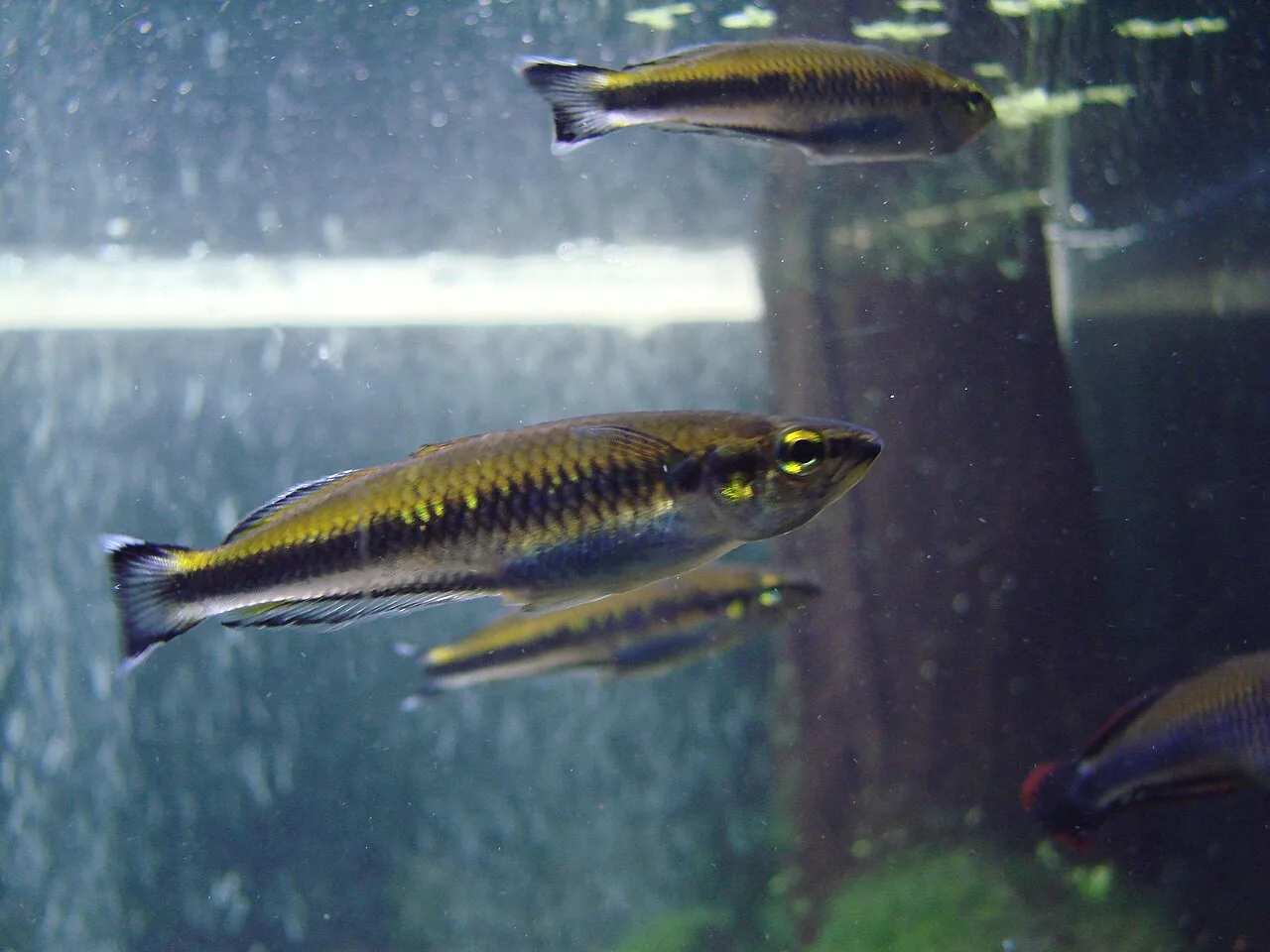
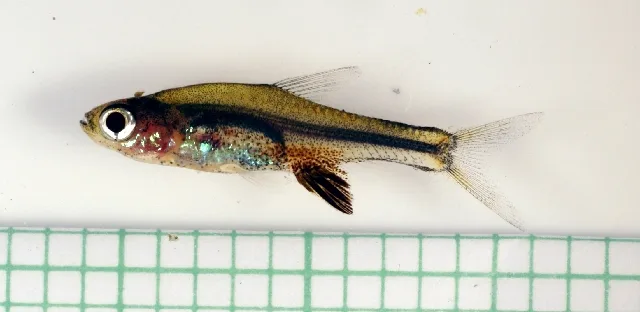
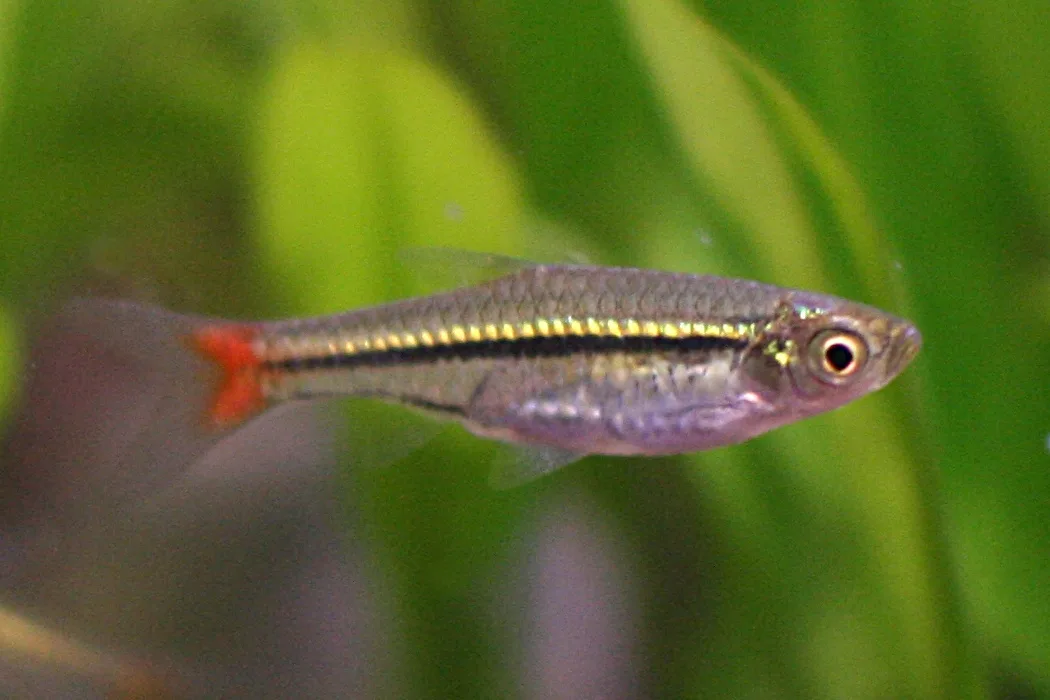
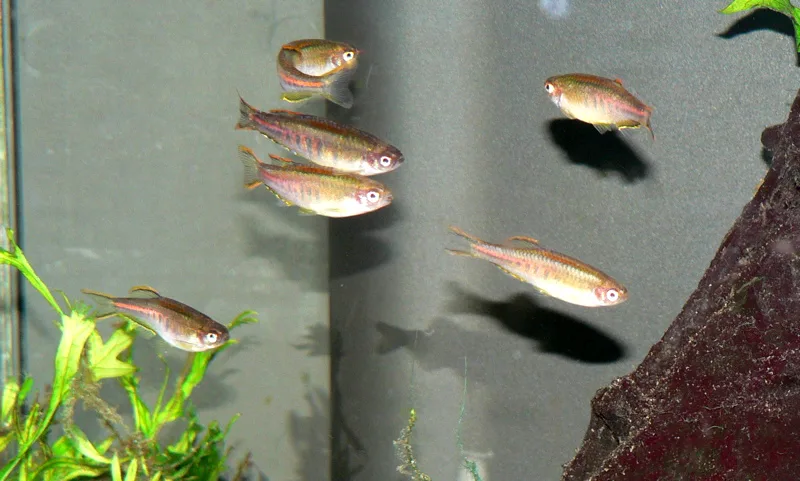
Tanichthys micagemmae stays at about 3 cm. A dark band and a pale stripe above it run into the tail. The fins carry red. It is slimmer than Tanichthys albonubes. Both tolerate cool water and suffer in permanently very warm tanks.
The species jumps. A cover belongs with it. In a school and against a dark bottom the pattern comes. As a single fish it fades.
Description
Jörg Freyhof and Fabian Herder described the species in 2001. The species name combines the Latin micare, to sparkle, with gemma, jewel, and refers to the glittering markings. It is placed either in the carp family or in the family Tanichthyidae.
Figures for the maximum length range from about 2.3 to 3 cm. Head and body below the lateral line are whitish with many dark grey dots. The two longitudinal bands are equally wide, the upper white, the lower black. The dorsal and anal fins have 8 and 11 rays. It differs from the White Cloud Mountain minnow T. albonubes by the lighter lower body and the position of the stripes, which run along the middle of the body rather than well above it.
Origin & habitat
This describes the origin, not how to furnish the aquarium.
Streams in central Vietnam. Clear, cool to mild, with plants. Vietnam stays the coarse origin. The area is small. Aquarium fish should be captive-bred.
The species occurs only in the Bến Hải area. Both the river in Quảng Trị Province and a tributary in Quảng Bình Province are named. The area includes the former demilitarised zone between North and South Vietnam, which was heavily bombed during the Vietnam War. The IUCN lists the species as data deficient.
Care
Water
18 to 24 °C, pH 6.5 to 7.5. A school from eight, tanks from about 40 litres, planted, with a cover. Not as a tankmate in a 28-degree discus tank. An unheated room tank can already be too cold in winter and often too warm in summer.
Company
Other small, quiet fish that tolerate cool water. Large tropical fish and hectic barbs, no. Shrimp fit in a dense tank.
Water and company
The species is kept at 19 to 23 °C in rather soft water with 37 to 142 ppm calcium carbonate, in groups of eight to ten. Suitable tankmates are other cyprinids, catfishes, loaches and tetras. Because of its size and peacefulness small freshwater shrimp fit as well. A well-planted tank is needed.
Diet
Fine prepared food. Flakes, cyclops, brine-shrimp nauplii. Several small feeds. Food that is too coarse is ignored.
Behavior
A peaceful school in midwater. Too few fish lose the cohesion. The males show the fins without injuring each other, as long as there is room.
The males constantly challenge one another but stay peaceful.
Reproduction
Egg scatterer in fine plants. The parents eat the eggs. In moss a few young survive. Deliberate breeding means moving the spawning plants.
The fish spawn in pairs along plants. In a well-planted tank the adults are said neither to search for the eggs nor to harm the young, so that a founder group maintains itself indefinitely under suitable conditions.
Gallery
More species in this group

Similar water needs
Species with a similar temperature, a similar pH and a comparable adult size. Whether their behaviour fits as well is what the compatibility check is for.