Paradise fish
Macropodus opercularis
19 views
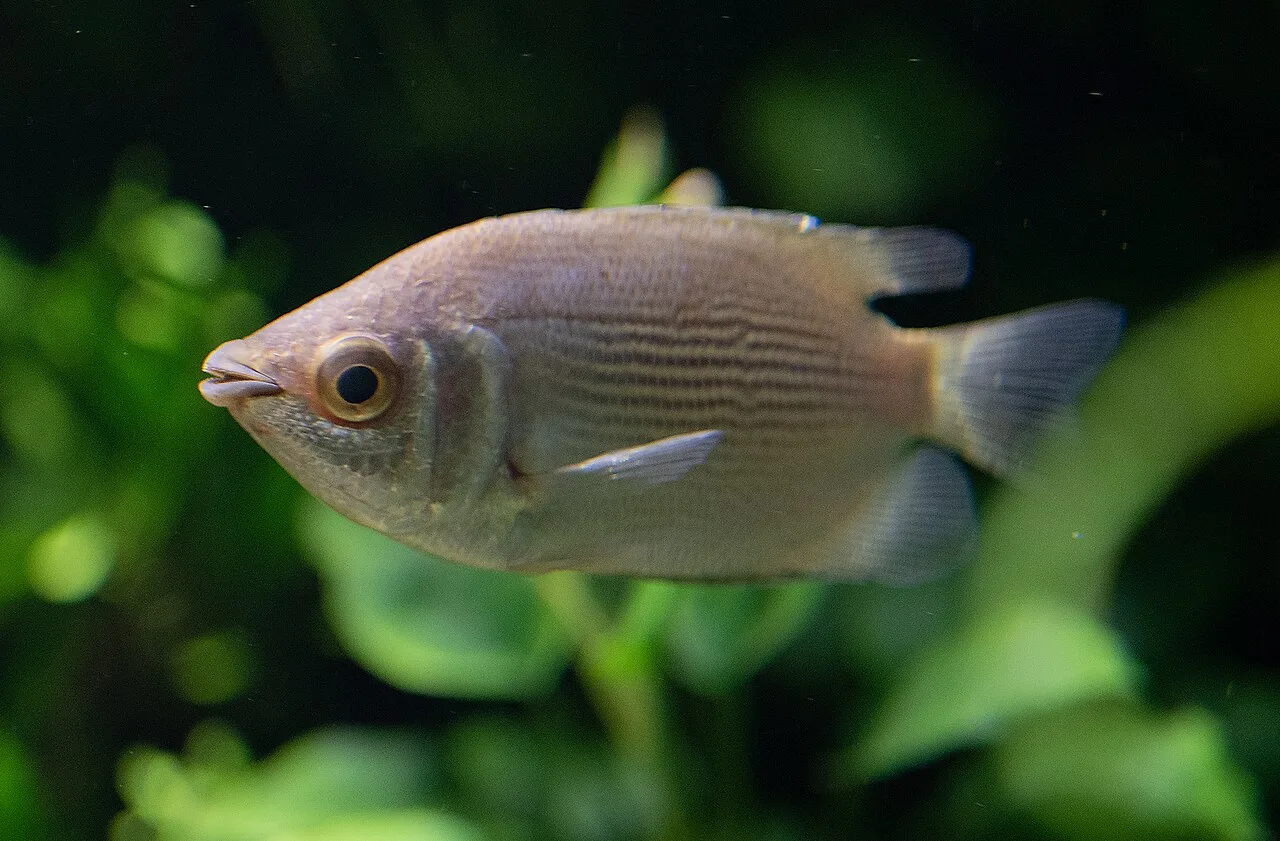
A labyrinth fish, also called the paradise fish. Males are about 8 cm. With filaments a length up to 10.4 cm is given.
- Temperature
- 16 – 26 °C
- pH
- 6.8 – 8 pH
- General hardness
- 4 – 18 °dH
- Maximum size
- 10 cm
- Minimum tank size
- 80 L
5 min read · 780 words
Fresh water
Quick facts
Place in the aquarium
Highlighted are the water layer and the spots where the species usually stays in the tank.
- Water surface Stays just below the surface. The top needs a calm current and a cover.
- Upper water Usually stays in the top third of the tank.
- Dense plants Looks for dense planting as cover, retreat or grazing ground.
Shrimp in the tank
Dwarf shrimp at risk
- Not shrimp safe
- Dwarf shrimp at risk
- Shrimplets at risk
- Shrimp safe
- Adult dwarf shrimp
- At risk
- Shrimplets
- Get eaten
- Safe from shrimp size
- about 4 cm
The paradise fish is dangerous for dwarf shrimp. It grows to about 8 cm, more with its fin filaments, and is regarded as one of the more combative labyrinth fish. Fish under about 1.8 cm are eaten, and so are young shrimp and smaller adult dwarf shrimp. With precisely spat water it even knocks down food above the waterline. Larger shrimp from about 4 cm are usually safe. Dwarf shrimp are better kept separately, while Amano shrimp can suit a large, densely planted tank.
Home & range
Hatched countries are where the species occurs. It lives in particular waters there, not across the whole country. The points name known waters for orientation, not collection sites.
- Country of origin
- Water for orientation
Native
Overview
Males colour up in the breeding season and carry extended fin tips. Females stay smaller and plainer brown. The base colour is grey-yellow to green-yellow and changes when breeding. The fish are relatively undemanding. Territory shows in a small tank, especially if they are kept permanently warm.
Names and features
Other German names translate as fork-tailed macropod, large-fin and gill spot. In English it is called paradise fish or paradise gourami. Macropodus comes from the Greek makros for long and podos for foot and refers to the long fins. Opercularis probably refers to the spot on the gill cover. Older names include Labrus opercularis Linnaeus, 1758, and Macropodus chinensis.
Standard length figures range from an average of 5.5 and at most 6.7 cm up to 7 to 8 cm. The tail fin is deeply forked. Forehead and front of the back carry blackish dots that vary between individuals, and six to eleven brick-red to reddish brown bars cross the body. The light green to dark blue gill-cover spot has a brick-red rear edge, and a dark stripe runs from the eye towards it. During courtship fins and upper body take on a blue tinge, and the ultramarine anal fin with its white edge stands out. The strongly elongated first pelvic ray is red at the tip. There is an albino form, regarded as less aggressive but also less cold-hardy.
Origin & habitat
This describes the origin, not how to furnish the aquarium.
A planted tank with hiding places matches the Asian habitat.
Origin
The paradise fish lives in oxygen-poor ponds and pools, and its main range is central and southern China with the islands of Hainan and Taiwan. It also occurs in northern Vietnam, in Hanoi in almost all urban waters, but not in Ho Chi Minh City. The type locality is probably near Guangdong. Populations in South Korea, Japan, Malaysia, Singapore, India and the United States go back to humans. Densely vegetated waters are preferred, near Hanoi often with water lettuce or water hyacinth. In rice fields the species lives at about 15 cm water depth, but mostly in their inflows, together with weather loaches, ricefish, crucian carp and goldfish. In Taiwan populations have fallen sharply because of river pollution and are considered threatened. This is linked to an increase in yellow fever mosquitoes and dengue fever.
Care
It says temperatures down to about 10 °C are tolerated if the drop is slow, and that an unheated tank is possible. Permanently high temperatures increase quarrels. Cover reduces that. A little algae is tolerated.
First import and keeping
A French soldier named Gerault brought fish from Ningbo to France in 1869, and 22 of a hundred survived. Pierre Carbonnier bred them the same year. The paradise fish was thus the second Chinese ornamental fish in the West after the goldfish and the first tropical freshwater fish bred in Europe. It reached Germany in 1876. A cool winter rest is beneficial. At least 76 litres for one male and 76 to 114 litres in a community tank are recommended. Suitable tankmates include sunfish, large tetras, smaller catfish and peaceful cichlids. Slow, long-finned fish such as fancy goldfish, angelfish, bettas and other gouramis are attacked. Fish under about 1.8 cm are eaten.
Diet
Small animal food and a prepared food that stays at the surface. Brine shrimp, mosquito larvae, flakes. Bottom tablets miss the fish. While courting the male becomes still more decided at the feeding spot. A second feeding place keeps the female in the food.
Behavior
Territorial, especially in permanent heat and with little structure. They may move eggs or fry from another bubble nest into their own.
Rest and fighting
Paradise fish take longer rests even during the day, sometimes lie on leaves and then breathe more slowly. At night they stay just below the surface or rest deeper on plants. They are neither fast nor enduring swimmers. With precisely spat water they knock down food above the waterline, and they also make sounds. Males fight with locked jaws, often to the death, and should be kept apart. When fighting they darken with blue lateral lines and spread their fins and gill covers. One male can live with females, and females also in groups.
Reproduction
Males build a bubble nest and guard the brood until hatching. The female holds the outer edge of the territory. At lower temperatures the young grow more slowly and form stronger bodies and larger fins. Very fast rearing in water that is too warm can cause stunting.
During mating the partners embrace in open water and release eggs and sperm. After each embrace the male collects the fertilised eggs and spits them into the bubble nest. After spawning he may attack the female violently. Brood care by the male alone is called a father family.
Gallery
More species in this group

Similar water needs
Species with a similar temperature, a similar pH and a comparable adult size. Whether their behaviour fits as well is what the compatibility check is for.