
Striped panchax
Aplocheilus lineatus
17 views
A surface hunter from India and Sri Lanka. It grows larger than a dwarf rasbora and eats what comes to the surface.
- Temperature
- 22 – 28 °C
- pH
- 6 – 7.5 pH
- General hardness
- 2 – 25 °dH
- Maximum size
- 10 cm
- Minimum tank size
- 100 L
4 min read · 578 words
Fresh water
Quick facts
Further published values
- Lifespan
- 4 – 5 a
Place in the aquarium
Highlighted are the water layer and the spots where the species usually stays in the tank.
- Water surface Stays just below the surface. The top needs a calm current and a cover.
- Dense plants Looks for dense planting as cover, retreat or grazing ground.
Shrimp in the tank
Dwarf shrimp at risk
- Not shrimp safe
- Dwarf shrimp at risk
- Shrimplets at risk
- Shrimp safe
- Adult dwarf shrimp
- At risk
- Shrimplets
- Get eaten
- Safe from shrimp size
- about 4 cm
The striped panchax is dangerous to dwarf shrimp. Males grow up to 10 cm, and the mouth is broad and upturned. The species lies in wait under floating plants and eats insects, but also fish up to about half its own length. Juvenile and adult dwarf shrimp fit that pattern. Larger shrimp from about 4 cm are usually safe, especially if they stay on the bottom.
As a surface hunter it catches shrimp mainly when they rise. For dwarf shrimp a separate tank is the safe solution.
Home & range
Hatched countries are where the species occurs. It lives in particular waters there, not across the whole country. The points name known waters for orientation, not collection sites.
- Country of origin
- Water for orientation
Native
Overview
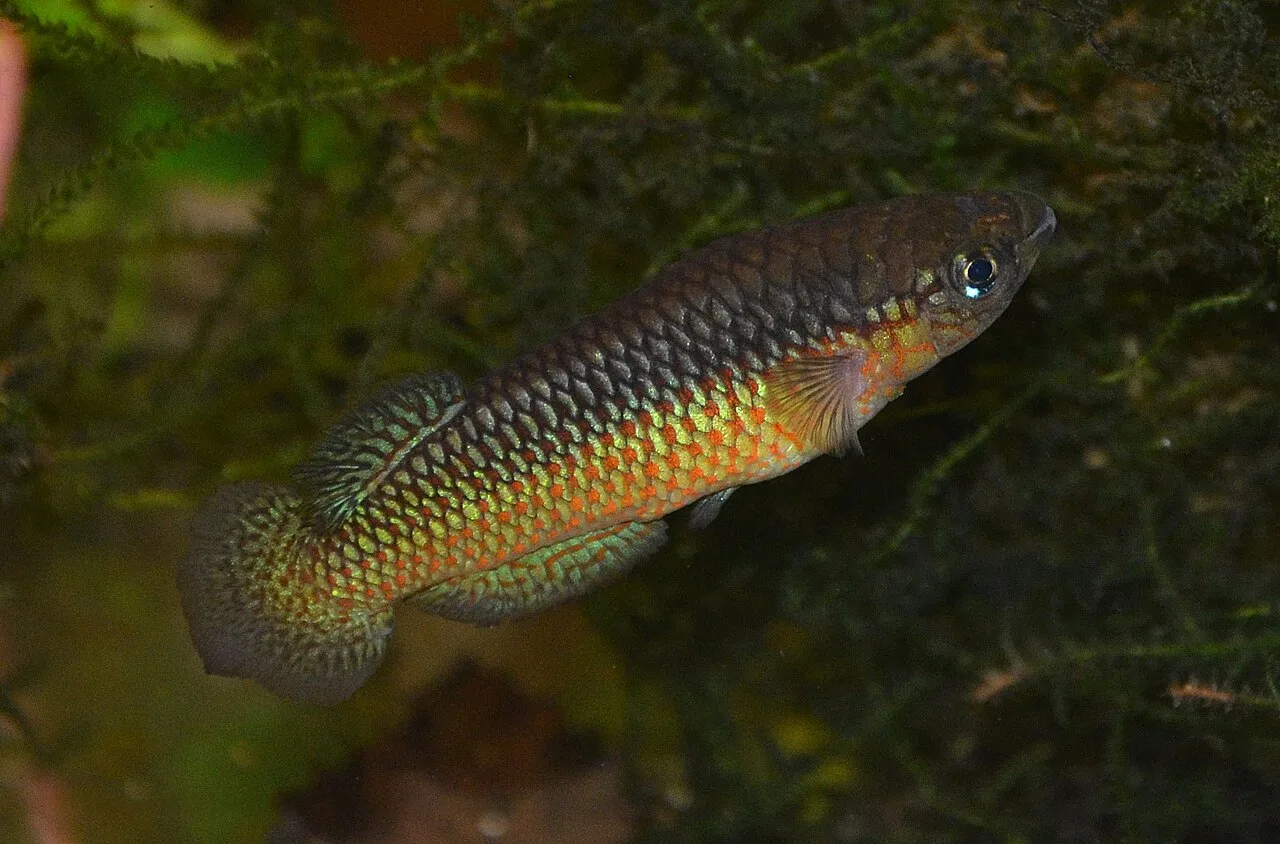
The striped panchax reaches about 10 cm. The body is elongate, the mouth upturned. Males are more colourful, with rows of dark spots and often yellow fins. Females are plainer and deeper. Golden fish are a cultivated form. The species stands just under the surface and shoots at food and at smaller fish.
It jumps accurately. A gap in the cover is enough. Keep the tank closed, even when the fish are standing quietly.
Features
Valenciennes described the species in 1846 from material from the Mumbai area. The species name lineatus, lined, refers to the six to eight dark cross bands on the rear body. They start just before the anal fin below the mid-line, grow longer towards the rear, and the last covers the whole base of the caudal fin. Males reach 10 cm, making them the largest of the genus, females 6 to 7 cm. Rows of gold-green shining scales run along the flanks. Like all Aplocheilus the fish carry a silvery spot on the crown.
Origin & habitat
This describes the origin, not how to furnish the aquarium.
Ditches, rice fields and planted banks in India and Sri Lanka. Warm shallows, cover from above, a clear view of the surface. Both countries stay a coarse origin.
The species lives in Kerala, Karnataka, Wayanad and the Western Ghats in India and on Sri Lanka. It inhabits mountain streams and lowlands, rivers, swamps, puddles, ditches and flooded rice fields, also among water hyacinths. Since 1960 it has been introduced in the USA and Hawaii. It reached Germany in 1909.
Care
Size
22 to 28 °C, pH 6 to 7.5. From about 100 litres and 80 cm for a small group, with floating plants but an open run at the surface. Weak current. Several females, not a crowd of males on a short run.
Company
Only fish that do not fit in the mouth and do not fight for the same food at the surface. Neons, Boraras and shrimp disappear. Corydoras can live below. Above, the panchax is the hunter.
The striped panchax is kept in 100 to 200 litres at 22 to 28 °C, pH 6.0 to 7.5 and 2 to 25 °dH, with good lighting, clear, well-filtered water and regular water changes. Limnobium laevigatum and Pistia stratiotes are suitable floating plants. With suitable feeding the fish live four to five years.
Diet
Live and frozen food from the surface, plus a granule that does not sink at once. Mosquito larvae, brine shrimp, small insects. Flakes that fall to the bottom it hardly sees. Several feeds, because one male holds the surface.
In the wild the species eats mainly insects that have fallen onto the surface, plus fish up to about half its own length. In the aquarium fruit flies, mosquito larvae, tubifex and finely scraped meat work well; dry food also works.
Behavior
A surface fish with a territory among the males. Short chases are normal. A fish that is driven off all the time needs more length or has to come out. The species is active by day and stands visible as long as there is cover from above. With no floating plants at all the fish become shy.
The panchax moves little and usually lies in wait under floating plants. It fixes prey with its eyes and detects it by changes in the surface ripples. In its home range it is used for mosquito control.
Reproduction
The eggs are laid in fine plants near the surface and are not guarded. The parents eat them. A breeding setup is a shallow tank with a spawning substrate, from which the adults are removed. The larvae need fine food and a cover.
Gallery
More species in this group
Similar water needs
Species with a similar temperature, a similar pH and a comparable adult size. Whether their behaviour fits as well is what the compatibility check is for.





